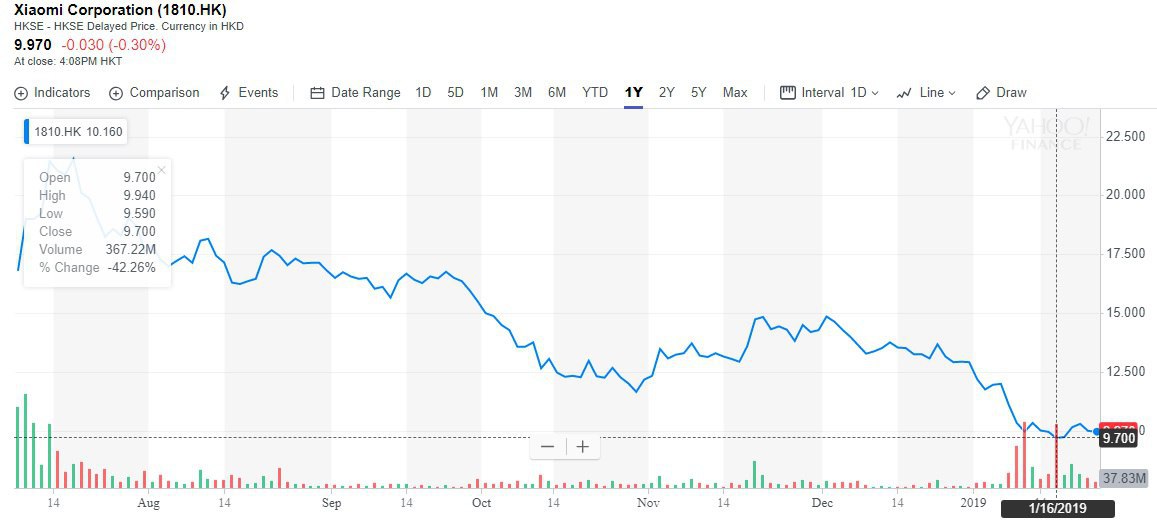
🔸 China’s Xiaomi Corp. is buying back its stocks
Barely six months after going public in Hong Kong. Last week, Xiaomi shares hit a record closing low of 9.70 Hong Kong dollars. That means it had lost more than US$20 billion of market value since a high-profile, US$5.4 billion initial public offering in July. To reassure investors, Xiaomi’s board said it would use its ability to repurchase up to 10% of shares which was around $7.7 million of stocks. On Tuesday, Xiaomi shares closed at HK$10.00, still more than 40% below their HK$17.00 IPO price.
Xiaomi said its board believed the buyback would demonstrate the company’s confidence in its outlook, and create value for shareholders.
Including Xiaomi, eight of Hong Kong’s 10 largest IPOs from last year are trading below the price at which they went public. The valuations of many Chinese tech companies have gone from hype to reality now, as they face challenges to live up to investors’ high expectations for growth amid a slowing economy
🔻 Trading Before the Big Deal
The coming listings of some of the world’s most valuable startups are heating up an opaque market for private trades in their shares. Bankers, brokers and investors that specialize in buying or selling unlisted shares of companies say there has been a significant increase in interest and activity.
Before companies go public, most of their stock is held by company founders, employees, venture-capital and private-equity firms and other institutions.
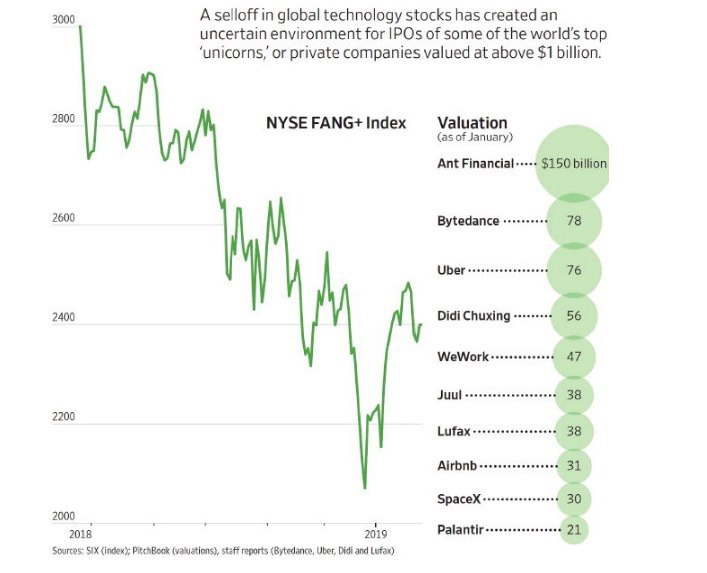
On the graph below you can observe some Tech Companies that are planning to go public this year, and their approximate value.
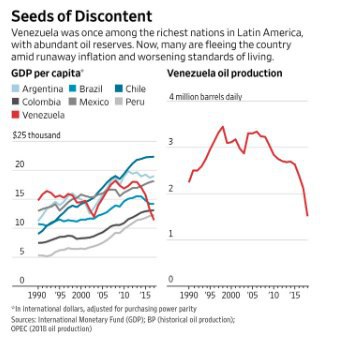
🔸 Country’s Crisis Spills Into Its Oil
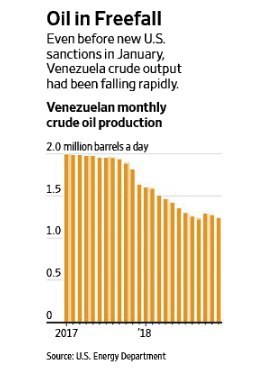
Venezuela’s deepening political crisis is threatening to upend the nation’s critical oil industry and further damage an economy. Inflation is estimated at more than a million percent. Widespread shortages of food and medicine have prompted three million Venezuelans to emigrate, mostly on foot.
Now, Venezuela’s opposition, backed by the U.S., Canada and many Latin American nations, has declared Mr. Maduro illegitimate, however, Mr. Maduro has responded that he isn’t going anywhere and has been backed by the armed forces.
Venezuela still exports about 500,000 barrels of crude oil to the U.S. every day. Cutting off Mr. Maduro’s oil money could have dramatic effects, causing Venezuelan oil production to fall another 40% this year.
🔸Pfizer Pivots to Cancer Drugs for Growth
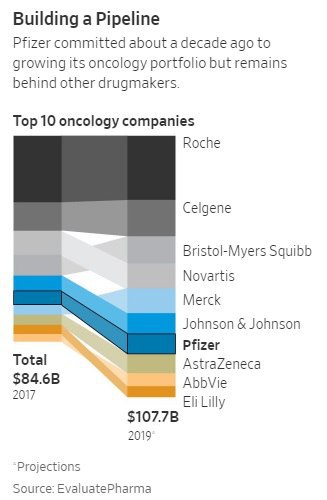
Twenty years ago, Pfizer didn’t sell any drugs treating cancer. Now, it sells 17, including four that were approved in the U.S.
The new lineup is projected to generate $8.3 billion in sales this year, according to EvaluatePharma. For the first time, Pfizer in 2019 expects oncology products to outsell the heart and other primary-care medicines the company was long known for.
ancer-drug sales are projected to reach $138 billion world-wide this year and are growing 11% a year, according to EvaluatePharma. A year’s treatment typically lists for more than $100,000.
🔻 Venezuela’s Oil Exports Decline Sharply
Venezuelan crude exports are declining sharply as new U.S. sanctions push the country’s oil industry closer to collapse. Backlogs in exports had pushed oil production to well below one million barrels a day, a more-than 10% drop from December. It is unclear whether the production falloff will last. Much of it depends on whether the U.S. gambit to target PdVSA will succeed in ousting Mr. Maduro and putting oil revenue in the hands of the country’s opposition.
Venezuelan crude exports are declining sharply as new U.S. sanctions push the country’s oil industry closer to collapse. Backlogs in exports had pushed oil production to well below one million barrels a day, a more-than 10% drop from December. It is unclear whether the production falloff will last. Much of it depends on whether the U.S. gambit to target PdVSA will succeed in ousting Mr. Maduro and putting oil revenue in the hands of the country’s opposition.
🔸 For Chinese Startups, an Economic Slowdown Brings a ‘Freezing Winter’
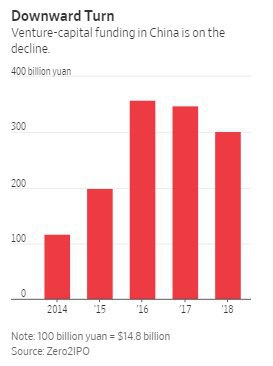
China’s hard-charging technology sector is experiencing something different: a slowdown. An economic deceleration amid the trade fight with the U.S. is causing layoffs, reducing bonuses and shrinking the easy venture funding that fueled China’s thriving startup scene.
Venture capital raised in China fell 13% to 302.5 billion yuan ($44.8 billion) in 2018 from a year earlier. The number of investment deals sank 10% to 4,321. Likewise, the capital raised by private-equity funds plunged 30% to one trillion yuan, with total investment into the market falling 14% to 852.7 billion yuan.
🔹 BP Profit Soars, Fueled by Higher Output
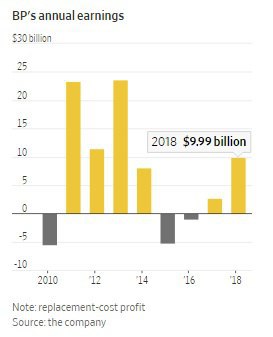
BP tripled its annual earnings and swung to a fourth-quarter profit on increased output and higher crude prices.
The U.K. company’s replacement-cost profit totaled $9.9 billion for 2018, up from $2.8 billion in 2017 and representing BP’s largest since a tumble in oil prices about four years ago led to an industrywide downturn.
Last year, it made solid headway in terms of production, with a 3% year-over-year uptick in oil and gas output. Excluding its Russian assets, BP had an average daily output of 3.7 million barrels of oil equivalent for 2018, its highest since 2010.
BP declared a fourth-quarter dividend of 10.25 cents a share, in line with prior quarters after having increased its dividend 2.5% last July.
The firm said its full-year cash flow from operations was $28.7 billion
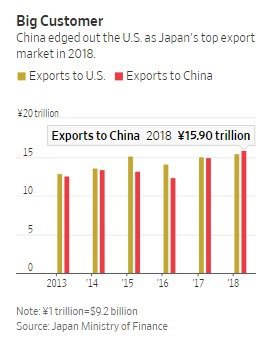
🔻 Japan now exports more to China than to the US.
China’s slowing economy is highlighting the dependence of Japan on its giant neighbor, driving Tokyo’s business leaders to take a gentler line than the U.S. in trade conflicts.
“It is impossible for Japan to exist if we turn China into an enemy,” said Hiroaki Nakanishi, chairman of Hitachi Ltd. and the head of the nation’s top business federation, in an interview. “Maybe they can do that in America, but it doesn’t work like that in Japan.”
In 2018, China imported about $146 billion in goods from Japan, up 6.8%, edging out the U.S. as the top market. Hong Kong took an additional $35 billion in Japanese imports.
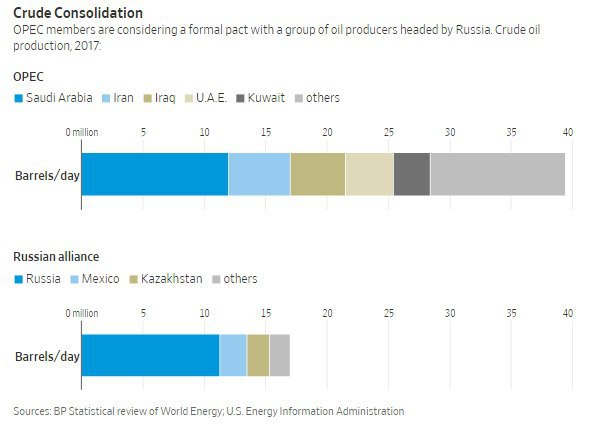
🔻 OPEC Pursues Formal Pact With Russia
An alliance with a 10-nation group led by Moscow would transform the cartel, which is under pressure from Trump and U.S. producers, and try to manage the global oil market.
Any formalization of the Saudi-Russia cooperation would be in the interest of lifting oil prices from their current roughly $60-a-barrel levels. A balanced Saudi national budget, for instance, requires oil prices above $80 a barrel.
OPEC members and the Russia-led group are set to debate the proposal during the week of Feb. 18 in Vienna, the officials said. Ministers hope to agree on a final deal when representatives of both groups meet in April.
Participants still need to iron out differences, all sides were likely to end up agreeing on some arrangement as oil prices could fall without a deal. Traders believe OPEC needs to coordinate with Russia to balance supplies efficiently, the official said.
🔸 Goldman Aims Cuts At Trading
Goldman Sachs Group Inc. is planning to cut back its commodities-trading arm. The retreat follows a monthslong review under new Chief Executive David Solomon that showed the commodities business’s dwindling profits don’t justify its costs.
Executives are discussing pulling back from trading iron ore, platinum and other metals, and are ordering cost cuts to the sprawling logistics network that handles the transport and storage of physical commodities.
Goldman has been a major player in commodities since 1981, that dynasty ended last year with the rise of Mr. Solomon.
Goldman is pushing into consumer lending and corporate cash management and said in January that more than 60% of its revenue now comes from more-recurring sources, up from 48% five years ago.
Commodities trading, meanwhile, is in decline. In 2017, Goldman’s traders had their worst year on record.

🔹 Uber is intensifying its pursuit of riders in the Middle East
After backing out of costly fights with rivals in China, Russia and Southeast Asia, Uber is expanding its presence in Saudi Arabia, Egypt and the United Arab Emirates.
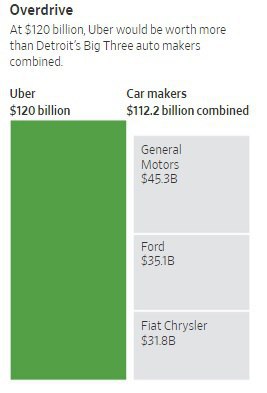
Uber executives say they are looking to reach a billion users as the company prepares for an initial public offering this year at a potential valuation of up to $120 billion. In its third-quarter earnings report in November, Uber said the Middle East and India were the two “high-potential markets” where the company would be investing heavily.
Uber has also engaged in on-and-off talks to acquire its main Middle East competitor – Careem. Bankers familiar with the company have said Careem is seeking between $2.5 billion and $3 billion, however, Uber and Careem declined to comment on price or deal talks.
🔻 SoftBank Sells Entire Nvidia Stake
SoftBank Group Corp. said its nearly $100 billion Vision Fund sold its entire 4.9% stake in Nvidia Corp. in January, locking in returns of $3.3 billion. Nvidia shares have lost nearly half their value since the recent peak in October 2018. The shares closed Tuesday at $149.95 on the Nasdaq exchange.
SoftBank, which operates the Saudi-backed Vision Fund, used the collar trade to sell Nvidia shares at an average price of $218 a share, double the average $105 a share it paid.
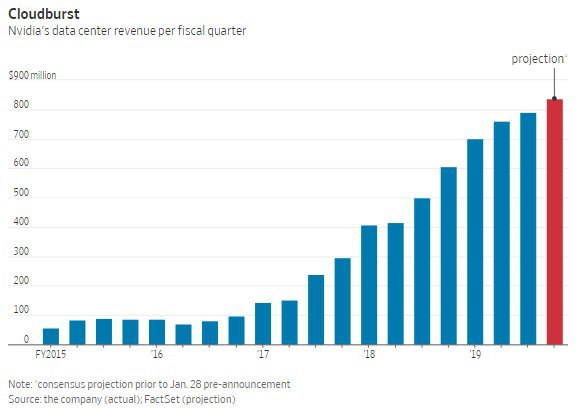
Nvidia last month slashed its quarterly outlook because of weak data-center sales to cloud computing giants
🔸 Snap’s Revenue Jumps, Loss Narrows
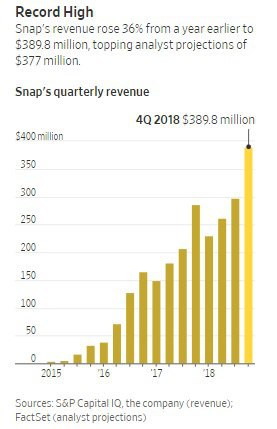
The social-media firm is riding a boom in online advertising to inch closer to profitability. The fourth-quarter results released late Tuesday sent Snap shares up more than 22% in after-hours trading.
Snap’s biggest challenge is how to become more than a niche platform popular among teens and young adults. Snap’s number of users stayed flat at 186 million.
Snap’s revenue rose 36% to $389.8 million in the fourth quarter, typically the heaviest spending period for advertisers, up from $285.7 million a year earlier. However,the company still is not profitable, the loss in the fourth quarter shrank to $191.7 million from $350 million a year earlier. The mail goal for the company for 2019 is to become profitable.
🔻 Farm Belt bankruptcies are soaring
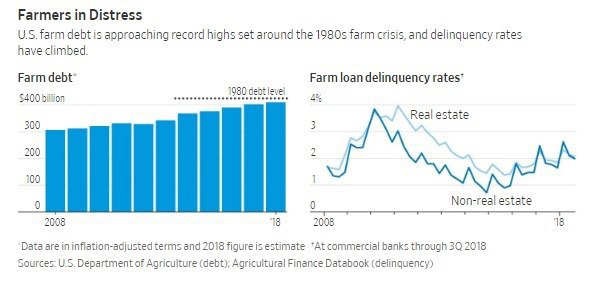
A wave of bankruptcies is sweeping the U.S. Farm Belt as trade disputes add pain to the low commodity prices that have been grinding down American farmers for years.
The rise in farm bankruptcies represents a reckoning for rural America, which has suffered a multiyear slump in prices for corn, soybeans and other farm commodities touched off by a world-wide glut, made worse by growing competition from agriculture powerhouses such as Russia and Brazil.
Trade disputes under the Trump administration with major buyers of U.S. farm goods, such as China and Mexico, have further roiled agricultural markets and pressured farmers’ incomes. Prices for soybeans and hogs plummeted after those countries retaliated against U.S. steel and aluminum tariffs by imposing duties on U.S. products like oilseeds and pork, slashing shipments to big buyers.
🔸 Amazon Invests in Driverless Startup Aurora, Valued at More Than $2 Billion
Aurora Innovation Inc. raised more than $530 million in the latest funding round, which was led by venture firm Sequoia Capital and included capital from Amazon. Aurora, founded in 2017 by veterans of autonomous-vehicle development, says it is developing a mixture of software and hardware that help vehicles see and navigate the world. The technology is a natural fit for Amazon, which could use autonomous forklifts, trucks and drones to shuttle packages quickly and lower its logistical costs. Amazon’s delivery expenses rose 27% to $27.7 billion last year. Aurora has more than 200 employees, and the company has 10 test vehicles on the road in California and Pittsburgh.
Aurora Innovation Inc. raised more than $530 million in the latest funding round, which was led by venture firm Sequoia Capital and included capital from Amazon. Aurora, founded in 2017 by veterans of autonomous-vehicle development, says it is developing a mixture of software and hardware that help vehicles see and navigate the world. The technology is a natural fit for Amazon, which could use autonomous forklifts, trucks and drones to shuttle packages quickly and lower its logistical costs. Amazon’s delivery expenses rose 27% to $27.7 billion last year. Aurora has more than 200 employees, and the company has 10 test vehicles on the road in California and Pittsburgh.
🔸Toyota Suffers From Share Losses
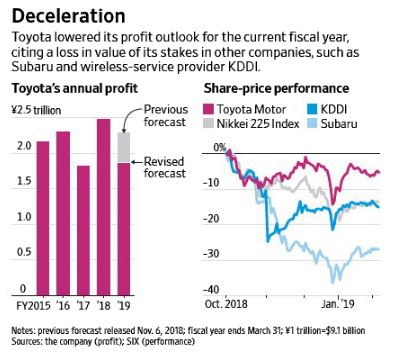
Japan’s largest car maker now expects to earn ¥1.87 trillion ($17 billion) for the fiscal year ending March 31, down from a previous projection of ¥2.3 trillion.
The value of Toyota’s shareholdings dropped by about $3.6 billion in the October-December quarter, when global stock markets were falling. Toyota, like many Japanese companies, often owns shares in its suppliers and business partners.
The auto maker said that revenue for its latest quarter rose 2.6% from a year earlier, while profit fell 81%
🔻 Spotify Signals Path With 2 Podcast Deals
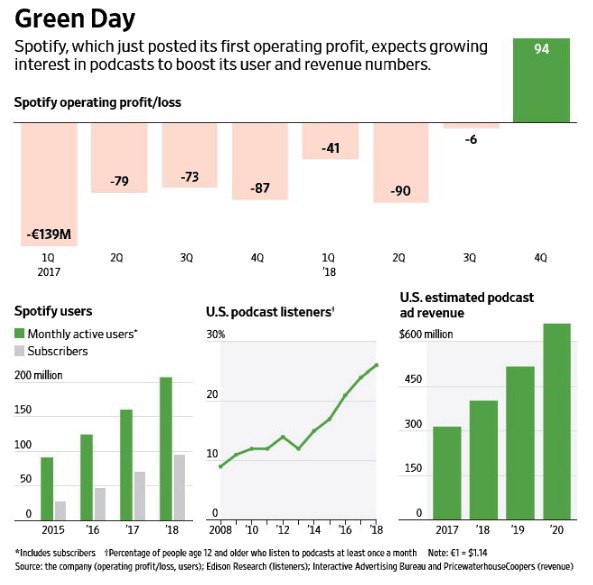
Spotify Technology SA is buying a pair of podcasting companies, accelerating its investment in nonmusic content. The company will buy podcast publisher Anchor in a move to increase its presence in other forms of audio. It also said it is buying podcast producer Gimlet Media. The value of Anchor is more than $150 million and Gimlet above $200 million. For the three months ended Dec. 31, Spotify posted a profit of €442 million ($502.3 million), or 36 European cents a share, on €1.5 billion in revenue. For the full year, Spotify posted a loss of €78 million on €5.26 billion in revenue.
Spotify Technology SA is buying a pair of podcasting companies, accelerating its investment in nonmusic content. The company will buy podcast publisher Anchor in a move to increase its presence in other forms of audio. It also said it is buying podcast producer Gimlet Media. The value of Anchor is more than $150 million and Gimlet above $200 million. For the three months ended Dec. 31, Spotify posted a profit of €442 million ($502.3 million), or 36 European cents a share, on €1.5 billion in revenue. For the full year, Spotify posted a loss of €78 million on €5.26 billion in revenue.
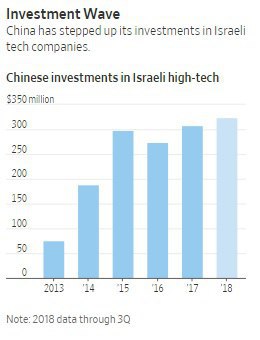
🔻 Chinese Investment in Israel Raises Security Fears
Officials said they worry that Chinese government entities could gain access to sensitive information by gaining control over and insight into technology companies that are in the dual-use space.
Chinese investors participated in 12% of deals in the first three quarters of 2018 with Israeli tech companies.
In the first three quarters of 2018 Chinese investors were involved in all 17 financing rounds for Israeli startups of $20 million or more.
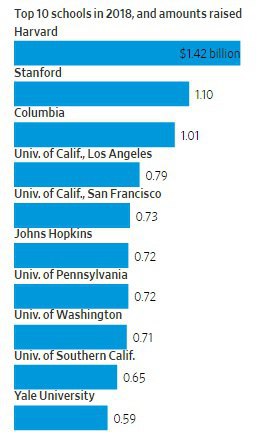
🔸 Donations to U.S. colleges hit a record las year
U.S. colleges and universities brought in a record $46.7 billion in donations last fiscal year. Giving increased by 7.2% in fiscal 2018, the ninth consecutive year of gains. Harvard, Stanford and Columbia universities each raised more than $1 billion.
U.S. colleges and universities brought in a record $46.7 billion in donations last fiscal year. Giving increased by 7.2% in fiscal 2018, the ninth consecutive year of gains. Harvard, Stanford and Columbia universities each raised more than $1 billion.
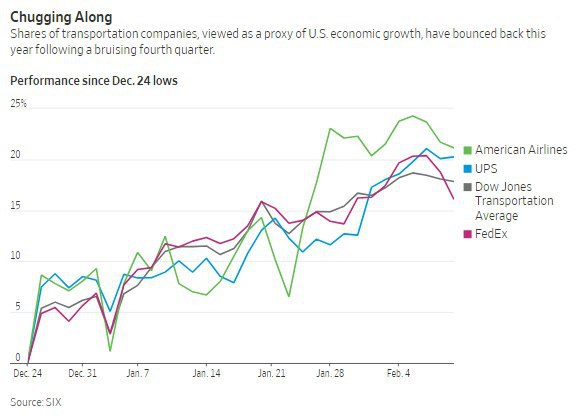
🔸 Dow Transports Bounce Back as Economic Indicators Stabilize
Shares of airlines, railroads and shipping companies are climbing, a sign the U.S. economy is on strong footing. The Dow Jones Transportation Average, which tracks the performance of 20 stocks ranging from American Airlines to Union Pacific to FedEx, has jumped 18% from its Christmas Eve low.
Transportation stocks are viewed as a barometer of economic activity because those companies carry the raw materials and goods that power manufacturing. Also, it is believed, that those stocks will continue to be benefit from strong e-commerce demand. Airlines, meanwhile, have benefited from lower fuel costs and generally have given strong forecasts for the year. Among the carriers that reported stronger-than-expected results for the fourth quarter were United Continental, Southwest Airlines and JetBlue Airways.