🔻 Saudi Arabia Sells More Than $7 Billion in Bonds
Saudi Arabia sold $7.5 billion in bonds Wednesday, drawing support from international investors. The bond sale was backed by several high-profile Western banks - BNP Paribas, JPMorgan, HSBC, Citi and NCB Capital. The bond issuance comes at a time of financial strain for Saudi Arabia. Last month, the kingdom announced record new spending, despite a decline in oil prices that would open up a wide budget deficit. Saudi Arabia’s public debt stands at around 19% of gross domestic product and officials have previously said it could grow to about 25% in 2021.
Saudi bonds have generally generated strong demand from investors drawn to the kingdom’s financial strength underpinned by enormous oil reserves. Saudi Arabia is rated A1 and A+ at Moody’s and Fitch, respectively.

🔻 Mainland Chinese Investors Buy Fewer Shares in Hong Kong
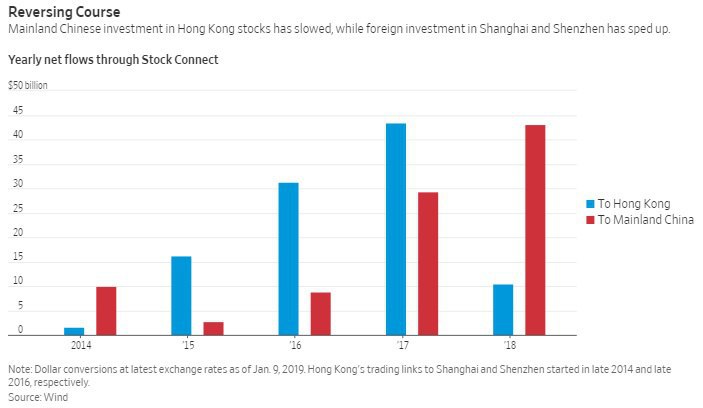
Net inflows to Hong Kong through the so-called stock connect program shrank to 82.7 billion Hong Kong dollars ($10.6 billion) in 2018, down 76% from HK$339.9 billion in 2017.
In contrast, net northbound inflows into equity markets in Shanghai and Shenzhen jumped 47% to 294.2 billion yuan ($43.2 billion) last year, aided by the inclusion of onshore securities, or A-shares, in influential indexes compiled by MSCI.
That means that as of end-2018, mainland markets had drawn a cumulative $94.1 billion through the program, at current exchange rates, while $103.2 billion had flowed south.
There were several reasons why less money flowed into Hong Kong last year - these included increasing demands from end-investors to redeem money from fund managers, and pessimism about the Chinese economy—which matters because Hong Kong’s stock market is dominated by mainland companies. Investors had taken a more defensive stance by shifting funds into Chinese bonds.
🔻 German Economy Signals Unease
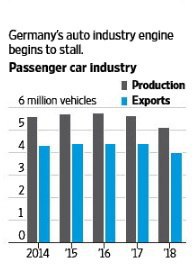
Fresh signs of a weakening German economy are raising fears that last year’s slowdown could spill into 2019.
Industrial production in Germany dropped in November, the latest reflection of a confluence of headwinds facing the global economy, including trade tensions and weakening demand from China. Industrial production data has clearly increased the risk of a technical recession in Germany.
Production in Germany’s key industrial sector, adjusted for inflation and seasonal swings, fell 1.9% in November from the previous month. It was the second consecutive monthly fall in German industrial output.
📢 Business news
🔻 Elon Musk’s SpaceX plans to reduce its workforce by 10%, or roughly 600 employees. The move is the most significant cutback since SpaceX gained international prominence about a decade ago. In a statement, Space Exploration Technologies Corp., as the company is formally called, indicated payroll savings are now part of its financial realignment.
🔸 Slack Plans to Follow Spotify on Unconventional IPO Route. Messaging company, recently valued at $7 billion, aims to debut in the second quarter, potentially making it the second big technology company after Spotify Technology SA to bypass a traditional IPO. In August, Slack raised $427 million in a funding round led by Dragoneer Investment Group and General Atlantic valuing the company at $7.1 billion.
🔹 General Motors Co. said its earnings are picking up speed, with added momentum due to come this year from plant closures and job cuts denounced by President Trump. The cuts should boost operating profit in 2019 by nearly 20%, or by more than $2 billion. GM’s shares rose 7% to $37.17 on Friday. GM said its expects earnings per share this year of $6.50 to $7. The average analyst estimate was below $6.
🔻 Cloud Should Shine for Amazon, Microsoft Earnings
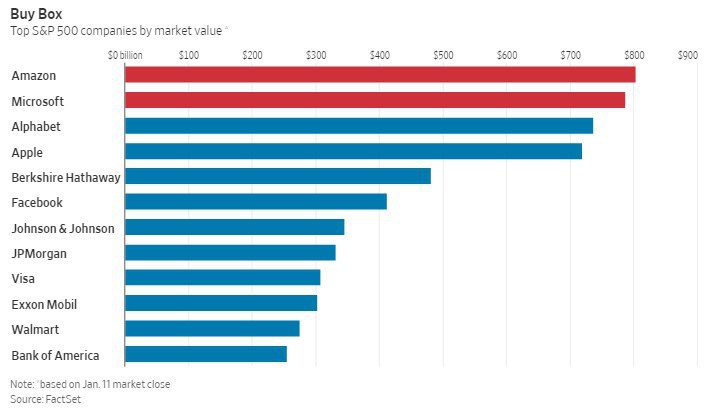
Can Amazon.com and Microsoft keep their cloud businesses growing strong? The pair are now the two most valuable companies in the world. The two very different companies, whose businesses have been diverging of late, have a common growth engine. Amazon and Microsoft are currently the two largest providers of public cloud services that corporate customers use to offload their computing and software needs. That business is generating nearly $50 billion a year in revenue now between the two and is expected to double by the end of 2020.
Can Amazon.com and Microsoft keep their cloud businesses growing strong? The pair are now the two most valuable companies in the world. The two very different companies, whose businesses have been diverging of late, have a common growth engine. Amazon and Microsoft are currently the two largest providers of public cloud services that corporate customers use to offload their computing and software needs. That business is generating nearly $50 billion a year in revenue now between the two and is expected to double by the end of 2020.
🔻 German Industrial Firms Worry About China
Concerns are rising in German about the impact of the economic slowdown in China on its largest European trading partner. China is Germany’s main trading partner, with bilateral trade between the two totaling €188 billion ($215.69 billion) in 2017, according to German government statistics. That year, German exports to China totaled €86 billion, making China the third-largest market for German exports after the U.S. and France. Germany was the world’s second-largest non-Asian importer of Chinese goods.
But China’s economy has been slowing faster than expected recently. In December, Chinese factory activity hit its lowest level in nearly three years, and official data showed that profits from big Chinese industrial firms declined in November for the first time in three years. Chinese consumers have cut back on spending, leading to a decline in sales of cars and other goods.
Economists at Bank of America Merrill Lynch said this week they expected Germany to have entered a technical recession— two consecutive quarters of negative economic growth— in the second half of 2018.

📢 Business news
🔻 Volkswagen AG, said on Monday it is investing $800 million to build a new electric vehicle at its plant in Chattanooga, Tennessee, as it shifts toward zero emission vehicles. It is adding 1,000 new jobs and electric vehicle production in Tennessee will begin in 2022.
🔸 FedEx Corp will pay $35.4 million to settle three lawsuits in which New York state and New York City accused the company of shipping millions of untaxed cigarettes to residents over a decade.
🔹 Apple Inc. slashed its quarterly revenue due to Chinese slowing economy. Apple reported about 20% of its sales came from China. The slowdown was sharpened by trade tensions between China and the U.S. Furthermore, Apple’s share of the Chinese smartphone market has been shrinking, crowded out by tech giants such as China’s Huawei Technologies Co. that market increasingly sophisticated phones at a lower price tag. Apple’s share of the Chinese smartphone market contracted to 7.8% in the first three quarters of 2018 from a peak in 2015 of 12.5%.
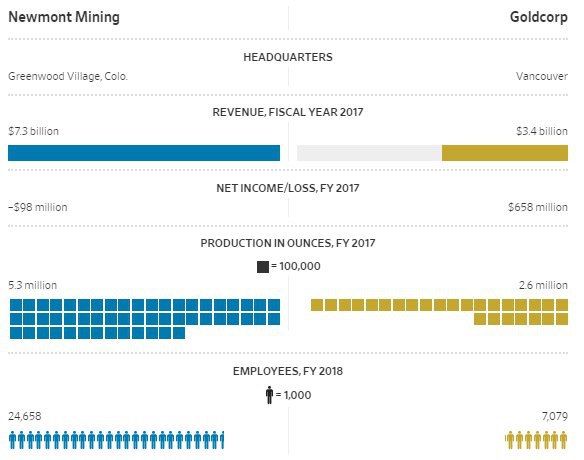
🔻 Newmont to Buy Goldcorp in Deal Valued at $10 Billion
Newmont Mining Corp. agreed to buy rival Canadian gold producer Goldcorp Inc. in a $10 billion, all-stock deal, creating the world’s largest gold miner. Newmont, the U.S.’s largest miner measured by market capitalization, said it would acquire each Goldcorp share for 0.328 of its own stock. That represents a 17% premium to the Canadian company’s 20-day volume weighted average share prices.
Gold prices, meanwhile, have languished. They are down about 30% from their 2011 peak. In recent years, they have traded flat, capped in particular by rising U.S. interest rates
🔸 China’s Exports Take a Surprising Fall in December
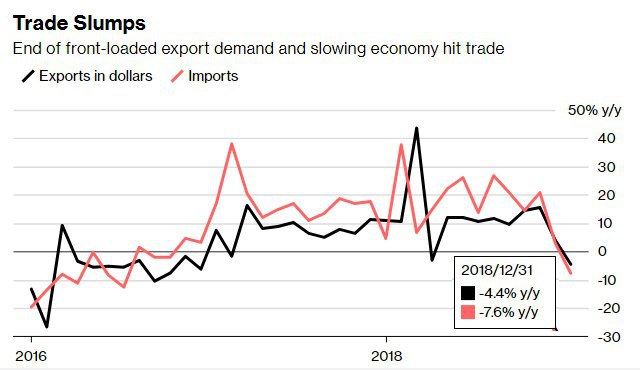
Chinese exports unexpectedly tumbled in December, declining 4.4% from a year ago, while imports dropped 7.6 percent. Both were the worst result since 2016, and left a trade surplus of $57.1 billion. December’s drop followed a nine-month run in which exports seemed to shrug off the U.S. tariffs. Despite December’s fall, China’s exports rose 9.9% for the full year of 2018, beating a 7.9% increase in 2017, while imports surged 15.8% on year, on par with 2017’s growth. However, for 2019 some economists predict weaker performance due to slowing in retail sales and even real estate, leaving the government to fall back on tax cuts and infrastructure spending.
Chinese exports unexpectedly tumbled in December, declining 4.4% from a year ago, while imports dropped 7.6 percent. Both were the worst result since 2016, and left a trade surplus of $57.1 billion. December’s drop followed a nine-month run in which exports seemed to shrug off the U.S. tariffs. Despite December’s fall, China’s exports rose 9.9% for the full year of 2018, beating a 7.9% increase in 2017, while imports surged 15.8% on year, on par with 2017’s growth. However, for 2019 some economists predict weaker performance due to slowing in retail sales and even real estate, leaving the government to fall back on tax cuts and infrastructure spending.
🔹 Oil Price Dips on Weak Chinese Data
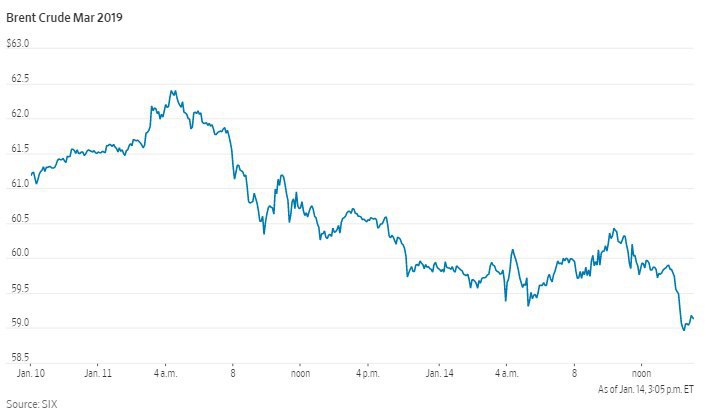
An unexpected decline in Chinese imports and exports in December weighed on equities and commodities Monday, as investors feared a further slowdown in the Chinese economy that could hinder global growth. West Texas Intermediate futures, the U.S. oil standard, ended down 2.1% at $50.51 a barrel on the New York Mercantile Exchange
An unexpected decline in Chinese imports and exports in December weighed on equities and commodities Monday, as investors feared a further slowdown in the Chinese economy that could hinder global growth. West Texas Intermediate futures, the U.S. oil standard, ended down 2.1% at $50.51 a barrel on the New York Mercantile Exchange
📢 Business news
🔻 Take-Two Interactive Software Inc. will pay the National Basketball Association (NBA) and its players’ union up to $1.1 billion. The agreement allows company to continue making its NBA 2K videogame franchise and other NBA-branded games, including smartphone apps. Game publishers traditionally pay licensing fees to the major sports leagues ranging from 10% to 15% of a game’s revenue.
🔸A German court dismissed a patent lawsuit from Qualcomm Inc. against Apple Inc. the first setback in the country for the chip maker in a dispute that resulted last month in the ban of some iPhone sales in China and Germany. The decision is the first win for Apple in a series of global patent disputes launched against it by Qualcomm, following rulings last month in Munich and Fuzhou, China, that ordered Apple to stop selling some older iPhone models in their respective jurisdictions. The newest iPhone models—including the XS, XS Max, and XR—weren’t affected by those rulings.
🔹 WhatsApp, which Facebook acquired in 2014 for $22 billion, is facing pressure in India to let authorities trace and read the encrypted messages of its more than 200 million Indian users. There are 2 ways proposed by the government: 1 - could force “over the top” services such as WhatsApp to allow the government access to users’ messages; 2 - new intermediary guidelines that would force WhatsApp and others to trace messages and remove objectionable content within 24 hours. The public and the tech companies have until later this month to respond to both sets of proposed rules.
🔻 Citigroup’s Revenue Weakens
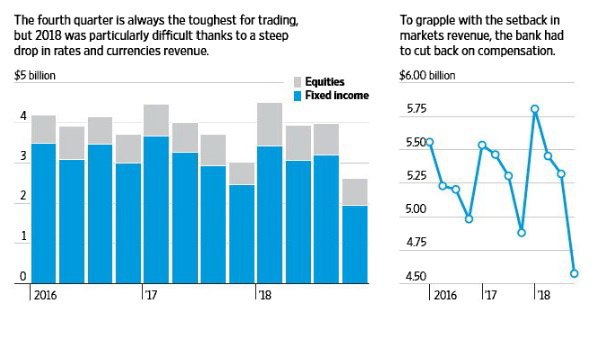
Citigroup rebounded from a year-earlier loss, but its trading business struggled under tough conditions in the fourth quarter. Citigroup sought to blunt the effect of the trading decline by slashing expenses, led by a steep drop in compensation. Pay across the bank was 14% lower than it was in the third quarter.
Citigroup rebounded from a year-earlier loss, but its trading business struggled under tough conditions in the fourth quarter. Citigroup sought to blunt the effect of the trading decline by slashing expenses, led by a steep drop in compensation. Pay across the bank was 14% lower than it was in the third quarter.
🔸 JPMorgan Profit Rises 67%
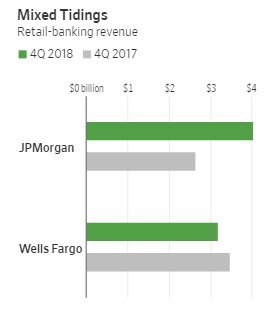
The bank reported a profit of $7.07 billion, or $1.98 a share. JPMorgan’s trading revenues decreased 5.7% to $3.17 billion from about $3.37 billion a year earlier. Higher interest rates boosted JPMorgan’s consumer bank. Profit was $4.03 billion in the fourth quarter, up 53% from $2.63 billion in the year-earlier period, driven largely by higher lending margins and an increase in credit-card balances.
The bank reported a profit of $7.07 billion, or $1.98 a share. JPMorgan’s trading revenues decreased 5.7% to $3.17 billion from about $3.37 billion a year earlier. Higher interest rates boosted JPMorgan’s consumer bank. Profit was $4.03 billion in the fourth quarter, up 53% from $2.63 billion in the year-earlier period, driven largely by higher lending margins and an increase in credit-card balances.
🔻 China Offers Iran $3 Billion Oil Deal
China’s state-run energy giant is making a new approach to clinch a $3 billion deal for more development of an Iranian oil field.
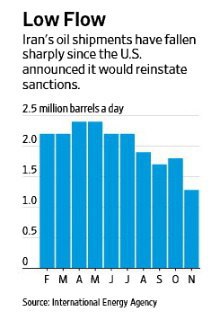
As you know, U.S. sanctions, which went into effect in November, prevent companies from signing contracts to access new oil fields in Iran, Washington granted exemptions allowing Iranian oil purchases by China, India, Japan, South Korea, Turkey, Taiwan, Italy and Greece to avoid a global increase in oil prices.
China Petroleum & Chemical Corp., or Sinopec, told its government-owned counterpart, the National Iranian Oil Co it wanted its share of the field’s production to be granted under the U.S. waiver allocated to China, one person said.
Sinopec is driving a hard bargain, making stringent demands. The company asked to buy equipment of its choice—made in China—and requested reimbursement for costs as soon as the new development undergoes testing, terms Iran normally refuses.
Late last year, after the U.S. allowed China to keep purchasing as much as 360,000 barrels of Iranian oil a day, Sinopec proposed a $3 billion investment plan in the Yadavaran oil field it operates in western Iran, according to people familiar with the proposal. The deal—if agreed— would double production at the field to 180,000 barrels a day within six months.
🔸 Tesla Will Make More Job Cuts
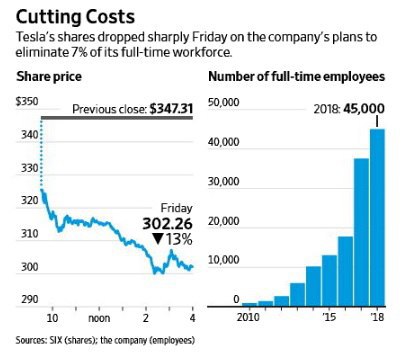
Tesla Inc. plans to eliminate 7% of its full-time workforce, the auto maker’s second round of job cuts in a year as it tries to maintain profitability while lowering the price of its Model 3 sedan.
The maker of electric vehicles has been jacking up production of the Model 3 while chasing its long-held dream of selling it at $35,000 to make it a mainstream sedan.
Tesla’s production struggles last year focused attention on its limited cash balance and Mr. Musk’s desire to avoid issuing new shares or taking on additional debt. The third quarter’s strong results and improved cash totaling $3 billion helped relieve some of that pressure. Mr. Musk reiterated in October his desire not to raise additional cash, telling analysts the company planned to pay off its debt without having to refinance.
In October, Tesla reported a record third-quarter profit of $311.5 million, surprising analysts and giving confidence to investors.
Tesla aims to begin delivering the Model 3 in Europe and Asia this quarter. Similar to how it began sales in the U.S., Tesla plans to start with a higher-priced version.
🔸 Dominant Dollar Bests Challengers
Beijing and Moscow have rarely had more reasons to rue the dollar’s global dominance. Yet changing the status quo will be difficult, and recent efforts to do so have yielded little.
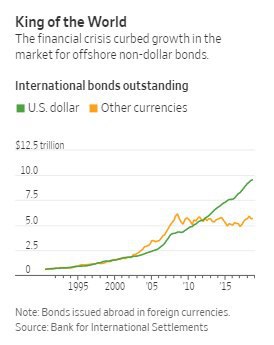
The dollar isn’t only the primary reserve currency held by other central banks. It is also ubiquitous in trade and international capital markets, making it crucial to the stability of emerging economies.
The pool of dollar bonds issued by non-U.S. governments and companies more than doubled between mid-2008 and last year, to $9.564 trillion from $4.299 trillion, international bonds in other currencies shrank to $5.672 trillion from $6.129 trillion.
International use of the euro has diminished since the eurozone sovereign-debt crisis raised the specter of default on debts previously believed safe. The euro’s share of global reserves shrank to 20.5% in the third quarter of 2018 from 28% in 2009.
China has spent years trying to boost the international use of its currency, including by encouraging offshore yuan trading and by recently introducing yuan oil contracts. However, contractors prefer to receive dollars, and all major recapitalizations of Chinese lenders funding the program have been done in dollars. Moreover, for the yuan to truly become a global reserve currency, China must stabilize its economy and clean up its financial system.
Also, the dollar does face some challenges from Moscow. Russia’s central bank sold or moved most of its U.S. Treasurys last year, official data shows, as part of an overt de-dollarization policy that includes closer links to China. And in the long term the yuan’s clout is likely to increase.
However, In many ways the U.S. currency’s pre-eminence looks safer than ever, after a drawn-out eurozone crisis and the recent slowdown in China
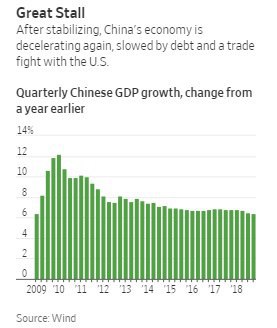
🔻 China’s Annual Economic Growth Rate Is Slowest Since 1990
China’s economic expansion languished to its slowest pace in nearly three decades last year, as a bruising trade fight with the U.S. exacerbated weakness in the world’s second-largest economy.
The 6.6% growth rate for 2018 reported Monday is the slowest annual pace China has recorded since 1990.
For now, Beijing appears to be determined not to deploy a big pro-growth package and is instead taking a path of gradual policy-easing. The central bank has been injecting more, and cheaper, funds into the banking system to encourage lending; the central government has removed tightfisted controls on local borrowing; Beijing is planning more tax cuts for both businesses and individuals, particularly those involved in the technology sector.
🔸 IMF Lowers 2019 Global Growth Forecast
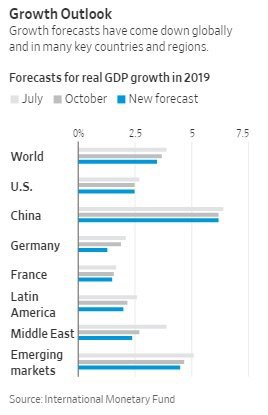
The global economy is starting the year on weaker footing, according to new quarterly forecasts from the International Monetary Fund.
The IMF cut its forecasts for world economic growth in 2019 to 3.5% down from 3.7% forecast in October and 3.9% expected in July.
The IMF’s forecast was pulled down in particular by poor economic performance out of Europe. Germany’s growth forecast for 2019 was cut 0.6 percentage points due to weak consumption and industrial production data; Italy was cut by 0.4 points due to weak domestic demand and high government borrowing costs and France was cut by 0.1 points due to the impact of ongoing street protests.
🔻 Silicon Valley’s Unbridled Optimism Gets Fresh Reality Check
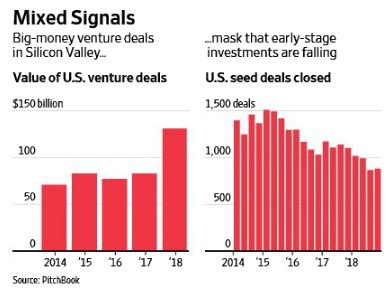
Startup investors and company founders warn that the unchecked growth of the past several years could be hitting a limit.
Yet a worrying sign is the shrinking of so-called seed deals, essentially the earliest investments in startups, dropping to 882 in the fourth quarter from more than 1,500 three years earlier. Venture capitalists typically follow the trajectory of tech stocks, as they did in early 2016 when they abruptly pulled back investments—only to return when the market roared back.
🔸 IBM Beats Earnings Expectations Although Its Revenue Again Declines
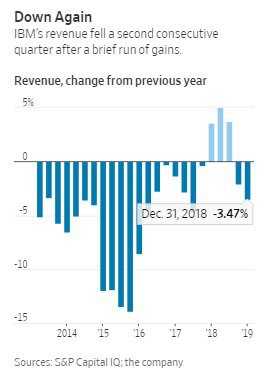
International Business Machines Corp. said revenue fell 3.5% in the fourth quarter. For the fourth quarter, revenue came in at $21.76 billion, compared with $22.54 billion a year ago. IBM swung to a profit of $1.95 billion from a $1.05 billion net loss a year earlier, when it took a $5.5 billion charge related to the U.S. Tax Cuts and Jobs Act of 2017.
Adjusted profit, which excludes some acquisition-related expenses and other items, came to $4.87 a share.