🔻 National Employment Report - November 2018
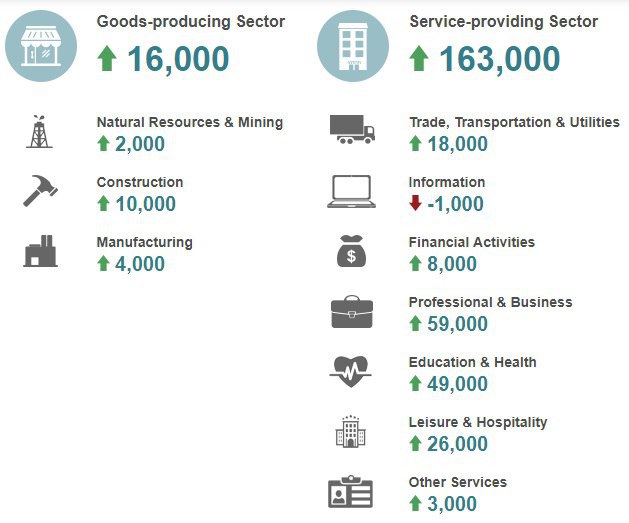
Private sector employment increased by 179,000 jobs from October to November in the U.S.
Some have suggested that slower hiring is the result of tightness in the labor market (the US is "running out" of available workers). Will we see wage growth accelerating in this morning's jobs report from the Labor Department? Economists expect a 3.1% increase in hourly earnings from a year ago.
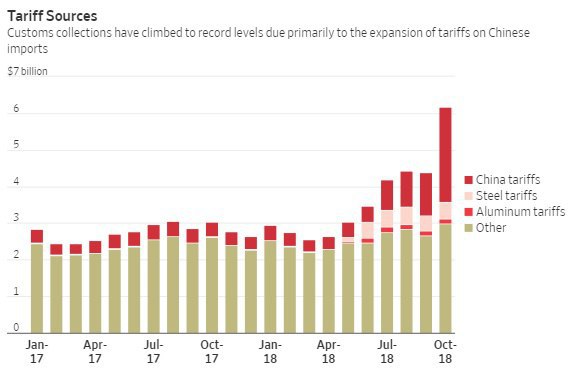
🔻 Tariffs are pouring into coffers, as Trump says, but not enough to cut deficits
The point, ostensibly, of tariffs is to reduce the trade deficit. The trade deficit has not, in fact, gone down, reaching a 10-year high. The other point about money going into the coffers is to reduce the budget deficit, which has exploded under Trump due to the tax cuts he embraced.
In the 12 months ending October, the budget deficit widened to $68 billion from $64.9 billion. So while the tariffs did in fact surge, it wasn’t by enough to improve the nation’s fiscal situation.
In short, yes, tariff revenue is coming into the U.S. Treasury, and the president isn’t exaggerating when he says that’s by the “billions.” But it’s not enough to prevent either the trade or budget deficit from deteriorating.
🔻 Cheaper Oil Ripples Through the Global Economy
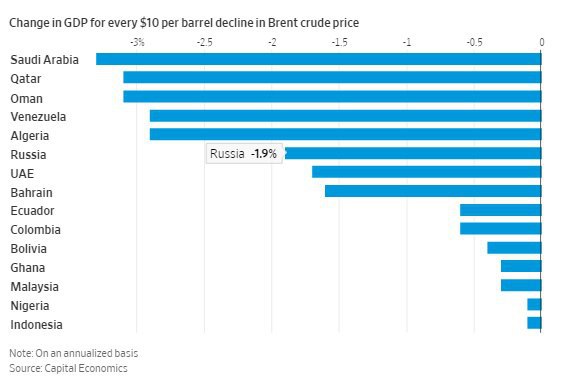
When oil falls, economic growth in major crude exporters suffers. On the graph below it can be seen how change in oil price impact on GDP of different countries.
When oil falls, economic growth in major crude exporters suffers. On the graph below it can be seen how change in oil price impact on GDP of different countries.
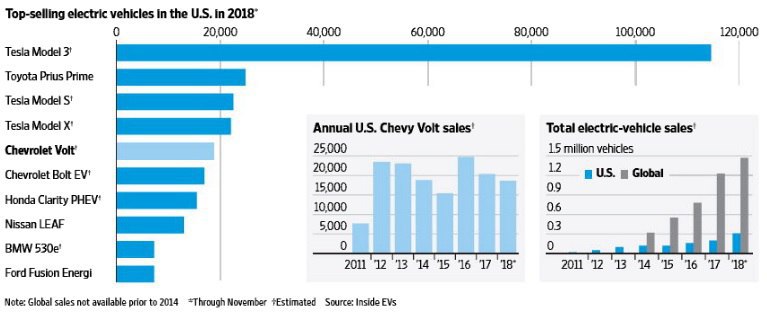
🔻 GM Unplugs Breakthrough Electric Vehicle
The Volt, though, was also a big money loser for GM. It cost a lot to build and wasn’t a big seller because of its high price and customer skepticism about American-made cars.
The auto maker said last month that it would end production of the Volt by March and idle the Detroit factory where it is built as part of a broader restructuring.
On the other hand, Tesla seems to be unreachable leader on electric-car market.
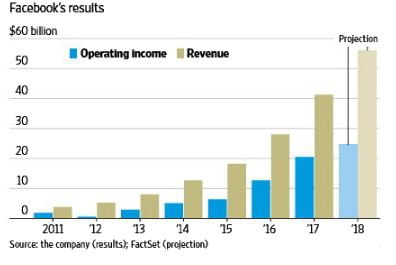
🔻 Facebook Always Meant Business
Facebook’s market value more than doubled over the next year and continued climbing, despite the fact that Facebook currently has an issues with British government, many of the company’s actions may have been good for the business.
Facebook’s market value more than doubled over the next year and continued climbing, despite the fact that Facebook currently has an issues with British government, many of the company’s actions may have been good for the business.
🔹 China Agrees to Reduce Tariffs on U.S. Autos
China agreed to reduce tariffs on U.S. autos to 15%, down from 40% currently.
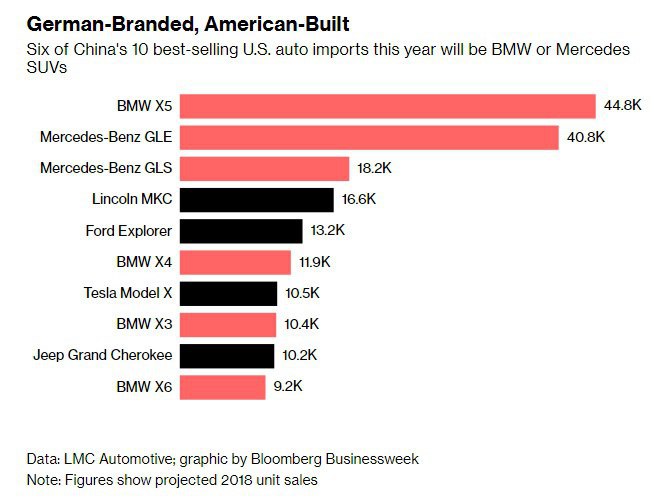
The tariff reduction benefits Daimler and BMW more than U.S. automakers such as General Motors Co. or Ford Motor Co. That’s because the German luxury brands dominate the top 10 list of vehicle imports into China.
Of China’s $51 billion of vehicle imports in 2017, about $13.5 billion came from North America, including sales of models made there by non-U.S. manufacturers like BMW. China imported 280,208 vehicles, or 10 percent of total imported cars, from the U.S. last year, according to China’s Passenger Car Association.
🔹 Amazon Cracks Down on Scams
Amazon was investigating suspected data leaks and bribes of its employees. The company has dismissed several workers in the U.S. and India for allegedly inappropriately accessing internal data that was being misused by disreputable merchants, these people said.
Amazon in recent weeks also has deleted thousands of suspect reviews, restricted sellers’ access to customer data on its website and stifled some techniques that trick the site into surfacing products higher in search results.
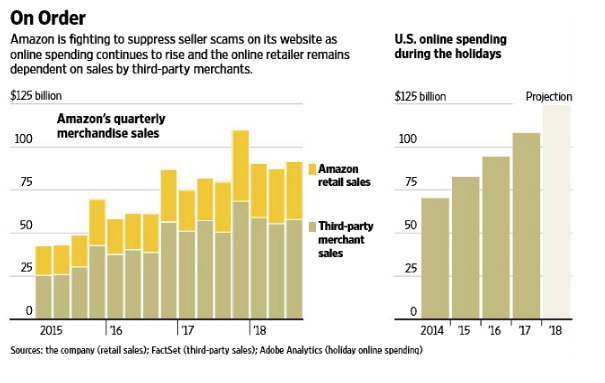
An estimated three million merchants sell products on Amazon, according to e-commerce data firm Marketplace Pulse. This year, U.S. shoppers are on track to spend $124.1 billion online, 15% more than last year, according to Adobe Analytics. Roughly half that spending takes place on Amazon, according to analysts.
🔻 Good time in the U.S.
The unemployment rate, at 3.7% in November, remained at a 49-year low. Economic output rose 3% in the third quarter from a year earlier. Inflation, after a long run below the Federal Reserve’s target of 2%, hit the mark without shooting past it. Wage growth picked up.
Can the good times last next year? It will depend on how much fiscal stimulus fades, how much higher the Fed pushes interest rates and how much farther Mr. Trump continues an aggressive trade agenda meant to strengthen the U.S.’s hand on the global stage in the long run
🔻 Boeing Opens Plant for Top Buyer China
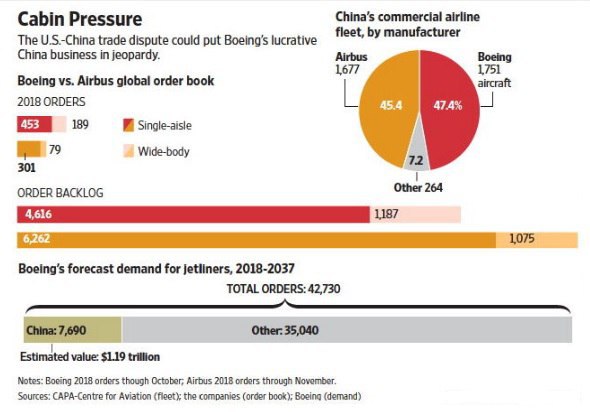
Boeing Co. opened a new Chinese production facility, as the American aviation company tries to cater to its top export market while steering clear of the tensions battering U.S.-China relations.
It will produce 100 jets a year and employ 300 people at full capacity.
Over the next two decades, the company expects China to buy one in six of all jetliners sold globally—some $1.19 trillion in Chinese orders Boeing expects to split with European rival Airbus SE.
🔻 Smaller Fed Moves Have Bigger Market Impacts
In a world of low inflation and slow recuperation from the financial crisis, even small interest-rate changes can have outsize effects on markets and the economy.
At the end of its next meeting Wednesday, Fed officials are set to raise their short-term rate for the ninth time since they began raising it from near zero in December 2015, bringing it to a range between 2.25% and 2.5%.
Fed officials expect the so-called neutral interest rate that neither spurs nor slows growth is lower than it used to be, which is one reason smaller changes in the federal-funds rate could have outsize effects.
The Fed’s moves encouraged companies to pile on debt when rates were low. With rates now rising, the Fed’s actions have begun shifting investors away from riskier corporate debt.
Banks initially enjoyed a boost from the Fed’s rate increases. The central bank’s moves allowed lenders such as Bank of America Corp. and JPMorgan Chase & Co. to charge higher rates on loans but not pay out much more in interest to depositors.
🔻 U.S. Soybean Farmers Work to Loosen China’s Grip
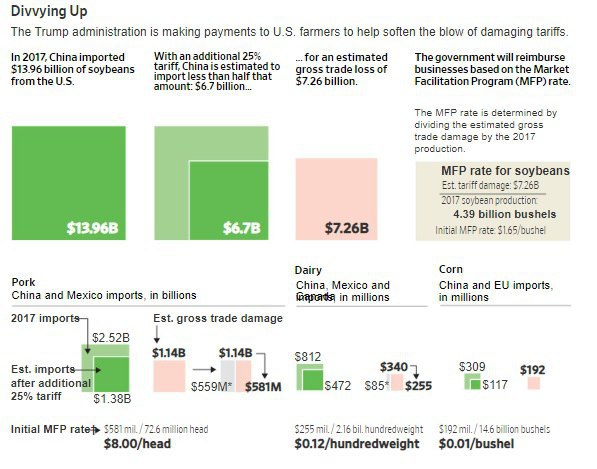
U.S. soybean farmers worked for decades to make China their biggest foreign customer. Now they face a tougher challenge: weaning themselves off the market.
As trade tensions cut deeply into exports, U.S. soybean farmers, industry groups and government officials are seeking a stronger foothold in international markets beyond China, including Europe and Southeast Asia.
Replacing China is a tall order. China last year bought 57% of all U.S. soybeans that were exported, more than eight times the total sold to Mexico
🔻 Apple has looked to India for new growth
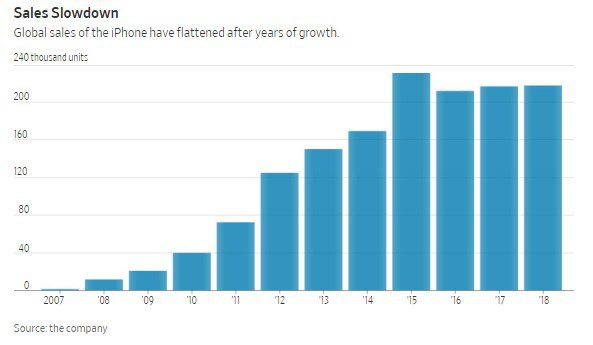
With global iPhone sales flattening, Apple needs big emerging markets. The company recently said it would stop reporting data on unit sales, a move analysts interpreted as an acknowledgment the iPhone’s best years have passed.
Even after reporting record annual revenue Nov. 1 on the back of higher iPhone starting prices of nearly $1,000, the company’s shares have fallen more than 25% since early November. The declines followed reductions in planned iPhone production and analysts’ reports that consumer interest in new iPhones is waning.
Apple is up against more daunting issues in India, which will have an estimated 39 million new smartphone owners this year. More than 75% of the smartphones sold in the country cost less than $250 and 95% cost less than $500, analysts estimate. Most sales come from local, unaffiliated shops in the countryside, where the majority of Indians live.
As the iPhone became one of the most popular smartphones in the world, Apple’s annual sales in India rose to more than $1 billion by 2015, from about $100 million in 2011.
That caught the attention of Mr. Cook and Cupertino executives. They wanted to make India the company’s next growth market and created a five-year plan to increase Apple’s sales to $5 billion by 2020.
🔻 Nasdaq Is In a Bear Market
Tech-heavy Nasdaq and Dow industrials suffer biggest weekly declines since financial crisis
The fear of slowing growth and a bear market has become much more prominent. There’s not many buyers who want to step up and say they’re willing to buy today, and many are waiting for the new year
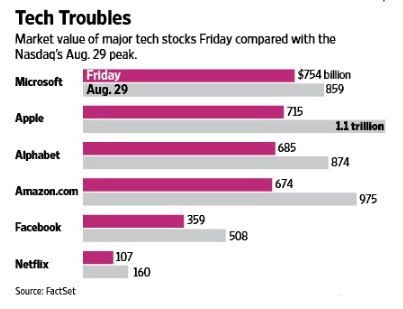
The decline of more than 20% from Nasdaq’s Aug. 29 high marks a sharp reversal for the benchmark, which is dominated by the technology giants that powered the broader stock market higher for much of the bull-market run that began in March 2009.
The intensifying selloff since late August has erased about $1.2 trillion in market value from Facebook, Amazon. com, Apple, Netflix, Google parent Alphabet and Microsoft, leaving the stock market without a clear leader.
Investors have long been contending with the possibility that U.S. economic growth will slow next year, raising the specter of a recession. That, along with the fading benefit of the corporate tax cut, the U.S.’s ongoing trade spat with China and a looming government shutdown, have led investors to pare back their riskier investments in an effort to preserve capital ahead of the year’s end
🔻 Gas Prices Are Falling
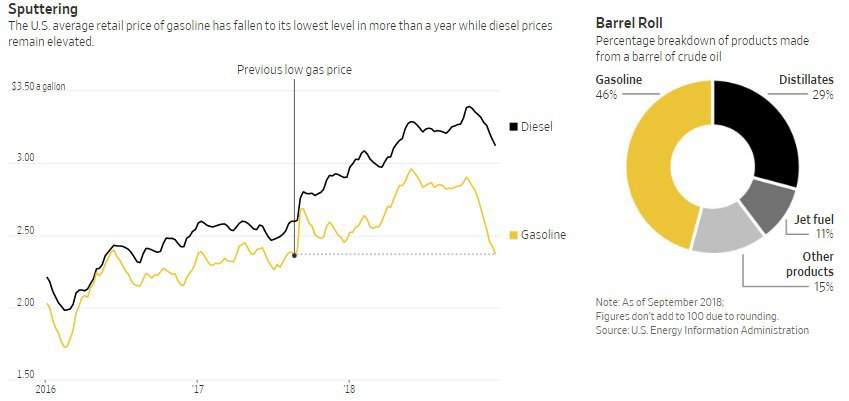
Retail gas prices across the U.S. averaged $2.33 a gallon Friday, down more than 10% from earlier this year and reaching the lowest level since August 2017.
Unusually, the low prices aren’t deterring U.S. refiners from producing more gasoline. That is because the prices of other oil products such as diesel fuel and heating oil have soared, thanks to cold weather in the U.S. and new environmental regulations coming into effect in 2020 that are leading to higher diesel demand.
When refiners can make significant sums selling diesel and heating oil, known in the industry as distillates, they become less sensitive to the profitability of each barrel of gasoline, which typically accounts for about half of U.S. oil use
At the same time, plentiful gasoline is typically a positive development for the economy at a time of some uncertainty about what 2019 will bring. Less expensive fuel could mean more discretionary spending for consumers, who in general have kept up their spending even as sectors such as housing and automobiles have slowed.
🔻 The U.S. trade balance from January 2017
When Donald Trump entered the White House on a platform of defiant nationalism nearly two years ago, many feared he would dismantle the global trading system the U.S. and its allies had built over the past 70 years.
The U.S. trade deficit reached its highest level in 10 years in October. Especially with China and Mexico, as a strong American economy sucks in imports.
The U.S. is stepping up efforts to draw its other trading partners into a united front to take on China. U.S. Trade Representative Robert Lighthizer and his EU and Japan counterparts have launched an effort at the WTO to crack down on China’s domestic subsidies and its technology-transfer requirements. The Group of 20 nations agreed at their recent summit to reform the WTO to address complaints it doesn’t adequately police China.

🔻 The Investment That Cost Apple $9 Billion
Apple Inc. has lost more than $9 billion this year on an underperforming investment—its own stock.
Like many large companies, Apple has used much of its windfall from the 2017 tax overhaul to buy back shares. But the recent plunge in stock prices has made that look like a bad idea.
The company’s repurchased shares were worth about $53.8 billion as of Wednesday’s close, some $9.1 billion less than it paid for them. Apple repurchased shares at monthly average prices as high as $222.07, according to securities filings. The stock closed at $157.17 Wednesday.
An Apple spokesman declined to comment.
Still, buybacks can help the company in other ways. Buybacks reduce share counts, boosting the earnings per share companies report to their investors.

🔻 The World’s Debt
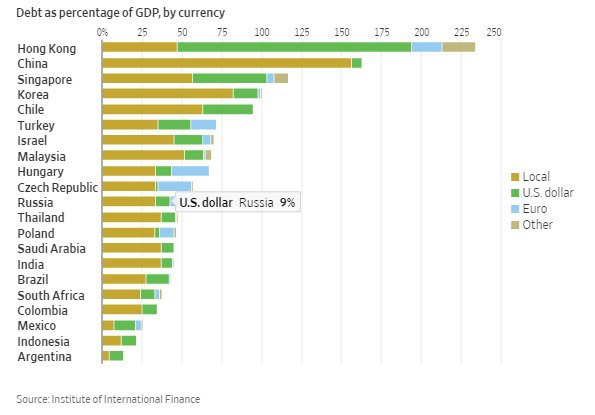
The world has never had as much debt as it has right now—nearly $250 trillion.
That figure is three times what it was two decades ago, according to a Citigroup analysis of data from the Institute of International Finance.
Growing debt goes hand-in-hand with growing economies, and for every borrower there is a lender for whom a loan or a bond is an asset
Investors worry that debt has been curtailed in ways that could hurt the economy. Banks, for example, have retreated from cross-border lending, which some economists said makes global finance less risky but may deal another blow to trade.
Few think debt is about to topple the world’s financial system or major economies. But as central banks end stimulus measures, many investors are on alert.
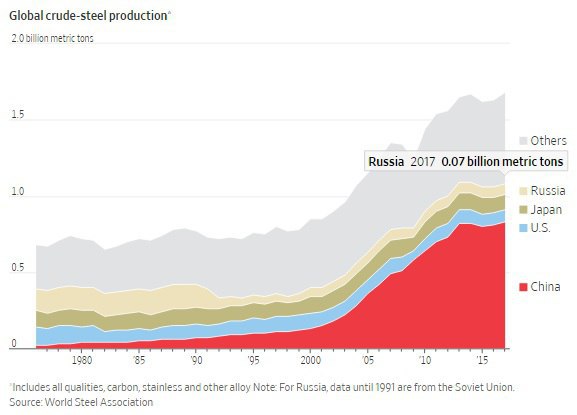
🔻 Global Steel Market Now Bows to China
By 2016, China’s steel industry employed about five million.
For anyone wanting to understand how China became dominant in steel, and the global repercussions of that transformation, the story of Baosteel provides answers.
The rich menu of subsidies helped China’s steelmakers set prices 20% to 40% lower than the U.S.
China went from providing 20% of U.S. flatware imports in 1996 to 67% last year.
Beijing provided subsidies on pipes of between 30% and 45% of the product’s value.
But now Beijing facing depressed global prices and growing debt, has forced the closure of smaller mills. The government aided Baosteel by pushing a merger with its largest rival, Wuhan Iron and Steel Group Co., in 2016, nearly doubling Baosteel’s capacity.
🔻 Rates Drop
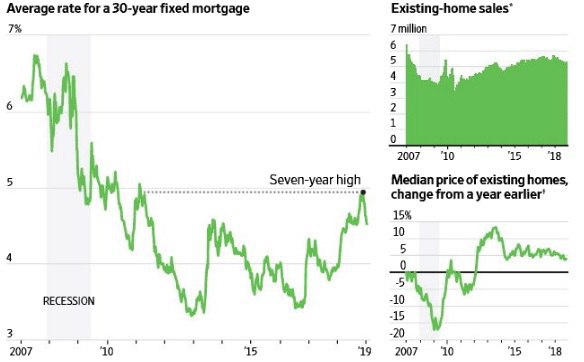
Mortgages rates have fallen after hitting their highest level in seven years. That could boot housing market in the U.S. that in recent months has seen slowdown in sales and prices.
Sales of existing homes rose 1.9% in November from a month earlier to a seasonally adjusted annual rate of 5.32 million, according to the National Association of Realtors.
🔻 Saudis To Cut Oil Exports to Lift Prices
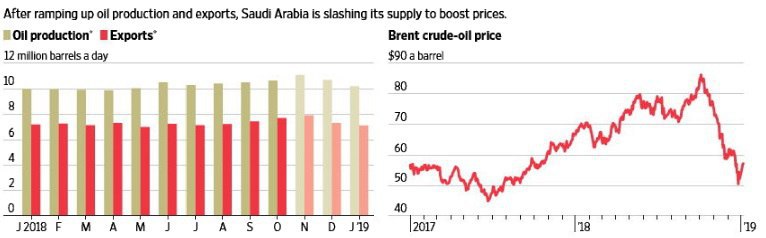
Saudi Arabia plans to cut crude exports to around 7.1 million barrels a day by the end of January in hopes of lifting oil prices above $80 a barrel.
Oil prices rose on the news. West Texas Intermediate futures, the U.S. oil standard, ended 1.2% higher at $48.52 a barrel. Brent, the global oil benchmark, rose 0.5% to $57.33 a barrel.
The new strategy comes as the kingdom seeks to cover a large government spending boost.
The new Saudi budget requires oil prices to rise to as high as $95 a barrel, according to an official with the Organization of the Petroleum Exporting Countries. But the kingdom would be satisfied with prices at $80 to $85 a barrel.
Saudi Arabia exported about 7.3 million barrels a day of crude last month. That was already down from around 7.9 million barrels a day in November and 7.7 million barrels a day in October.