Five Blockchain Use Cases Might Boost Global GDP by USD 1.76T - PwC
Driven by need for trust in digital world, blockchain technology is expected to boost global gross domestic product (GDP) by more than a trillion dollars, estimated professional services network PwC, and will do so through five major use cases.
PwC's latest report, titled "Time for trust: The trillion-dollar reasons to rethink blockchain," discussed the top five uses of blockchain driving its adoption, and their economic impact.
In the order of their potential to generate economic value, these use cases are:
1. Provenance
Potential boost to global GDP by 2030: USD 962bn
Blockchain enables organizations and customers to track the movements of a product and identify its origin, and transparency allows for enhanced customer safety and trust, ethical responsibility, environmental friendliness, etc.
2. Payments and Financial Instruments
Potential boost to global GDP by 2030: USD 433bn
Wholesale central bank‑issued digital currencies (CBDCs) can facilitate more efficient clearing operations between central banks and their member banks, while retail CBDCs would be the digital equivalent of a bank note for public use. Meanwhile, stablecoins are used in experiments to transform cross border payments.
3. Identity
Potential boost to global GDP by 2030: USD 224bn
The new technology can safeguard personal credentials online, including personal identification and professional credentials and certificates, which would result in "vast" cost efficiencies and would help prevent fraud and identity theft.
4. Contracts and Dispute Resolution
Potential boost to global GDP by 2030: USD 73bn
Blockchain can bring great changes into this field, as it's able to bring together ledgers, contracts, and payments, improving the flow of commercial agreements and flagging any disputes.
5. Customer Engagement
Potential boost to global GDP by 2030: USD 54bn
Blockchain can save traditional, card-based loyalty and reward programs from dying out, as it can boost engagement through integration with customer relationship management (CRM), as well as generate more value by making them more user-friendly for smartphone users.
This brings us to the report's key finding, as it highlighted that,
"Blockchain technology has the potential to boost global gross domestic product (GDP) by USD 1.76 trillion which is 1.4% of global GDP over the next decade."
This conclusion came from an assessment of the way in which the technology is being used at the moment, as well as its potential to "create value across every industry," such as healthcare, government and public services, manufacturing, finance, logistics, and retail, found the PwC economists.
"There is an opportunity for all," the report argued, adding that "our economists expect the majority of businesses to be using the technology in some form by 2025. Once it has hit the mainstream, the economic benefits are expected to rise steeply."

Here’s How Big-spending Chinese Firms Use their Blockchain R&D Money
A new study of how Chinese firms have been making use of the millions of dollars they have injected into blockchain technology has found that companies are prioritizing government-related developments and financial sector solutions.
The report, published by Securities Daily (via East Money), looked at how 23 publically listed companies have been spending the funds they have invested in blockchain-themed R&D since 2016, the year when larger Chinese firms “began testing the waters” of blockchain research.
The likes of Yuanguang Software, primarily an enterprise software provider, have increased their R&D spending by just under 7% per year – around USD 24.3m since 2016 – with much of that money going directly to blockchain-themed research efforts.
In many cases, companies are channeling a whopping 20% of their annual revenues into R&D, again, with blockchain taking the lion’s share.
A number of Yuanguang Software blockchain solutions have passed the product planning review stage, the media outlet added, including a digital education platform and a financial service platform designed for use in the energy sector.
Another firm, Hailian Jinhui, a steel industry player with stated “digital currency” interests, has applied for almost 50 blockchain patents and has been engaged in blockchain standardization efforts.
Although real-world applications are still largely in the pipelines, Chinese firms appear to believe that a breakthrough in commercialization is on its way, with a prominent IT professor opining that most firms consider that patents will provide them with a “competitive weapon” in the blockchain race.
A “majority” of the surveyed companies have looked to implement government-focused developments, particularly as a number of central and local government organs have been so keen to introduce blockchain-powered data sharing and exchange, business collaboration, and digital documentation solutions.
The media outlet reported that a total of 32 provinces and municipalities across the country have already issued blockchain-related policy documents – a further sign of growth for the blockchain sector in the public sector.
Banks and financial organizations, too, are becoming increasingly blockchain-keen, and are keen to boost contact-free, digital solutions pertaining to account registration and management, invoicing, bookkeeping and tax-related matters.
No Anti-Blockchain Voices in Russian Government, Says Policy Chief
The head of the Russian parliament’s financial markets committee Anatoly Aksakov said there are “no anti-blockchain voices in the government,” major industry players remain crypto-keen – and believes that a “cryptoruble” pilot will begin next year.
Per media outlet RBC, Aksakov – the chief architect of Moscow’s crypto and blockchain policy and legislation – was speaking at the recently held Blockchain Life 2020 forum. And he added that token issuance is becoming a hot topic in the Russian business world.
Aksakov reportedly told attendees,
“I know that a large number of serious businesspeople are preparing to issue digital assets. The Central Bank has taken a big step forward by announcing that it is starting consultations on the matter of digital assets. I am sure that pilots on a digital ruble will begin, perhaps next year.”
The Central Bank has so far only committed publically to consultation talks on the issuance of central bank digital token, although last year it stated that it saw “no need” to develop a digital ruble.
The State Duma committee chief assured that he is in dialogue with "serious crypto players" over the issue of regulating the country’s crypto market in Russia. He said that there were “no opponents of blockchain technology in government bodies,” adding that "everyone understands how important it is to develop technology, although many of them have differing points of view."
He expanded on this point, adding,
“The main issue for those who are critical of cryptoassets is that they see risks in these for both the financial system and the general public. When we make decisions, we need to hear everyone out. We take everyone’s views into the account, including the Central Bank, which has a very conservative position [on this matter.]”
KuChain and IRISnet Team Up to Establish Joint Labs for Accelerating the Development of the Cosmos Ecosystem
On October 30, 2020, KuChain and IRISnet announced the establishment of Joint Labs - Ti-Labs. Running on the back of a think-tank that is fueled by the intelligence of the masterminds behind KuChain and IRISnet, the Labs will shoulder the responsibility of enlightening the whole Cosmos ecosystem.
“Ti-Labs”’s name is inspired by titanium, the indispensable material in building rocket ships and other spacecraft. Ti-Labs will not just hold regular meetings for information sharing and integration between the tech teams in regard to the development progress across various verticals in the Cosmos ecosystem, but will also bring forward-looking insights that will shed light on future development directions. Meanwhile, looking beyond the two communities, to facilitate a wider range of information synchronization, communication, and collaboration among like-minded developers across the whole Cosmos ecosystem, Ti-Labs aim to incubate and support projects as long as they carry the Cosmos gene.
The Cosmos ecosystem participants can also enjoy handy support in terms of commercialization and industrialization, especially those that are oriented towards directions such as cross-chain asset transfer, on-chain stable coins, DEX, user applications, and developer tools.
Ti-Labs welcome all teams that devote to promoting the Cosmos ecosystem to join in Labs’ development, to boost the development and applications of the interchain ecosystem.
“Ti-Labs is a bold innovation in the Cosmos ecosystem. In the future, Ti-Labs will facilitate communication and collaboration between KuChain and IRISnet to promote an open-source ecosystem and resources.” KuChain operation lead Lou Yu stated.
Jeffrey Hu, research director of IRISnet, also stated, "I am very excited to cooperate with the KuChain team to establish Ti-Labs. Ti-labs will provide investment and incubation assistance from multiple dimensions to Cosmos ecosystem projects and further facilitate the development of its ecosystem."
KuChain is a next generation public chain based on Cosmos-SDK designed to serve decentralized financial applications like DeFi and DEX. KuChain has introduced “four-layer network” technical logic and modular design concepts. It will increase the application scenarios of decentralized finance and complement the ecosystem of Cosmos.
IRISnet (a.k.a IRIS Hub) is an Interchain Service Hub designed to support the next generation of distributed applications. Built with Cosmos-SDK, IRIS Hub enables cross-chain interoperability through a unified service model, which supports not only token interchain transfer but also trustworthy data consumption and computation invocation across heterogenous systems. IRIS Hub is the first self evolutionary blockchain launched in the Cosmos ecosystem.

Whales Moving Millions in Bitcoin as Hong Kong Regulator Makes Move
The world of crypto has received an unwelcome jolt after the Hong Kong financial securities regulator announced – somewhat abruptly – that all crypto exchanges will need to register with the body if they wish to continue trading.
Per Reuters, the head of the Securities and Futures Commission (SFC) will end its “opt-in” regulatory framework for crypto exchanges, bringing all trading platforms in Hong Kong under the control of the SFC – no matter if they trade securities or not.
The regulator is yet to explain if its move will see it impose stricter regulations on the Hong Kong crypto industry, which has been allowed to grow pretty much unchecked into one of the world’s largest crypto trading hubs.
In November last year, the SFC announced that exchanges can apply to be regulated by this Commission.
However, the crypto crackdown that effectively ended Mainland China’s dominance of the official crypto exchange market overnight in September 2017 will loom large in the minds of Hong Kong-based crypto enthusiasts.
An op-ed piece published by the state-run media outlet the People’s Daily has gained traction in the crypto community – and contains a number of references to how some Chinese citizens have been using crypto as a means of tax evasion. On a more positive note, though, the same article does also outline ways in which Chinese citizens can purchase crypto legally.
The article was co-authored by Shan Zhiguang, of the policy-making State Information Center think tank.
However, crypto users online believe that the move may be linked to a potentially more worrying trend in Mainland China, with reports about the arrest of Chinese-owned crypto exchange officials accelerating.
The Twitter-based blockchain tracker account Whale Alert has had a busy day with multiple reports of huge amounts of crypto moving off platforms such as Huobi and Binance in the past few hours.

Nearly USD 1B In Bitcoin, Possibly From Silk Road, Moved
Nearly USD 1 billion in bitcoin (BTC) believed to be from the infamous Silk Road darknet market moved today, for the first time in five years, claimed blockchain tracker Elliptic.
According to their report, BTC 69,369 - currently (8:16 UTC) worth USD 945.4m - has been moved out of the bitcoin address 1HQ3Go3ggs8pFnXuHVHRytPCq5fGG8Hbhx, which had had the fourth highest balance of any bitcoin address until that point.
The tracker found that "through blockchain analysis, we can determine that these funds likely originated from the Silk Road." Co-founder of Elliptic, Tom Robinson, told Bloomberg he's "about 60% confident that these funds are from the Silk Road at the moment — I’m not certain about it."
In 2012, this BTC was moved out of the Silk Road's wallet, at the time worth USD 350,000, and then moved to the above-stated address in 2013 after laying dormant for a year. Since then, said the report, the address went dormant again, save for BTC 101 transfer in 2015 to BTC-e, a crypto exchange for which the report claims was "favored by money launderers" then "taken down by US law enforcement in 2017."
However, the team has warned that whoever moved the funds, and for whatever reason, "the funds are now on the move, and whoever now controls the bitcoins may want to cash them out," urging exchanges to be on a lookout.
And speaking of which, Robinson told Bloomberg that it's not clear if these BTC were moved by the founder, a vendor, or law enforcement. The report gave two possible explanations among others:
Silk Road founder Ross Ulbricht or a Silk Road vendor could be moving their funds, though it's not very likely that Ulbricht is able to transfer bitcoin from prison. He got a double life sentence for his part in founding and operating the darknet marketplace.
There is an encrypted file circulated on hacker forums for the past year, claiming to hold the cryptographic keys to the above-written address. This means that whoever would crack the password on the file could take the bitcoin within it. Therefore, another possibility is that the encrypted wallet file has been real, the password has been cracked, and the bitcoins were moved.
Robinson added in a tweet that it's possible that the owner of the wallet moved the BTC to a new wallet to prevent it from being taken by whoever cracks the password.
He also appears to be more convinced that the funds are the founder's than the report seems to suggest. "I'm going to stick my neck out and suggest that there is a fair chance that these are Ross Ulbricht's bitcoins," Robinson tweeted.
The Silk Road was well-known for its privacy-keeping efforts, as it combined bitcoin with open-source software for enabling anonymous communication Tor. This effort, wrote Elliptic, enabled "the seemingly anonymous trade of illicit goods and services." The market had some 4,000 vendors and 15,000 buyers, and had facilitated total sales of USD 183m.
The report added that it's believed that the Silk Road earned a total commission of around BTC 614,000 (USD 8.4bn). The FBI seized, and the US government later sold, some BTC 174,000 from Ulbricht, at the time worth c. USD 105m, and USD 2.37bn today. So taking those BTC out of the picture, as well as those moved today, then there is still BTC 370,631, worth USD 5bn, sleeping somewhere.
Bitcoin is currently trading at USD 13,628. It went up less than 1% in a day and remained mostly unchanged in the past week.
Cryptocurrency might be a perfect addition to a financial service practice, if you’re trying to grow and maintain your business.
Why would I say this when we know that most advisers would never tell their clients to allocate more than 5% of their portfolio to cryptocurrencies?
Adam Blumberg is a Certified Financial Planner, and has been in financial services for 12 years. He is also co-founder and chief educator for Interaxis, a company trying to bridge the education gap between digital assets and traditional finance. He will join CoinDesk's Bitcoin for Advisors conference on Nov. 9-10 to explore the benefits of digital assets.
The answer is in the demographics and the investment habits, styles, needs and goals of those that do and might find crypto appealing. Gen X and millennials have lived with the internet most or all of their adult lives. They have become used to having all their services on-demand and having the ability to fact- and price-check everything.
By signing up, you will receive emails about CoinDesk products and you agree to our terms & conditions and privacy policy.
Price checking became the norm with financial advisers over a decade ago, leading to the rise of robo-advisers. I was early in my FA career when Betterment and Wealthfront launched, and I saw the appeal. I already had clients asking me about my fees and how they were justified given the returns.
Other advisers just kept telling themselves – and each other – they couldn’t be replaced by a computer. “Our jobs are too important.” And now, advisers are similarly gun-shy about crypto, at risk of missing the industry’s next disruptive trend.
Robo-advisers currently have over $100 billion in assets under management (AUM), and the average age of the investors is well under 40. Those investors didn’t see the need to pay over 1% to financial advisers who did little more than pass the investing function on to third parties, who charged additional fees, only to underperform the market.
THE STORIES ARE THERE FOR ADVISERS TO TELL THEIR CLIENTS AND INFRASTRUCTURE IS BEING BUILT TO HELP MAKE CRYPTO A SMART PLAY IN FINANCIAL PLANNING.
In addition, we have seen the growth of Robinhood, where 80% of the users are millennials, as well as apps like Acorns and Stash that offer a digital-first and highly customizable experience.
The moral here is, if Gen X and millennial investors want a certain way to invest, save or transact, they’re going to find it and they’re going to help dictate the fees and services. It’s likely crypto represents the next frontier of investing.
Let’s look at that group’s attitudes toward investing. According to CB Insights, 33% of millenials don’t think they’ll need a bank at all, and 83% express openness to alternative investment strategies.
Currently, the age group with the largest number of bitcoin investors is the 25-34 group, according to Grayscale (like CoinDesk, a unit of Digital Currency Group). However, the average age for those that are interested in bitcoin is 42, or those that are in their peak and growing earning years!
Couple those statistics with the fact that this group stands to inherit over $60 trillion in the next three decades and are charted to quintuple their wealth by 2030.
What you have is a group of smart investors with growing incomes and wealth who know what they want to invest in and are wary of paying extra fees.
Crypto gives financial advisors the ability to offer something to those younger investors that many advisors can’t or won’t talk about. Clients want it, and they want help from their advisor. More than half of those surveyed by Grayscale said they would be more motivated to invest in bitcoin if their adviser recommends it.
Crypto can fit in with changing fee structures and service offerings. For advisers who are offering subscription, flat-fee, hourly or project services, crypto solutions fit very nicely. Having conversations about where crypto makes sense, and helping clients understand, buy, safely store and account for their crypto is highly needed by retail investors.
‘Dozens’ of Arrests as South Korean Police Swoop on Bogus Ethereum Fund
South Korean police have closed the net on an alleged ethereum (ETH) scam operation named EtherWallet, making “dozens” of arrests nationwide in suspected USD 44.5 million fraud wrap. Some 3,000 victims have been identified, the police said.
The Seoul Metropolitan Police Agency has been formally investigating EtherWallet since early summer this year, after a group of hundreds of investors filed an initial complaint with the police back in January.
The EtherWallet operators allegedly used multi-level marketing (MLM) tactics to recruit members, promising investors lucrative rewards for pooling their ETH holdings in what they claimed was a shared fund.
Police initially believed that around 1,500 investors had been duped out of their crypto holdings, but per Yonhap News, the latest figures appear to show that double that amount may have handed over their ethereum to the alleged fraudsters.
And the police stated that they had found a “nationwide ring” of operatives subordinate to a “Mr. A” (name withheld by the South Korean courts for legal reasons).
EtherWallet chiefs had been “giving lectures on a large scale in university auditoriums” across the country until police closed the net on the firm earlier this year.
But now police feel they have sufficient evidence to swoop, arresting eight suspected masterminds and an unnamed, double-digit number of local operatives on fraud and embezzlement charges.

Crypto lender Cred Inc. has filed for Chapter 11 bankruptcy protection in Delaware on Saturday.
In its filing, Cred listed estimated assets of between $50 million and $100 million and liabilities between $100 million and $500 million.
In an emailed press release, Cred said Grant Lyon has been named to the company's board to oversee the restructuring process. It has also hired MACCO Restructuring Group as financial advisor to evaluate M&A and other restructuring opportunities.
In October, the lender published a cryptic letter saying that it has experienced “irregularities” in the handling of “specific” corporate funds by a “perpetrator of fraudulent activity.” In response, Cred said it had been advised by legal counsel to temporarily suspend inflows and outflows of funds relating to its CredEarn program.
At the same time, trading platform Uphold told customers that it had “decided to discontinue its relationship with Cred.”
Additionally, Uphold announced via a tweet on Sunday its intention to pursue legal reparations on behalf of its customers citing a "breach of contract, fraud, and related claims."
Cred may have already been in a tenuous position as several crypto lenders struggled to weather the bitcoin (BTC, +2.88%) crash in March, with some making margin calls of $100 million or more.
Cred’s CEO Dan Schatt did not immediately respond to request for comment.

‘Russian Dictators Will Use Blockchain to Rig Elections,’ Says Critic
Russia’s new blockchain-powered voting systems could be exploited by unscrupulous politicians, becoming “tools” for the architects of rigged elections and voter fraud, a journalist has alleged.
The claims were made in a new column entitled “Blockchain for Dictators” by Sergei Golubitsky, an IT journalist and a long-time contributor to the liberal-leaning Russian newspaper Novaya Gazeta.
Golubitsky stated that Russian blockchain-powered voting – already rolled out in recent by-elections, at the national level in testbed zone for a referendum on constitutional reform and previously by the Moscow city authorities – is fundamentally flawed.
He claimed that all iterations of blockchain voting so far used in the Russian political process are more like standard corporate distributed networks than true blockchain networks – due to the fact that they are not decentralized in nature and are hosted on government-servers.
A number of reports have claimed that the blockchain voting processes already used have been riddled with fatal issues.
In a stinging attack, the journalist wrote that the Russian state feared “completely losing control over election results,” in a system that allowed powermongers to “govern without democratic traditions.”
He added that “electronic voting on a pseudo-blockchain” was becoming widespread in Russia, penning,
“Soon we will see [pseudo-blockchain voting] in Russia everywhere (because, as far as I know, this adaptation trend has already been taken up by the powerful elite).”
However, he did offer hope for proponents of “true” fully decentralized voting platforms that make use of blockchain technology, stating,
“All technologies, however, have one remarkable property: If they provide objectively better results, sooner or later they will be used, regardless of whether we like them or not.”
Regardless of Golubitsky and other critics’ opposition, Russia looks set to roll out more blockchain-powered voting systems in the near future, with offerings from the state-run telecommunications firm Rostelecom and Russian software giant Kaspersky Lab gaining traction in the Russian public sector.
Ex-CIA Analyst: Beijing Blockchain Network May Spark Chinese Net Dominance
The Chinese Blockchain Service Network (BSN), already active in all major Middle Kingdom cities and continuing to add interoperability options, could pose a major threat to America’s dominance in the digital realm, said a security expert and former CIA official – raising questions over the project's possible implications for the crypto sector.
The opinions were put forward by Yaya J. Fanusie, an Adjunct Senior Fellow at the Center for a New American Security (CNAS) think tank in Washington, DC. In a recent analysis piece for Lawfare, Fanusie claimed that while the BSN is being touted as a “system of low-cost backend architecture on which software developers around the world can build blockchain applications, including digital assets such as cryptocurrencies,” it is also seen as a tool that will serve the core cyber policy interests of the Chinese Communist Party (CCP).
Fanusie claimed that American financial authorities “have benefited from the ubiquity of US computer infrastructure in global business,” but thinks that the BSN is “trying to challenge that norm.”
He wrote,
“The CCP leadership believes that blockchain technology offers a foundational infrastructure for future technological innovation and that China should set the global standards in that arena. To begin doing so, China is inviting blockchain developers to build decentralized software applications on the BSN’s Chinese-run servers, even though some of the servers are located outside China.”
The network is overseen by an entity under the National Development and Reform Commission, one of the government agencies responsible for China’s macroeconomic planning.
And while the former CIA official stated that America may not feel the effects of the BSN’s successes full-on, its existence is indicative of a new approach from Beijing in the struggle between the two powerful nations.
He wrote,
“The BSN is not going to upend the US domination of the internet anytime soon. But it indicates a new, and sensible, Chinese strategy. […] The good news is that while China’s blockchain internet is in its infancy, the US has time to follow its development and respond accordingly.”
But there could be pressing dangers ahead for the USA and its allied, he warned.
Fanusie opined that the BSN “could undermine movements for human rights and political freedom,” and added that “Much of the blockchain developer community has strong libertarian leanings, promoting decentralized applications as means for censorship resistance and to fund protests against authoritarianism and state brutality.”
It is an irony, he added, that the BSN’s decentralization effort is “authoritarian-owned.”
The analyst cautioned that the “elusiveness of global blockchain adoption is exactly why China’s strategy deserves attention.”
He elaborated on this point, writing,
“The BSN is trying to significantly reduce the input costs of blockchain development, which would increase cost-savings and help keep blockchain projects alive as they seek users and profitability.”
And Fanusie believes that China’s “outsized role” in bitcoin (BTC) mining may have taught its leaders a thing or two.
He opined,
“Chinese computer processing companies dominate the bitcoin mining industry largely because they operate in Chinese provinces where hydroelectricity is cheap, allowing them to sustain wider profit margins even when bitcoin’s volatile price drops.”
Fanusie concluded that American decision-makers should “watch out for the BSN’s potential to hinder future investigations and enforcement actions relating to digital currencies.”

BitPay Launches Mass Payout Service For Companies That Don’t Own Crypto
Major crypto payment processor BitPay has announced the launch of BitPay Send, a new mass payout service that allows organizations to pay their employees, affiliates, customers, vendors, contractors, and others with cryptocurrency. The development could help the company reach out to businesses that want to pay in crypto, but are hesitant to hold it for security reasons.
Stephen Pair, CEO of BitPay, was quoted in a statement as saying that “traditional international payment methods are cumbersome, costly and slow. With BitPay Send, companies can make mass payouts without having to buy, own or manage crypto and their recipients receive payments quicker and at a lower cost”.
The service is available in some 225 countries, and payments are subject to a 1% fee. Recipients are not required to have a bank account. They are, however, obliged to have a BitPay ID and a crypto wallet.
The payment processor, that also offers BitPay Wallet and BitPay Prepaid Card, funds payments in fiat and leverages the blockchain to send pre-tax payments without requiring the service’s users to own or handle cryptocurrency. This allows users to make payroll payments, facilitate customer cashout requests, pay independent contractors or affiliates, issue rewards or rebates, and financially settle with marketplace sellers, according to BitPay.
The new feature pits BitPay against other companies that provide similar services, such as San Francisco-based crypto business BitWage. In comparison, the firm’s standard subscription for payroll and invoicing services is free-of-charge for companies, but the incurred charges include a 2% and USD 1 fee for stablecoin wage distribution, among others.
One of the first companies to use BitPay’s new functionality include New York-based digital advertising firm AdGate Media which is to use the service to pay its global network of affiliates, the statement said.
“We have lots of affiliates who wanted to be paid in bitcoin, especially those who are based outside North America and Europe where access to bank accounts is difficult,” said Dan Sapozhnikov, President of AdGate, adding that they "did not want to buy and hold crypto."
Bitcoin Cash Faces Increased Selling Pressure Ahead of Hard Fork
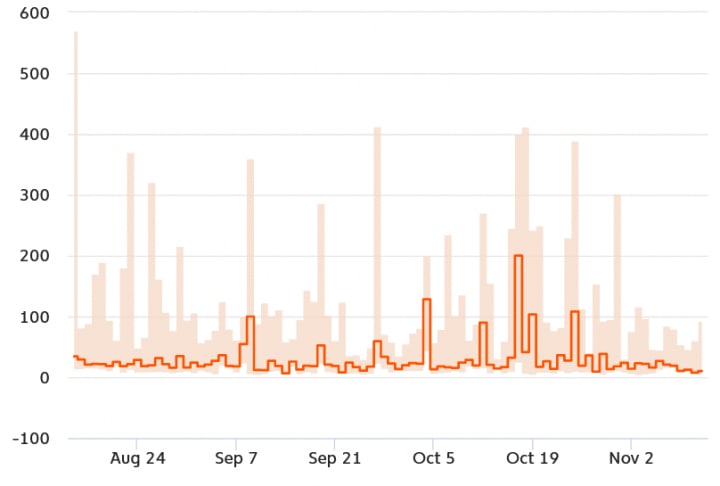
With the Bitcoin Cash (BCH) hard fork fast-approaching, BCH inflows to exchanges reached their highest point in eight months, and it appears that more market participants want to sell than buy the coin, according to the data provided by blockchain analysis company Chainalysis.
Another hard fork is coming to Bitcoin Cash on November 15, 2020, following a series of disagreements and tensions related to the project's future and the proposed changes in the underlying code.
According to Chainalysis' Market Intel, BCH inflows to exchanges in the last day hit BCH 271,220 (USD 70m), which is the highest level they reached in the last 244 days, or since mid-March. They came relatively near to this number in early September with a jump to BCH 258,528, which coincided with a sharp selloff in the whole market that week. This number also surpasses the 7-day average of BCH 163,674 and 180-day average of nearly BCH 80,000.
Inflows to exchanges fluctuate with changes in market sentiment and "an increase in inflows suggests increased selling pressure in the market," according to Chainalysis.
Furthermore, those assets that are held on exchanges increase if more market participants want to sell the coin than to buy it, as well as if buyers choose to store their assets on exchanges, said Chainalysis.
The change in BCH held on exchanges in the last day is BCH 70,320, down nearly 28%. Nonetheless, this is still above the 180-day average of some BCH 10,500.
Market Intel also offers a look into the BCH trade intensity. This metric compares the value of order book trades to exchange inflows, and if there is an increase in trade intensity, that "suggests more market participants want to buy than to sell." In BCH's case specifically, the median trade intensity in the last day is 10.23, below the 180-day average of 27.4, or the 7-day average of 15.28.
At the time of writing (14:24 UTC), BCH, ranked 6th by market capitalization, trades at USD 257 and is down by almost 1% in day and is unchanged in a week and a month. The price is down by almost 9% in a year.
Ethereum King Buterin Loses Live Showdown to Twitch Chess Queen
Ethereum (ETH) co-founder Vitalik Buterin took a break from his crypto activities and met his match – on the chess board versus a National Canadian Team player and well-known Twitch-based chess streamer.
In a much-talked-about live-streamed faceoff versus Alexandra Botez, an International Chess Federation-recognized Woman FIDE Master and a five-time Canadian National Girls Champion. Buterin put on a brave show in a timed, 10-minute per person matchup on the Chess.com platform.
It was all smiles for both players, with no shortage of friendly chat throughout. But Botez, playing black, easily had the measure of her ETH architect opponent, checkmating him with over a minute to spare and three major (second-row) pieces left on the board.
Buterin’s supporters had hoped for an upset against Botez, with some even backing their man on online crypto betting forums. But the Twitch celebrity made easy work of her opponent – and even took the time to explain to him where he had gone wrong in their matchup, with the stream eventually turning into something of a chess lesson for the Ethereum mastermind.
Botez initially challenged Buterin on Twitter back on November 14.
Buterin is a keen amateur chess player and said that he has a 1,500 score on the open-source Lichess server. He said during the stream that he learned to play chess predominantly from his grandfather during visits to Russia as a young boy.
Botez mentioned that she had a number of crypto connections, mainly through her network of friends

Reddit Users Fume at Details of PayPal Crypto ‘Lockout’ Case
A Reddit user has claimed they have been “permanently banned” from the PayPal platform “due to cryptocurrency buy/sells being treated as ‘item sales.’”
Per a thread created by the Redditor, the PayPal customer claimed that they wanted others to be aware of what they called an “ignorance-fueled misunderstanding,” and claimed that they did not exceed any of PayPal’s transaction limit thresholds, instead buying and selling “USD 10,000 worth of crypto throughout the week” at a rate of “less than USD 500 per transaction.”
The Redditor claimed that they had been unable to speak to customer services representative about the matter and wrote,
“They genuinely think I made item sales worth that much, it's why they asked me for purchase receipts for each of these crypto transactions as if I shipped something.”
In the same thread, some users expressed concerns that PayPal – which has recently entered the crypto sector in the United States – may be unsuitable for some crypto traders.
One commenter wrote,
“This is why I don’t trust PayPal and their centralized design. They already suck with eBay transactions: How does crypto make it any different for them? Can already see people buying crypto and getting banned from them for some really dumb shit and them kicking you off and keeping your crypto.”
Another opined that PayPal’s decision to freeze accounts for 180 days when the platform detects what it determines is unusual behavior “could be enough to stop you cashing out life-changing sums during a bull run.”
And another opined that the rules that the financial sector needs to abide by simply do not apply to platforms like PayPal, writing,
“People need to stop thinking they have bank-like options with PayPal, they are a private entity and they only comply with their own terms.”
As reported, users own the cryptoasset they buy on PayPal but will not be provided with a private key. Also, currently, users can only hold the cryptoasset they buy on PayPal in their account. It cannot be transferred to other accounts on or off PayPal. Moreover, at this time, crypto can't be used as a way to pay or send money on PayPal.
Limited Facebook's Libra Might Be Launched in January
Facebook-led digital currency Libra is preparing to launch as a single coin backed one-for-one by the dollar as early as January, the Financial Times reported, citing three undisclosed people involved in the initiative.
The other currencies and the composite would be rolled out at a later point, the report said, adding that the exact launch date would depend on when the project receives approval to operate as a payments service from the Swiss Financial Market Supervisory Authority.
Meanwhile, one person involved in Novi, the developer of digital wallet designed for Libra digital currencies, told Financial Times that the wallet was “ready from a product perspective”, but would not be rolled out everywhere initially, with the company prioritizing “half a dozen high-volume remittance corridors” including the US and some Latin American countries.
Canadian Restaurant Sends a Bitcoin Message To SMEs
While more big companies and investors are turning into bitcoin (BTC) in search for a reserve asset and hedge against inflation, one Canadian small business shows that it might help smaller enterprises too.
Canadian restaurant chain Tahini’s, which calls itself the "best Middle Eastern restaurant in the world," has been banging the BTC drum again, calling the token “digital gold” and reaffirming its decision to convert its fiat reserves to BTC.
The chain serves Middle Eastern food at four locations in Canada, with three more set to open, and was founded in London, Ontario.
It first made headlines in the crypto world in August this year, when it took to Twitter, announcing that it was converting its “entire” cash supply to BTC.
And in a recent series of tweets, the firm once again voiced its beliefs – like those of American software firm MicroStrategy – that businesses will benefit over the long-term from ditching cash in favor of BTC-buying.
Tahini’s wrote that its “current macroeconomic environment implies that there is going to be 10 to 15% expansion” to its monetary supply “every year for the next three to five years (or more).”
The firm added that “Assets are going to inflate. Bitcoin is digital gold and it’s going to have the highest real yield because you can’t make any more of it.”
The restaurant owner also took time to take a swipe at other asset classes, including gold, adding,
“All the other investments are overvalued trades. Bonds are unethical, stocks are grossly overvalued, gold is a shitty store of value that debases by 2% a year. Gold in 2020 is a scam, you’ll see governments and institutions pumping it to dump on retail misinformed investors because bitcoin is 1000x better across all aspects.”
And the chain claimed that it would continue to convert cash revenues to BTC in “coming years and maybe forever if we don't have a need for the fiat,” adding that “We will not wait for S&P 500 to start doing so.”
Crypto in 2021: Bitcoin To Ride The Same Wave Of Macroeconomic Problems
2020 was the year that the bitcoin (BTC) and the wider crypto market started responding to macroeconomic trends and indicators more actively. While critics continue to argue that this market responds only to its own issues and movements, it looks like investment in bitcoin from the likes of MicroStrategy, Square, and even SMEs like Snappa and Tahini’s was a reaction to low interest rates and a struggling dollar.
This is likely to continue into 2021, with a range of industry figures and analysts telling that they expect low interest rates and quantitative easing (QE) to remain fixtures of the macroeconomic landscape for some time to come. And while some expect deflation to be more of a risk in the first half of the year, others expect inflation or currency debasement to be a possibility in the second half.
Taken together, this all suggests that 2021 might be favorable for cryptoassets — and bitcoin in particular — in terms of the macroeconomic climate.
2020: What did experts say?
Back in 2019, experts predicted that 2020 would bring low interest rates. They also suggested that the year may witness a global recession, which a growing number of economists were forecasting at the time.
With the help of the coronavirus pandemic, these two predictions have been proven true, with the decline of (already low) interest rates and a global recession helping to boost bitcoin and other cryptoassets, even if the crypto market suffered something like a massive flash crash in March when the pandemic first rocked global markets.
Experts also suggested that ongoing trade conflicts and difficulties may increase investor demand for ‘safe’ assets such as bitcoin. However, international trade has been overshadowed by the response to COVID-19, so it’s hard to say whether the ongoing risk of a no-deal Brexit, for example, contributed to the crypto market’s 207% rise in capitalization this year.
Hot money printers and low interest rates
Everyone we’ve spoken to estimate that quantitative easing and — in particular — low interest rates will continue in 2021 (and possibly beyond).
“Rates are likely to stay low for the foreseeable future because much of the developed world simply can’t handle higher interest rates,” said Kevin Kelly, the co-founder and chartered financial analyst at Delphi Digital.
According to him, higher interest rates would cause financial conditions to tighten, which would drive up default rates and bankruptcies at a time when optimistic growth prospects are already hard to come by.
Kelly added that large-scale debt monetization (aka QE) is likely to continue well into 2021, particularly as governments issue more sovereign debt to finance the spending required to keep the global economy afloat. And he isn’t the only one who estimates this, with Bitcoin developer, educator and entrepreneur Jimmy Song suggesting that politicians are more or less politically obliged to keep the dollar printer going.
“Quantitative easing is the only way any of these politicians will get to get any support, so that's what they'll do. 2021 might not be as crazy in terms of money printing, but the effects of USD expansion should be felt around the world as this newly printed money circulates,”.
There’s now an emerging school of thought that the arrival of effective coronavirus vaccines will help the global economy get out of its funk in 2021. However, Bloomberg Intelligence senior commodity strategist Mike McGlone is more cautious.
“I have no clue how long it will last, but expect the trends to be enduring and think there is a bit too much optimism that widely distributed vaccines will reverse rapidly rising Debt-to-GDP, QE and MMT on a global basis,” he said.
Business Giants Invest USD 60m in Blockchain-powered
A group of South Korean and Japanese business giants including Hanhwa Investment & Securities, SoftBank and SK have joined more established blockchain investors to complete a Series B investment round worth over USD 60m in South Korean firm Chai, the provider of a blockchain-powered payment gateway.
Chai completed a USD 15m Series A in February this year.
The firm is a partner of stablecoin issuer Terra, and makes use of Terra’s blockchain and stablecoin offerings to, it claims, offer lower transaction fees and provide its users with discounts.
Chai launched in South Korea last year – and claims to have over 2.5m users. A partnership deal with BC Card, one of South Korea’s biggest credit card issuers, has also boosted its profile.
Some 2,200 merchants in South Korea have partnership deals with Chai, with the latter looking to expand its reach in the wake of the coronavirus pandemic. The pandemic has seen South Koreans turn to contactless pay, with a 17% increase in contact-free payments since the start of the crisis per central bank figures.
The government has also pledged to foster contact-free payment platforms as part of a bid to reduce eliminate the damage caused by pandemics and other modern risks.
Per a press release report from Fn News, the investment round marks a new South Korean record for a fintech firm, and was led by Hanhwa Investment & Securities, part of the Hanwha Group conglomerate, which has some USD 166bn worth of assets.
SoftBank, meanwhile, operates the Vision Fund, the reportedly world’s biggest IT-focused venture capital fund, with capital of over USD 100bn.
SK is one of South Korea’s big two mobile and internet carriers – and is another of South Korea’s so-called chaebol, or mega-companies.
Commercial bank KEB Hana’s investment arm also took part in the round, as did the venture capital firms InterVest, Aarden Partners and K2 Investment Partners – as well as blockchain accelerator Hashed.
The latter’s CEO and managing partner Simon Kim said that he was “excited to see how blockchain is fueling further advancements in fintech services,” and was “looking forward to Chai’s expansion” outside South Korea and “into the global market.”

Sberbank Urges Central Bank to Reconsider Digital Ruble Issuance Plans
The state-controlled commercial bank Sberbank has expressed fears that the Russian Central Bank’s “digital ruble” plans will have a negative effect on liquidity in the nation.
The Central Bank has accelerated its plans to roll out a central bank digital currency (CBDC) with a pilot slated for next year – likely in a response to China’s progress with its digital yuan project and the European Union’s own digital euro efforts.
But per Kommersant, Sberbank appears to have been put off by the fact that the Central Bank apparently favors two CBDC models – both of which they feel would be disadvantageous to commercial banks and other financial sector entities.
The bank’s Deputy Chairman Anatoly Popov is quoted as stating that he estimates that in three years’ time some USD 28bn - USD 56bn worth of fiat could be converted to digital currency.
Popov opined that one model would see regulators manage clients’ wallets on a Central Bank-run CBDC platform with banks and other financial organizations serving as “mere intermediaries,” helping their clients do little more than open wallets and use them to make settlements.
The second model, he said, would see the Central Bank create wallets for commercial banks, which would then be passed on to the client, with no indication as to who hosts the wallet – the commercial bank or the Central Bank.
Popov claimed,
“We believe that the models of CBDC issuance currently being discussed have a number of serious shortcomings. They limit, among other things, the activities of commercial banks. Our concern – as a financial institution – is that liquidity […] will be transferred to the [Central Bank].”
And should his USD 28bn - USD 56bn forecasts come true, Popov added, these funds “will no longer be available for lending, which will ultimately lead to a shortage of liquidity.”
The banker concluded that this could, in turn, eventually hit customers in the pocket, too, concluding,
“As a result [of the fall in liquidity], there could be an increase in rates.”
Popov’s calls came after the Vice President of the Russian Association of Cryptocurrencies and Blockchain (RACIB) made similar claims earlier this month, urging Moscow to give commercial banks more control over Russia’s forthcoming CBDC.