Mastercard CEO names reasons for quitting Libra Association
Mastercard CEO Ajay Banga commented on the company’s departure from the Libra Association in October last year.
In a conversation with the Financial Times, Banga said that he was initially interested in the idea of a global currency, but then questions arose about its legal compliance and commercial model, which prompted the payment giant to change its position. According to him, the key members of the project did not want to make a firm promise "not to do something that may not be consistent with local laws."
“Client identification, anti-money laundering mechanisms, data management. When I discussed these issues with key Libra supporters, they did not express their intention to consolidate all this in writing, ”explained Banga.
He also did not understand the business model of the future project: “When you don’t understand how money is made, most likely they are made because you don’t want it.”
In addition to the above reasons, Banga singled out one more. Initially, he liked the idea of Libra, as a means of distributing financial services, but then he found out that it would be tied to his own Facebook wallet.
“Initially, it was an altruistic idea, but it was transformed into their own wallet. Then I expressed my displeasure. If you want to distribute financial services, the authorities should pay you in this currency, you should receive it as an understandable tool and use it to buy rice and bicycles. If you get Libra, which you then need to send to your Calibra wallet, and then convert it to pounds and buy rice for them, I don’t understand why this is necessary and how it should work, ”said the CEO of Mastercard.
Banga responded to the comments of critics who believe that payment companies are simply afraid of the spread of the blockchain as a direct and dangerous competitor:
“More than 30 thousand banks, 60 million retail outlets and billions of consumers from 200 countries cooperate with us. Moreover, in each state we adapt to local requirements, adjusting our system. Everyone, even the digital giants, admit that this is a very difficult job. ”
The new generation of Samsung Galaxy S20 smartphones will support cryptocurrencies and tokens
Samsung, the world's largest smartphone manufacturer, has confirmed that the new Galaxy S20 line of smartphones has added support for cryptocurrencies, including BTC, ETH and ERC20 tokens.
Samsung's website reported that the new generation of Galaxy S20 smartphones will include a proprietary app that allows users to store private keys for BTC, ETH and ERC20 tokens.
"We have created a secure processor designed to protect your PIN, password, template, and private keys. In combination with the Knox platform, security is embedded in all components of your phone, from hardware to software. Thus, personal data remains confidential."
Samsung first introduced The blockchain Keystore in early 2019. The cryptocurrency app is available to users of Samsung devices in the United States, Canada, South Korea, the United Kingdom, Germany, Switzerland, Spain, Portugal, Sweden, Austria, Finland, Denmark, Norway, and Iceland.
Last summer, it was reported that the Samsung Galaxy S10 will have a cryptocurrency wallet from Pundi X, and in September, the company released a new blockchain smartphone KlaytnPhone with a built-in cryptocurrency wallet.
The market of smartphones with support of the blockchain continues to grow. In November 2019, HTC announced that it will release a special version of the Exodus blockchain smartphone with Binance Chain support, and earlier the company released the Exodus 1S blockchain smartphone with the ability to launch A full bitcoin node.
Last September, the Pundi X startup announced the imminent launch of the BOB blockchain smartphone, and in the same month it was reported that LG is also preparing to release a smartphone for the blockchain. However, these two devices are still not on the market.
Retail bitcoin investors radiate optimism
According to the observations of Arcane Research analysts, the number of search queries for the phrase "Buy Bitcoin" is growing steadily, contracts on unregulated derivatives exchanges are trading above the spot price, and the "fear and greed index" is kept at the August levels.
Experts note a significant decrease in the bitcoin dominance index-up to 61%. The decrease in the market share of the first cryptocurrency was due to the ongoing rally of many altcoins.
Low-cap coins have increased by almost 40% in two weeks
The degree of" greed " of the index was higher than the current one only in June-July of last year-after the price of bitcoin reached the $13,000 mark quite suddenly.
An increase in the values of this indicator may indicate that bitcoin is attracting new investors. In contrast to the extremely volatile June growth, the gradual increase in the indicator looks more organic.
"This may mean that the interest in buying bitcoin is less driven by FOMO lost profit syndrome," analysts share their thoughts.
Arcane Research also finds it noteworthy that despite the price increase, volatility is now significantly lower than last summer.
This may indicate that the market is becoming more Mature over time.
In particular, the difference in relation to the spot price for the June contracts is 6%. This may indicate an optimistic mood among retail investors.
Lebanese Bitcoin Scammer’s Identity Revealed After Two Years of Covert Cybersecurity
The scammer is linked to over $1 mil USD in stolen digital assets
While difficult to estimate the total damage caused by the scammer, Energi Defense claims to be able to link him to at least $1,000,000 USD in stolen assets.
An equivalent of $500,000 USD of these digital assets is already recovered.
The investigation lasted two years before all relevant information was collected and reported to the authorities
Getting approached by scammers is commonplace in the life of a crypto enthusiast. Bad English, looking for an instant payday, and fear tactics represent only a small fraction of the tools utilized by the common crypto scammer.
However, some scammers are like spiders, weaving a web, and waiting for victims to inconspicuously fall into the trap. According to the Energi Bureau of Investigation Simon S. Tadros is the most sophisticated scammer they’ve ever encountered.
For the longest time, they resorted to the usual kick and block tactics, which only caused scammers to create new accounts and come back. Once their strategy changed the team made real progress by utilizing social engineering against the scammers.
Members of the team would create accounts to pretend to be real users. In fact, they were waiting to be approached by scammers.
According to the project, Simon S. Tadros used a network of alt accounts on Discord to lure victims into a false sense of security, by offering advice, giving support, and earning their trust. Tadros usually waited two to three weeks before trying to scam people and almost exclusively scammed people looking for help.
He was also active in anti-scam groups which gave him an alibi and clear access to hundreds of crypto groups. By implementing social engineering, the project noticed that all of the scammers are alt accounts and they lead to one single account Kratos.
The team reported the information to an unnamed law enforcement agency, but they didn’t stop there. Finally, after locating a link to his potential real-life identity, they set up a sting operation where Simon would prove through his actions that he is Kratos.
At the time of writing, we have no idea whether Simon S. Tadros is considered wanted by the Lybian police or as an international criminal. We also do not have access to the evidence collected by the cryptocurrency project, only their claims.

DeFi Faces Multiple Challenges On Its Way To Dominate Crypto
While Bitcoin (BTC) maximalists remain skeptical, many other industry players believe that DeFi, or decentralized finance, is set to become the dominant sector within the cryptoasset industry. Decentralized finance has already been one of the fastest-growing sectors for a couple of years now, while the acceleration of its growth in recent months has brought even more attention to it.
As industry commentators told Cryptonews, DeFi is really the only sub-sector within crypto that has provable traction and an easily understandable value proposition. That’s why they believe it could become almost synonymous with the wider crypto industry.
The magic of more predictable returns
For basically everyone working in the space, yields are the reason why DeFi has grown so impressively in recent months. Brendan Forster, Co-founder of Dharma, an Ethereum-based crypto lender, said that DeFi incentivizes users by offering them more predictable returns than trading.
“The overarching driver has been ‘yield farming’ or ‘yield harvesting’,” he told Cryptonews. “Basically, several projects - Compound, Balancer, Synthetix - have introduced or revamped incentives for supplying capital to their projects. These incentives have catalyzed the inflow of a lot of capital into the systems.”
According to DeFi Pulse, assets worth USD 1 billion were locked into DeFi platforms as of June 1, yet this passed USD 2 billion by July 7. That’s a doubling in a single month.
“Compound launched its liquidity mining which incentivizes users to use the platform in return for rewards in COMP, a native governance token,” he told Cryptonews.
“At one point users were paying close to 20% APY annual percentage yield to borrow stablecoins simply to earn the rewards; many projects followed suit, with the notable exception of Aave, leading to an explosion in DeFi activity.”
Calculations from CoinMarketCap indicate that DeFi currently offers handsome returns.
Analyzing Compound, it estimated that lenders can earn interest and a rebate in COMP worth up to 68% of what they loaned, depending on the cryptoassets they lock into the platform.
Consulting24 Team Launched a New Domain to Compare Exchanges to Buy Bitcoin
Consulting24, being the fastest growing consulting firm in Estonia, has been able to provide its services to hundreds of clients from across the globe. And, this certainly has assisted the company in understanding the present need of the market. BuyBitcoin24, hence, is an initiation, finding the loopholes of the current ecosystem that repels users from looking through the voids. Thus, allowing every user to skim through the unreliable exchanges and focus on the ones that are worthy of all attention.
Making it easier to find the best exchange by comparing the three top exchanges, BuyBitcoin24 can certainly become a life savior for those who are naïve in the crypto business. Plus, it will offer quick decision-making capabilities to those with the already established crypto business network. Overall, the initiative would mark a new beginning within the blockchain niche.
More About Consulting24
Consulting24, as a consulting firm, aims at exploring the different and newer ways of helping clients to establish a successful blockchain business. With already being able to help over 100 clients with registration last year and being able to obtain more than 300 licenses so far, Consulting24 have come a long way.
Consulting24 is for all those individuals who believe in the advantages of digital coins and their application. If you wish to start a company that could help others realize the perks of the niche, Consulting24 is always there to assist you with your goals.
From bank account signups to IEO advisory to Tokenization, Consulting24 has immense experience and an unmatched score with customer satisfaction. And, BuyBitcoin24 is just another solution to make crypto transactions smoother and reliable for our clients.
Do Not Buy Bitcoin Without Comparing with BuyBitcoin24
Consulting24 has already given a lot of reasons why it is important to compare exchanges. However, not every comparison domain is as flexible as BuyBitcoin24. You get to find out the intensive comparison results in just click of a mouse. Check the current exchange rates and fees, trading volumes, countries, and currencies supported as well as available payment methods. Compare these parameters to tick the one from the list that meets your needs.
It is as easy as a breeze. Working your terms through the website is hassle-free. You can compare the top three exchanges for various cryptos and ultimately select the one providing you the benefits you have been looking from long back.
Either you wish to buy Bitcoin or Ethereum or other digital coins, comparing exchanges would help you find out the best match for your requirements. After all, searching over 1000 exchanges, one at a time, won’t be feasible at all.
Cardano Holders Disappointed Over Initial 4.6% Estimated Staking Rewards
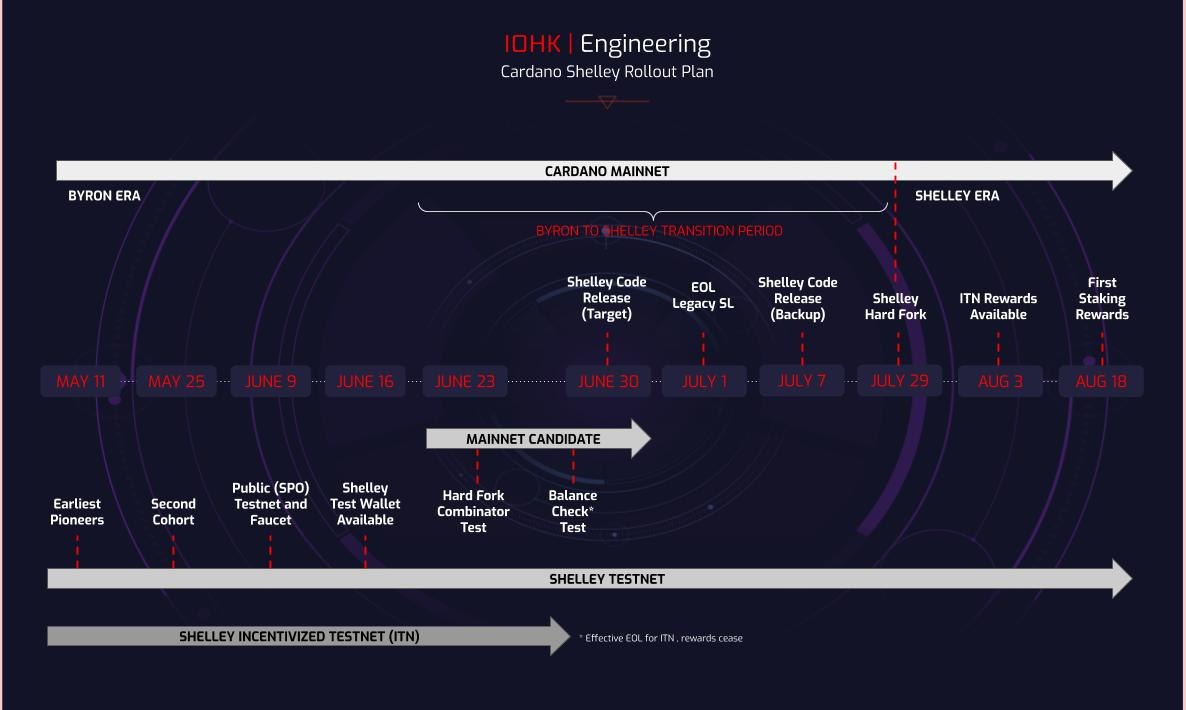
In the countdown to the Shelley mainnet launch at the end of this month, Cardano has released details of its staking reward system.
The amount of staking reward is determined by several factors, such as the number of staking pools in operation, the saturation of a delegated pool, and block production efficiency. At present, all elements are undetermined.
However, based on the default estimates of IOHK, users will receive 4.6% per annum.
Rewards from the Incentivized Testnet (ITN) were between 6% – 8%, depending on individual testnet staking pools. As such, news of a sub-five reward on mainnet is something of a blow for ADA holders.
In response to the announcement, one user wrote:
“Most people were predicting 6-10% and even Charles said in one of his AMAs it would be similar to the ITN. I’m happy with 6% but under 5.. better to sell and buy property.“
Another pointed out that the figure is notional; what’s more, 4.6% is still a better rate than any bank is currently offering.
Cardano Staking Walkthrough
Dr. Lars Brünjes, the Education Director at IOHK, gave an overview of the Cardano staking process, as well as a walkthrough of the staking calculator.
“How are rewards calculated? That happens on an epoch by epoch base. Every epoch, which lasts for five days, rewards are determined and paid to all participants.”
Each stake pool receives a reward determined by factors such as the ADA pledge of the pool, the margin operational costs of the pool, performance in terms of block production efficiency, and the amount staked with the pool.
After all the costs are subtracted, the remaining balance is split proportionally between all delegators.
Brünjes also spoke about the diminishing returns on pool saturation, this process lowers the reward payout if a pool becomes too big. This is currently set at around 0.66%. If a pool controls more than this of the entire stake, then rewards paid to that pool are reduced.
The idea is to incentivize stakers to move funds to smaller pools, in the hunt for better payouts, which also encourages greater decentralization of the network.
Brünjes mentioned that discussions with the community will take place after staking goes live. That way, feedback to change the system parameters can be made.
'A New Class of Attack' In Crypto Is 'Actively Exploited' - Research
The crypto market went through one of its wildest rides with the March market crash, among other events seeing a so-called "zero-bid" attack on MakerDAO, a decentralized lending facility built on the Ethereum (ETH) blockchain and the creator of the DAI stablecoin. A recent research, however, found a possible explanation behind the attack, putting a spotlight on the relevance of mempools and consequences of not monitoring their vulnerabilities carefully.
"Cryptolawyers take note--new fodder for your force majeure / material adverse exception event type contract clauses. Cryptoclients take note - does your lawyer know the ways a blockchain can screw up & leave you with unhappy potential litigants?," wrote today attorney Gabriel Shapiro.
Dan Elitzer, an investor at IDEO CoLab Venutures, stressed that the report contains "strong evidence of a new class of attack that all DeFi users (in fact, all blockchain users) will need to be aware of."
Meanwhile, commenters are calling for higher liability of each individual part of the crypto ecosystem.
As reported in April, the Maker Foundation faced a proposed class-action lawsuit by investors, claiming that it "intentionally and fraudulently" misrepresented the risks of the MakerDAO protocol to investors, as well as that some investors suffered a 100% collateral loss on Black Thursday.
These comments came today as a reaction to a report by blockchain transaction manager Blocknative, which stated that they have "uncovered evidence that the MakerDAO liquidations on March 12 and 13 were an engineered event."
They claimed that the evidence can be found in the mempool, the pre-chain area within the Ethereum ecosystem that miners use to create blocks, stating they captured over 30 million rows of data over the course of the massive crash on March 12, known as Black Thursday. What they found are "several 'vulnerabilities' that appear to have been exploited."
The report listed three major contributing mempool factors to the events on March 12 and 13:
Stuck Transactions — mempool congestion significantly increased stuck transaction rates, blocking subsequent transactions from the same address.
Mempool 'Compression' — a reduction in the marketable portion of the mempool (transactions with sufficient gas to be considered by miners), which can bias gas price estimates.
'Hammerbots' — automated transaction systems that magnified congestion, and therefore compounded mempool compression.
One of the consequences of this congestion were the now notorious 'zero bid auctions' on liquidated MakerDAO CDPs (Collateralized Debt Positions). These factors led to auctions (forced liquidation of large number of undercollateralized CDPs) to get stuck, essentially blocking the market participants and bots from participating in the 10-minute auction window and allowing the zero bid transactions to win out. 37% of liquidation auctions connected to Black Thursday were won by zero bids, resulting in the loss of USD 8.32 million in aggregated locked CDP value.
"The mempool is a critical – yet ephemeral and often overlooked – element of the blockchain ecosystem," the report stated, adding:
"At this stage, we do not know how often techniques like these are exploited in the wild – only that they appear to be actively exploited. And we do not know how many related exploits exist – only that sophisticated exploits appear to have been demonstrated to be effective in the real-world."

BTC.TOP Launches 'Joint Mining' Platform, Users Pay After Breaking Even
Crypto mining pool BTC.TOP, via its subsidiary B.TOP, now offers "joint mining" - enabling users to buy hash power, as well as pay the fees and share the profit once their revenue reaches the cost of the equipment they initially bought.
"We hope to lower the entry barrier for those who would like to mine but cannot purchase or operate the mining machines because of various limitations," Jiang Zhuoer, founder and CEO of BTC.TOP, was quoted as saying in a press release.
B.TOP provides a variety of services, including hardware procurement at cost price. The company will not charge a maintenance fee until the user has broken even, they claimed, with the mining revenue automatically being settled by the platform on a daily basis according to the BTC/USD exchange rate.
More specifically, the platform offers to purchase the latest generation mining machines at bulk order prices directly from the manufacturers, including Bitmain, MicroBT, Canaan, and Innosilicon.
Furthermore, stating that B.TOP has access to cheap electricity prices, B.TOP can provide access to its users to the low electricity prices of its industrial-scale mining operations at cost price, they said.
"When these accumulated net revenues are equal to the cost initially paid by the user to purchase the miner, the user enters into a profit-sharing phase with B.TOP," said the mining pool. This is when the platform will charge a percentage of the user’s net mining revenue as maintenance fee or service charge, between 17.5% to 30%. The exact percentage depends on the user's total initial investment.
Zhuoer added that B.TOP offers shares in a single miner at cost price. A single share is exactly one terahash (TH) of hashrate. So, if a user wants to purchase one share in an Antminer S19 miner that costs USD 2,628.65 and has a total hashrate of 95TH, the share would be USD 27.67.
Users also have a choice to either withdraw their miners from B.TOP’s data centers in order to have them shipped to a wanted destination, or re-sell their miners to B.TOP at any point for the latest market price.
Meanwhile, other services have been available for those users who do not possess mining equipment but want to mine as an investment, offering different options. For example, those who mine on NiceHash are selling hash power to buyers, who in turn can rent that hash power.
Another is Mining Rig Rentals, which also offers crypto mining rig hashpower rental service. Users can fund their account with one of five supported cryptoassets and rent their own rig, with refunds if a rig underperforms.
Another option is Hashtap that allows buying hashing power provided by zpool and redirects it to the pool of the user's choice.
HashNest claims on its website that it's one of the earliest companies to provide cloudmining services, hosting a number of brands of miners. There is also Bitcoin Pool, provided by Bitcoin.com, as well as a variety of other cloud mining options.
Russians in Yaroslavl, Kursk to Use Blockchain Voting in 2021 Election
Citizens in two more Russian regions are set to be granted the right to cast their votes on a blockchain-powered platform when the country goes to the polls in parliamentary elections next year.
Per media outlet Open Media, the Central Election Commission of Russia (CEC) has stated that residents of the Kursk and Yaroslavl oblasts will be able to make use of the platform – which made its debut earlier this year.
As previously reported, 1.14 million Russians used the platform to cast their votes in a recent referendum on constitutional reform in the capital Moscow, as well as the city of Nizhniy Novgorod. An earlier citizens’ vote on parking-related issues in Moscow also made use of the same platform.
A number of issues have been reported with the platform, however. The system crashed just after launch, initially unable to deal with the volume of traffic on the network. A voter managed to “spoil” their ballot and send a coded message on the network. And a media outlet reported that passport data on all 1.14 million voters was inadvertently made publically available on a state server.
Regardless, the CEC has called blockchain voting a success, and said that it intends to make improvements to the system ahead of a potential nationwide rollout.
The Kursk Oblast comprises the city of Kursk, as well as the surrounding area, and has some 1.12 million residents. The Yaroslavl Oblast, meanwhile, has around 1.27 million residents.
The CEC said that demand is already high for blockchain voting in both regions, with up to 60% of residents already eligible. To register, citizens will need to create accounts at local government-run websites.
The CEC added that it will look to address potential voting irregularities by ensuring that citizens who have registered to use the blockchain platform are not allowed to change their minds and instead decide to cast their votes at a polling station.

Battery Maker LG Chem Makes Blockchain-powered Sustainability Drive
LG Chem, one of the world’s biggest lithium-ion battery producers, said that it will build a blockchain-powered supply chain traceability platform for its battery products.
The firm, part of the wider LG Group of companies, said that it spent USD 92 million in a sustainability-based R&D initiative last year – and said that the new battery platform is one of the fruits of that investment.
Per Updown News, LG Chem stated that it invested more than 4% of its sales revenue for 2019 in a companywide sustainability drive that has focused on “mid- to long-term R&D projects, especially in the battery and bio sectors.”
LG Chem is one of the top five lithium-ion battery producers in the world, and is arguably the LG Group’s main money-spinner. Per a Research and Markets release last week, the global lithium-ion battery market was valued at USD 36.7bn last year. It is expected to reach USD 129bn by 2027, at a compound annual growth rate of 18% from 2020 to 2027.
Analysts say that a spike in electric vehicles and smartphone sales is expected to drive the growth.
However, the lithium-ion producing sector has come under fire from activists in recent years, with reports connecting the industry with widespread human rights abuses.
Last year, Amnesty stated that the industry was “linked to human rights abuses including child labor in the Democratic Republic of Congo (DRC), and environmental risks which could undermine their green potential.”
The organization called for battery makers to make “radical changes” to the way they operate.
LG Chem said it would use the platform to track and manage the supply chain of raw materials used in battery manufacture.
The firm stated that sustainability throughout the entire supply chain was the only way forward for companies in the industry.

Hack Forces Travel Company to Pay USD 4.6m in Bitcoin Ransom
A recent hack of a major travel management firm has reportedly left attackers with USD 4.6m worth of bitcoin (BTC), after the company on July 28 was forced to pay to restore access to internal files, Reuters reported, citing a record of the ransom negotiations.
The attack targeted up to 30,0000 computers belonging to the US-based travel management firm CWT with a type of ransomware known as “Ragnar Locker” that encrypts all files on a computer, rendering them useless until a ransom is paid, the report said.
And although the travel firm did shell out BTC 414, currently worth about USD 4.6 million, the original demand from the hackers was reportedly far higher at USD 10 million. “It’s probably much cheaper than lawsuits expenses, reputation loss caused by leakage,” a message sent from the hackers to a CWT representative said, according to Reuters.
The company representative, who said he communicated with the hackers on behalf of the chief financial officer, then managed to negotiate the ransom down to USD 4.5 million, the report further said.
“Okay let’s get this moving forward. What are the next steps,” the company representative asked in a message to the hackers, it added.
How Do Coinbase Loans Compare to Other Offers in the Market?
As major US-based crypto exchange and wallet provider Coinbase announced its plans to launch lending services in the US this fall, how they compare to what other industry players are already offering?
At this stage, details are scarce, however, the company revealed that their users will be able to borrow using bitcoin (BTC) as collateral. Also, they added that this service will allow users to borrow up to USD 20,000, representing a maximum of 30% of their BTC holdings, with an 8% annual percentage rate (APR).
Compared with other companies that offer loans backed by cryptoassets, Coinbase’s proposed terms seem to be more restrictive, with a lower maximum loan-to-value (LTV) rate (the aforementioned 30%), and the APR relatively high. Also, their competitors offer a wider selection of possible collateral.
In comparison, UK-headquartered Celsius Network offers a one-year USD 1,000 loan against BTC with a similar LTV rate of 33% with an APR of 2.77% if paid with its CEL token, and 3.95% if paid with fiat. The company also offers a higher maximum LTV rate than Coinbase (50%). Also, in other cases, APR can reach 5.67% if paid in CEL, and 7.95% if paid in fiat.
Next, US-based peer-to-peer crypto-backed loan platform SALT Lending offers loans of at least USD 5,000 with an LTV rate of between 30% and 70%. For a one-year loan backed by bitcoin in 30%, the APR is also lower than the one proposed by Coinbase, standing at 5.95%.
Competing major exchange Binance is already offering crypto loans. However, their users are able to borrow only in tether (USDT) and binance coin (BNB). If BTC is collateral, an initial LTV stands at 65%, while annual interest rate is 18.25%. A maximum single loan in USDT is 70,000.
Meanwhile, Coinbase said that they "hear from customers that they need cash for expenses like home renovations or car repairs, but they do not want to prematurely sell their crypto, or take out high-interest loans that could come with 20%+ APR."
"With portfolio-backed loans on Coinbase, customers can borrow cash quickly from their Coinbase accounts,” the exchange said yesterday, adding that their clients can "get the cash in their accounts within 2–3 days."
In the first phase of the service’s development, loans should be offered in 17 states across the US, including Alaska, Arkansas, Connecticut, Florida, Georgia, Illinois, Massachusetts, New Hampshire, New Jersey, North Carolina, Oregon, Texas, Virginia, Nebraska, Utah, Wisconsin, and Wyoming.
Slim Chance of New Russian Crypto Law Emerging in Autumn, Say Experts
Insiders say there is a chance that Russia’s new crypto law could be drafted by autumn – a move that would see a set of regulations in place for the start of next year. But one claimed that that chance of such a quick turnaround from policymakers is “low” – despite no shortage of industry input.
Maria Stankevich, head of development at the EXMO exchange, told that there was a “slight chance to see a better structured and written document” than draft laws issued back in May. The May draft law, met with horror by most of the industry, proposed something close to a China-style crypto crackdown, but has since been shot down by forces within the government.
Stankevich stated that the chances of a new bill had been increased because crypto firms had been so forthcoming with advice.
She said,
“The market, including EXMO, Binance and other independent organizations and companies have sent their own draft legal proposals to the State Duma. Basically, all the Duma needs to do is to unite all of these proposals. But we are sure that there is a low chance of seeing a final version of the draft law released during parliament’s forthcoming autumn session.”
Stankevich was speaking after, in an interview with Radio 1, Yuri Pripachkin, the President of the Russian Association of Cryptocurrencies and Blockchain, stated that policymakers could look to draft a new bill in autumn.
Pripachkin claimed that his organization would also prepare “an appropriate consultation document that will ensure that Russia does not lose its placing in the new digital world.”
The chief architect of Russian crypto law, the parliamentary committee’s financial markets head Anatoly Aksakov, has repeatedly spoken of an autumn timeline for a bill in recent weeks – although this seems unlikely to many observers, including Stankevich.
A standoff has pitched pro-blockchain and crypto advocates, the crypto industry and other pro-industry forces against the crypto-skeptic Central Bank of Russia. And that impasse still seems a long way from resolution. Only last month, the Central Bank called crypto investment a form of gambling that it said was on a par with roulette.
Trezor Fixes New Vulnerability, KeepKey Working On It; New Malware Targets Wallets
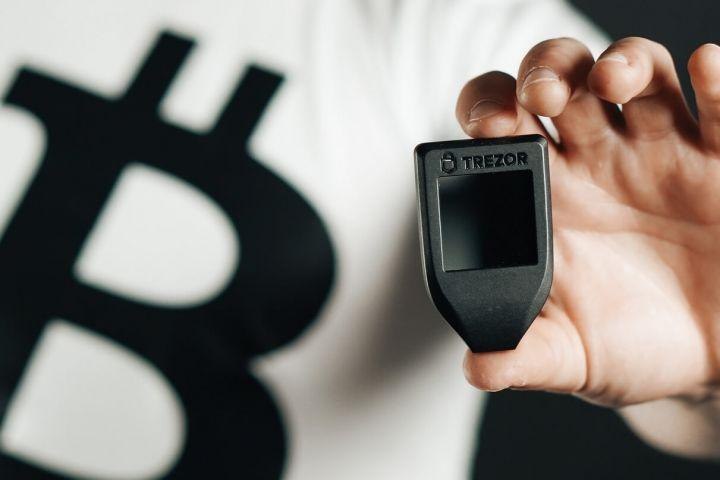
Swiss hardware wallet provider Shift Crypto said it has disclosed a vulnerability in the Trezor and KeepKey hardware wallets that could allow for potential ransom attacks – while a potentially nasty new malware strain is threatening to cause widespread wallet theft if left unchecked.
The vulnerability can potentially be exploited when users enter passphrases on their devices.
And researchers at cybersecurity firm ESET have discovered a previously undocumented trojan malware family which spreads through malicious torrents, and employs various multiple methods to wring as much cryptoassets as possible from its victims – while remaining undetected throughout.
Fixed, not fixed
SatoshiLabs, the maker of the Trezor hardware wallet, has paid a bounty fee to Shift Crypto, and said it has fixed the issue in recently released upgrades.
A Shift Crypto employee using the handle benma, who said he is one of the main developers of the BitBox02 wallet, wrote in a blog post that he successfully performed a remote attack on both wallets by interactively modifying Electrum running on the Bitcoin Testnet.
The developer said that, in order for users’ cryptocurrency to remain safe, it is “important that the hardware wallet validates any input it receives from the computer.”
He added,
“In this case, the passphrase should be confirmed with the user on the device before using it to derive the seed. The Trezor and KeepKey did not do this in the case of the passphrase entered on the computer.”
As such, a malicious actor could modify “data transferred via USB could send an arbitrary fake passphrase to the Trezor/KeepKey, and hold any coins received in this wallet hostage,” wrote benma, who added,
“The passphrase entered by the user could simply be ignored, and the actual passphrase used would be only known to the attacker.”
The author added that Trezor released a fix in Trezor One v1.9.3 and in Model T v2.3.3 devices on September 2. Benma added that he has also spoken to a representative from KeepKey. The latter reportedly said that the company has not designed a fix for the issue yet, and is instead “working on higher priority items first.”
'Triple threat'
Meanwhile, ESET, which has named the trojan malware family KryptoCibule, has called the malware a “triple threat in regard to cryptoassets,” as it uses its victims’ resources to mine coins, attempts to hijack transactions and extracts crypto-related files while using various techniques to avoid detection.
In a press release, Matthieu Faou, the ESET researcher who discovered the new malware family, said,
“The malware, as written, employs some legitimate software. Some, such as Tor and the Transmission torrent client, are bundled with the installer; others are downloaded at runtime. Presumably, the malware operators were able to earn more money by stealing wallets and mining cryptoassets than what we found in the wallets used by the clipboard hijacking component.”
Faou added that sophisticated work had obviously gone into the malware’s design. KryptoCibule uses the Tor network and the BitTorrent protocol as part of its communication infrastructure to stay under the radar. But mining and wallet theft were likely the malware makers’ key aims.
Crypto.com Aims for Its First Profitable Year Despite Asian Setback
Cryptoasset-power debit card and trading services firm Crypto.com said it is on track to end the year with its figures in the black for the first time in its history. But it will have to accomplish this feat without one of its key partners, after an accounting scandal involving the German card issuer Wirecard forced Crypto.com to halt an enrollment dive in Asian markets.
Kris Marszalek, CEO of the Hong Kong-based Crypto.com, told Bloomberg that his company was “really fortunate to be growing rapidly during this time of a global pandemic.”
He also noted,
“August was another record-breaking month for the company in terms of revenue and all transactional metrics.”
But the CEO conceded that Crypto.com is now “in the process of migrating away from Wirecard both in Asia and Europe.”
The Wirecard scandal involves a series of accounting irregularities dating all the way back to 2008 and partially exposed in 2015, involving what the Financial Times labeled a significant gap between the short-term assets and liabilities in Wirecard’s payment business operations. The scandal came to head earlier this month after the German parliament announced it would launch a probe into the firm and the state’s failure to prevent what it has termed widespread corporate fraud.
The Crypto.com chief stated that his firm is continuing to enroll new debit card users in Europe. However, rollouts have been put on hold in Asia until the firm finds a new partner in the region.
Previously known as Monaco (an ICO from 2017), the company acquired the Crypto.com domain in 2018. Monaco was already lead by Marszalek back then.
Crypto.com currently offers a metal Visa card with a cashback of up to 5% on all spending to its customers in Europe, the USA, and Singapore, with more markets to be added soon.
Building on the success of its crypto.com chain coin (CRO), which has become the 11th-largest cryptoasset, with a current market capitalization of some USD 2.9bn, the provider said it is developing a community around its token. It offers a range of cashbacks on purchases, promotions, discounts, and referrals that it thinks will to lure more people to the crypto sector.
Crypto.com has also been hosting competitions that it hopes will see increased crypto activity from its users. After listing the DeFi app Decentralised Information Asset (DIA) token on its platform this month, Crypto.com launched a campaign with a prize pool worth USD 20,000 in DIA tokens for users making DIA deposits.
Also in September, the company launched DeFi Swap, "a decentralized protocol deployed on the Ethereum blockchain" for swaping and "farming" DeFi coins.
The company claimed it had met key milestones for this year, including the launch of its wallet and initiating the shipment of MCO Visa cards in Europe, both of which took place in May. Crypto.com said that in the months ahead, it will look to launch of its Chain mainnet, as well as expand the MCO Visa card’s coverage to the Asia-Pacific region and Canada.
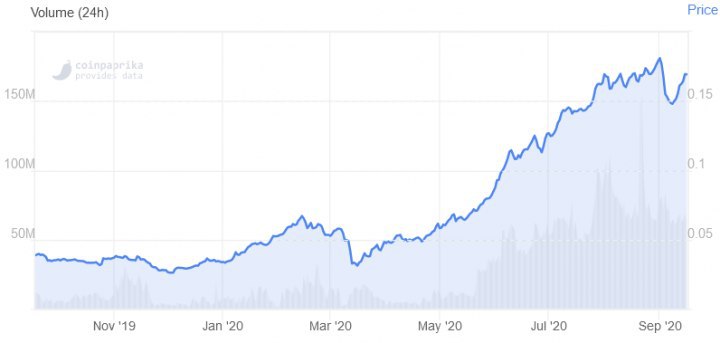
At pixel time (13:01 UTC), CRO trades at USD 0.169 and is down by almost 2% in a day, trimming its weekly gains to 13%. The price is unchanged in a month, while it rallied by 329% in a year.