A New Dawn: Dusk Network Daybreak Testnet Launches 1 February
In only another two weeks, Dusk Network will bring years of hard work to fruition. Years of developing bleeding-edge zero-knowledge cryptography have come to the point where the technology is about to be tested. The technology is a response to the current financial ecosystem, which Dusk Network believes must make way for a fairer financial system in the future - fully decentralised.
With the launch of Daybreak, the first cluster of nodes will support the Dusk Network, allowing its privacy blockchain to go live. Those who will lead the way and run the first nodes, also known as ‘provisioners’, will be experts who are on-boarded from the community.
However, the Dusk Network community has a lot of enthusiastic supporters who would love the chance to back the project by running a node.
In fact, a Dusk spokesperson said that there were over 700 signups to run a Dusk node from enthusiasts in just one day. According to the team, those from the community who can demonstrate a certain level of expertise will be the first provisioners, but once they have paved the way, the rest of the community who have signed up, will be on-boarded on an on-going basis, based on their profiles and signup dates.
There is much conversation happening in the crypto space as regards zero-knowledge cryptography, and Dusk Network is certainly pioneering the way in this respect with their unique L1 blockchain.
The smart contracts on the Dusk Network blockchain will be privacy-preserving, meaning that the user will keep their identity and transactional data private.
Only the two parties on either side of a transaction will be able to see the data they need to see. They will be able to see a ‘viewkey’ of their data and will be able to use this to decrypt the transaction.
Normally, the transactions made on a blockchain are visible on a block explorer, but in this case the actual amount of each transaction and the transaction inputs will remain completely invisible, thereby completely preserving the privacy of the user and their activity.
Right to privacy is not only for the individual but equally for enterprises. The power of permissionless smart contracts, together with technology that is compliant with GDPR and financial directives should pave the way for a fairer future for finance - Dusk Network is making that happen.

Renowned Photographer And Videographer Paul Nicklen Joins ‘SAVAGE’ To Highlight The Eco-Friendly Possibilities Of NFTs
Photography and NFT marketplace 'SAVAGE' continue to push this industry's boundaries. Expanding the team with legendary photographer and videographer Paul Nicklen brings more legitimacy and appeal to the project. Nicklen will be a contributor and advisor to the project.
Fans of photography and videography will be familiar with the name Paul Nicklen. The Canadian filmmaker and marine biologist has documented the beautiful parts of our planet for over two decades. Additionally, he lives a life of art, purpose, and adventure while proudly advocating for conservation efforts to protect our home.
Nicklen made a name for himself by becoming an assignment photographer for National Geographic magazine and Sony Artisan of Imagery. Paul built a loyal and global audience looking forward to his future creative works through his portfolio. Additionally, his expertise in the field makes him one of the world's leading polar specialists and conservationists. However, he had no real interest in the NFT space until rather recently.
Growing concerns over the negative environmental impact of non-fungible tokens have awakened something in Paul Nicklen. Research by Memo Atken indicates a single-edition NFT's carbon footprint is the same as driving a petrol car for 1,000 km. However, the benefits and solutions the 'SAVAGE' marketplace brings to the table can change even the mind of Paul Nicklen.
Standing out among other non-fungible token marketplaces and platforms requires a unique mindset. The focus on photo and video is a worthwhile venture, but not the only reason why 'SAVAGE' attracts such attention. The platform also notes strong partnerships with Polygon Studios, the Crypto Climate Accord, and Energyweb. All parties share the same vision: reducing - or nullifying - the carbon footprint of decentralized applications in the NFT industry.
Through Polygon's Proof-of-Stake consensus blockchain, 'SAVAGE' can benefit from a massively reduced footprint over networks like Ethereum, which rely on Proof-of-Work. Moreover, the guidance by Crypto Climate Accord and EnergyWeb facilitates any carbon offsets as they become necessary.
To date, the 'SAVAGE' team has established the world's first carbon-neutral NFT marketplace for 8k video and the highest resolution photography. Paul Nicklen is known for his 8k video footage, which will find a good home on the 'SAVAGE' platform.
Nicklen will become an advisor to 'SAVAGE' and contribute content to the platform, per the announcement on his Instagram page. Partnerships and team expansions like these are the lifeblood of bringing non-fungible tokens to the mainstream.

Has The Crypto Market Reached A Bottom?
Bitcoin hit a low of $33,000 on Monday. A bounce has seen it get back above $36,000. Is the low now in, or is this just a short sideways movement before continuing the plunge to $30,000?
The Federal Reserve holds its first FOMC meeting of the year today. What comes out of this two-day meeting could cause a big reaction in world markets. Fed chairman Powell goes into the meeting on the back of a particularly hawkish promise to end tapering quicker, and to impose at least three rate hikes this year.
Should Powell stick to his guns, then the stock market is going to face a lot of downside pressure, and crypto, considered a leading indicator for macro markets by some, could well take another leg downwards. A decisive break of the $30,000 resistance would likely see bitcoin heading back down to $20,000, a level not seen since the market top of 2017 which turned this level into support.
However, that worst case scenario is probably not likely yet. At least in the short term. Powell could still come out of the meeting tomorrow and convey more of a dovish tone, given that a lot of steam has already evaporated out of the markets.
According to Gareth Soloway, who appeared on Crypto Banter on Monday, the Fed is between a rock and a hard place. He thinks the Fed will only be able to raise interest rates a couple of times at most, given that this is likely to throw markets into a tailspin.
For bitcoin, it looks like it is very oversold right now. Just talk from the Fed of raising rates has seen the number one crypto currency fall quite dramatically. We are now at a point where the RSI looks to have bottomed, or to be nearing the bottom, on all higher time frames.
Leverage in the system is still way too high though and many experts, including Soloway, believe that a bounce from here to around $46,000 is likely, but that the leverage still needs to be flushed out.
Perhaps Soloways’s prediction that bitcoin will fall to sub $20,000 will signal absolute capitulation, and allow the crypto market to recover and continue its upward trajectory on a more solid technical structure.
Fed Puts Damper On Crypto Market Bounce After FOMC Meeting Announcement
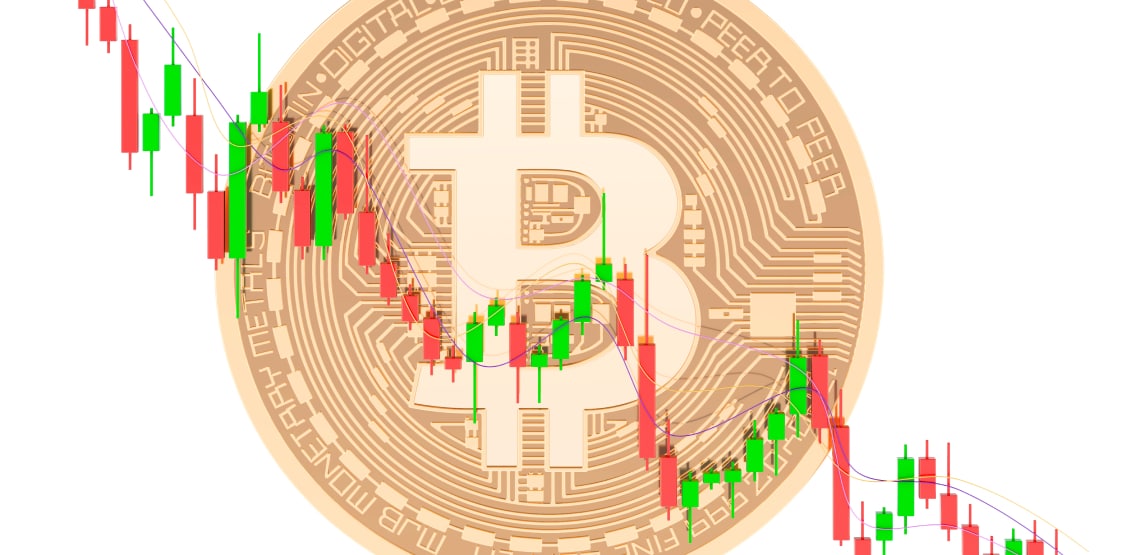
After a very severe crypto market plunge resulting in bitcoin sliding to $33k from $69k in only a matter of 12 weeks, and a fall across traditional stock markets, all eyes were on Jerome Powell as he made his announcement after the FOMC meeting.
The crypto market had bounced nicely after bitcoin seemingly found a possible bottom at $33,000. Technical indicators were signalling the potential bottom and bitcoin, perhaps having found it, rose 16.7% over the last four days.
Good reverses from potential bottoms were also prevalent across the rest of the cryptocurrency sector, with ethereum up 23%, solana up 26%, and avax up 37%, among the larger cap cryptos.
For this to not be a dead cat bounce, and for the crypto market to be able to attempt to disrupt and turn the downward trend around, good news needed to be heard from Fed chairman Powell.
As it turned out, what Powell said was pretty much in line with what was expected. He talked about reserving the right to change Fed policy as it was needed, in response to evolving market conditions, but the first interest rate looked to still be on for March, although Powell would not be drawn on the size and frequency of rate hikes.
He mentioned how wages were climbing across the jobs markets, and how supply bottlenecks were adding to the uncertainty, but he felt that this was now easing. He mentioned the massive Fed balance sheet but looked uncomfortable when he explained that his board would not address the unwinding of this, at least until rate hikes had started.
As Powell answered questions from the hand-picked audience, the DXY Dollar Index spiked, which signals a stronger dollar and conversely should result in blunting the price rises seen across stock markets and, perhaps causing more downside, at least in the short term for crypto.
Currently, bitcoin is down over the last hour. It has lost around 3% since the commencement of the speech. Most of the crypto market is still in the green, but the next few hours and the daily close will perhaps tell a different story of where crypto is going next.
Powell didn’t really say anything new, so in theory what happens now should be already baked in. It might be said that Powell avoided giving any clear information, and he appeared to be reserving the right to completely negate any future promises. In short, it looked as though the Fed would be reactionary rather than stick to a clear plan.
PsyOptions Acquiring Tap Finance Is A Crucial Milestone For Decentralized Options Trading On Solana
The Solana blockchain is home to some interesting and exciting decentralized finance opportunities. For example, solutions like Tap Finance and PsyOptions go beyond traditional liquidity provision and yield farming. Instead, they provide exposure to cryptocurrency-related options, tapping into a significant market.
The concept behind PsyOptions is rather interesting. The options protocol on the Solana blockchain uses physically settled contracts. Following a recent IEO on FTX and Gate.io - and subsequent listings for spot trading of $PSY - the protocol now looks to expand its footprint. The acquisition of Tap Finance and its Decentralized Options Vault (DOV) technology puts a different spin on the options trading industry.
The main appeal of PsyOptions is how it provides exposure to options "the American way". However, its upcoming undercollateralized options protocol borrows elements from the European market model. PsyOptions will also serve as the main settlement layer and clearinghouse for Decentralized Options Vault when it launches on the Solana blockchain. Acquiring Tap Finance is a crucial step toward becoming the go-to on-chain financial services provider for DeFi enthusiasts globally.
"Our team is extremely excited to bring Tap under the PSY DAO to lead structured products. This deal isn't just great because of these incredible developers and people, we are also quickly expanding the PSY DAOs geographical footprint to increase censorship resistance and create an ecosystem with no bounds. We've created an incredible roadmap together, and have already begun executing!"
More importantly, the acquisition lets PsyOptions - and PsyFinance, formerly Tap Finance - leverage options-based yield solutions by combining PsyOptions' and Tap Finance's native technology stack into one robust infrastructure. Furthermore, the team can now effortlessly spin up new vaults tied to specific crypto assets when there is sufficient user demand.
The Decentralized Options Vault concept currently provides PsyOptions users with exposure to BTC, ETH, SOL, stSOL, FIDA, USDT, USDC, and PAI. Additionally, users can benefit from Covered Call and Secured put strategies, two automated options strategies generating revenue.
The European architecture powering future PsyOptions' products will benefit the upcoming revamp of the Decentralized Options Vault. Version two of this product is under development and will help increase the capital efficiency of the protocol. In turn, that will provide better yield for all users leveraging the protocol's automated options strategies. Moreover, the DOV v2 will feature liquidity mining initiatives, introducing another revenue stream for users.
The transition from 100% collateralized and asset-settled American-style options to undercollateralized cash-settled European-style options marks a significant milestone for the Solana DeFi ecosystem. It also highlights the versatility of this ecosystem and the products built on top of it. The acquisition of Tap Finance by PsyOptions confirms decentralized finance can cater to a more mature and institutional-level crowd.

Russia’s Finance Ministry Wants To Give Crypto A Chance
The Ministry of Finance has proposed to only regulate cryptocurrency in the country, claiming that banks could be authorized to provide crypto exchange services. The Russian government is also leaning in favor of legalizing crypto assets instead of banning them. However, the country’s central bank holds a drastically opposite view and wants to ban all cryptocurrencies.
Even though both the Russian Ministry of Finance and the Bank of Russia agree that crypto should not be made a legal tender, they both differ on opinions on whether crypto should be legal assets. The Ministry of Finance has proposed new regulations that would grant certain banks a universal license to trade cryptocurrencies in a strictly controlled environment. Additionally, the proposal also claims that all parties involved in the crypto market would need to be licensed. Crypto investors would be individually recorded under intense KYC processes and anti-money laundering guidelines. Furthermore, crypto transactions are to be taxed and perpetrators would be tried under criminal law.
The Minister of Finance Anton Siluanov has reportedly written to Prime Minister Mikhail Mishustin presenting his case for legalizing cryptos as financial assets. The Ministry is aiming to legalize around $26 billion worth of cryptocurrencies held by the entire population of Russia, claiming that the amount constitutes a sizeable percentage of the entire population’s total savings.
The Bank of Russia, on the other hand, has taken a complete u-turn from its previous, more crypto-accepting stance. On January 20, the bank published a report detailing the threats to financial stability, monetary sovereignty, and environmental concerns and called for a complete ban on cryptocurrency use and mining within Russian borders. However, back in December, the bank had announced that they intended to regulate the crypto industry rather than ban it outright.
Several other officials and institutions have opposed the central bank’s latest proposal to completely ban cryptocurrencies. Former president and prime minister of Russia, Dmitry Medvedev, has pointed out that a stern anti-crypto policy could backfire and bring about the opposite result. The State Duma has also protested against the proposal to ban cryptos and is actively working on a new crypto law.
The Minister of Digital Development Maxut Shadayev has reportedly said that any restrictions on the issuance and circulation of cryptocurrencies would halt the development of the blockchain industry and create roadblocks in the country’s growing IT sector.
In a virtual speech on January 26, Russian President Vladimir Putin has admitted that the country holds competitive advantages in crypto mining due to its cheap power sources. He stated,
“The Central Bank does not stand in our way of technical progress and is making the necessary efforts to introduce the latest technologies in this area of activity. I would ask both the Government of Russia and the Central Bank to come to some kind of unanimous opinion.”

Bitcoin, Ethereum Technical Analysis: Bitcoin Hits $43,000 After Tesla Announcement
Following a strong weekend, bitcoin’s surge continued to start the week, as Tesla announced close to $2 billion worth of holdings in BTC. Overall, crypto markets were around 3% higher on Monday.
Bitcoin, which consolidated for the majority of last week, moved closer to a three-week high today, climbing by as much as 3% as of writing.
BTC/USD rose to an intraday high above $43,500.00 during Monday’s session, as markets reacted to the news that Tesla currently holds $1.9 billion in bitcoin.
The move came as bitcoin marginally broke out of its resistance level of $42,060 for the first time since January 21.
As of writing, the RSI also climbed to a high point, tracking above its long-term ceiling of 60, which it last hit in mid-November.
Monday’s move has also led to a crossover of the 10-day (red) and 25-day (blue) moving averages, which many long-term bulls have been waiting for.
Bulls may take this as a sign to add more upward pressure to prices, with some targeting $45,000 as the next point of profit taking.
ETH was also tracking at multi-week highs on Monday, as bulls continue to flock to the world’s second largest cryptocurrency.
As of writing, ETH/USD climbed to a high of $3,111.16 today, after trading at $2,965.43 less than 24-hours ago.
Overall, ethereum is up over 20% in the last week, coming as its 14-RSI broke beyond two key resistance levels in that time.
The first break came after a break above 44 on February 3, followed by Saturday’s surge above the 55 ceiling.
These moves have created a shift in both the 10-day and 25-day moving averages, which, similar to BTC, is set for a crossover.

RBI: Cryptocurrency Is a Big Threat to Macroeconomic and Financial Stability in India
The governor of India’s central bank, the Reserve Bank of India (RBI), has reiterated his concerns that cryptocurrency is a “big threat” to the country’s financial and macroeconomic stability. He also warned investors of the risks of investing in crypto, stating this type of investment has no underlying value.
Reserve Bank of India (RBI) Governor Shaktikanta Das said during a press conference Thursday that cryptocurrency is a major threat to India’s macroeconomic and financial stability.
Referring to any crypto not backed by the central bank as “private cryptocurrency,” Governor Das was quoted by local media as saying:
Private cryptocurrency, or whatever name you call, is a big threat to our macroeconomic stability and financial stability.
He explained that any cryptocurrencies with currency-like property will undermine the RBI’s ability to deal with financial and macroeconomic stability issues.
The central bank governor proceeded to warn investors about the risks of investing in cryptocurrencies. Referring to the Dutch tulip bulb market bubble in the 17th century, he cautioned:
Investors in cryptocurrency should keep in mind that they are investing at their own risk. They should also keep in mind that the cryptocurrency has no underlying, not even a tulip.
Das noted that the RBI’s position is very clear on crypto. He said in early January that cryptocurrencies are “prone to fraud and to extreme price volatility, given their highly speculative nature.” The governor stressed: “Long-term concerns relate to capital flow management, financial and economic stability, monetary policy transmission, and currency substitution.”
In December last year, the RBI urged the Indian government to completely ban cryptocurrency, stating that a partial ban will not work. However, the government is still consulting with various stakeholders to come up with an appropriate crypto policy.
Meanwhile, the RBI is working on a central bank digital currency (CBDC), the digital rupee. India’s finance minister, Nirmala Sitharaman, announced last week during her budget speech that the digital rupee will be issued in the financial year 2022-23.
Russian Regulators Find Common Ground — Bitcoin Can’t Be Used for Payments
Russian authorities are yet to reach full consensus on the future of cryptocurrencies but government institutions are on the same side of the fence in their intention to ban bitcoin payments. Other operations with digital assets are to be legalized and regulated, representatives of Russian business have revealed.
The Central Bank of Russia, the Ministry of Finance and the government have converged on the question of how to regulate Russia’s crypto space. Decentralized digital currencies will not be accepted as a means of payment, the head of the Russian Union of Industrialists and Entrepreneurs (RSPP) Alexander Shokhin told reporters following a meeting devoted to digitalization.
Last month, Bank of Russia urged for a wide-ranging ban of crypto-related activities, including their use in payments, exchange and mining. The hardline policy proposal was met with opposition from other institutions, including the finance ministry which came up with its own vision of how cryptocurrencies should be treated. Siding with the treasury’s stance, the federal government adopted a plan which favors regulation over prohibition.
“It is already clear that both sides in this discussion have generally come closer. In particular, if we are talking about prohibitions, then that is rather about a ban on the use of cryptocurrency as a means of payment, while other aspects are subject to regulation,” Shokhin was quoted as saying by the daily Izvestia. According to the government-approved regulatory concept, coins can be bought, exchanged, and sold, the report notes.
Vladimir Potanin, co-chairman of RSPP’s Coordinating Council and president of Nornickel, noted that the regulatory bodies are still seeking agreement on the details of Russia’s crypto framework but he emphasized that all of them support a ban on the use of cryptocurrency as a legal tender.
“The business community has reached an understanding with the government, the central bank and lawmakers that cryptocurrencies are more complicated and difficult to regulate than digital financial assets,” the billionaire elaborated, quoted by Forklog.
While regulating certain aspects of the crypto economy such as the issuance of tokens, the Russian law “On Digital Financial Assets,” which went into force in January of last year, left many unanswered questions. A working group at the State Duma, the lower house of parliament, is now preparing legislation to fill the gaps.
A new law introducing comprehensive rules for the circulation of cryptocurrencies in Russia, based on the finance ministry’s proposals, is expected by Feb. 18. Earlier this week, the chairman of the Financial Market Committee Anatoly Aksakov announced that a draft is already on his desk. Deputies plan to adopt it during the spring session of the Duma.
New York Stock Exchange Files Trademark for Offering Trading Services in the Metaverse
The New York Stock Exchange (NYSE) has registered a trademark application to offer digital currency and NFT trading services in the metaverse. The application, filed on February 10th, constitutes the first foray of the company into the concept of the metaverse. The organization might be competing with other exchanges and established NFT marketplaces in the future.
The New York Stock Exchange (NYSE) is one of the first bourses in the world seeking to anticipate the rise of virtual worlds and the business opportunities associated with them. The company filed a trademark application on February 10 to offer trading services using augmented and virtual reality tools, this meaning that the NYSE might be thinking of opening a metaverse-based trading platform.
The applications mention several keywords, including:
Downloadable virtual reality, augmented reality, and mixed reality software; downloadable software for enabling users to experience virtual reality and augmented reality visualization, manipulation, and immersion.
The filings also mention the technology for offering trading services for NFTs and digital currencies. This would put NYSE as a direct competitor to other already established markets such as Opensea and Rarible. According to Michael Kondoudis, a trademark lawyer, this is proof of the importance of the metaverse as part of the business model of the financial institution. He stated:
This filing is the latest confirmation that the metaverse is real and businesses need to plan accordingly. Businesses no longer need to wonder if it is going to happen. It is just a matter of when.
Companies are rallying to offer their services in the metaverse to gain advantage as first movers. This is the opinion of Kondoudis, who has reported several similar applications of companies trying to push their presence into these burgeoning virtual worlds. He stated:
The NYSE is clearing taking a proactive, forward-thinking approach to ensure that it is the leading financial exchange in the metaverse.
Other financial companies also seem to be taking the metaverse seriously. This is the case with JPMorgan, one of the biggest investment banks in the world, that just recently opened a lounge in Decentraland, a metaverse-based platform.
This week, Victoria’s Secret, the famous lingerie company, also filed several trademark applications to offer its products in virtual worlds as NFTs.
Keep Your Coins Act: US Lawmaker Introduces Bill to Protect Privacy in Cryptocurrency Transactions
A U.S. congressman has introduced the “Keep Your Coins Act” in order to “preserve Americans’ right to privacy in transacting with crypto assets.” The lawmaker says, “this legislation would prohibit any federal agency from promulgating a rule that would impair a person’s ability to act as self-custodian.”
The office of Congressman Warren Davidson (OH-R) announced Thursday that the lawmaker has introduced the Keep Your Coins Act “to protect transaction privacy.”
The announcement explains that the proposed legislation is “designed to preserve Americans’ right to privacy in transacting with crypto assets,” adding:
Specifically, this legislation would prohibit any federal agency from promulgating a rule that would impair a person’s ability to act as self-custodian.
“A person would then be able to conduct peer-to-peer transactions with their crypto assets without the need to utilize a third-party intermediary,” the announcement continues. “This would essentially cut out any need for a financial institution or money service business to facilitate a transaction.”
The lawmaker from Ohio detailed: “As the federal government seeks more regulation of the crypto ecosystem, it seeks to impose more surveillance over American citizens. It’s vital that we preserve the attributes of cash transactions by protecting the permissionless nature of cash.” Rep. Davidson stressed:
No third party should be required for two people (or companies) to use money as a means of exchange, store of value, and record of account. This bill ensures that individuals will always have the ability to transact without any intermediaries.
Davidson announced his intention to launch the bill Tuesday after Canadian Prime Minister Justin Trudeau invoked the Emergencies Act. One of the measures afforded by the Canadian act is for banks and financial service providers to be able to “immediately freeze or suspend the account of an individual or business” affiliated with the Freedom Convoy protests without a court order.
Commenting on the Emergencies Act announcement, Davidson tweeted Tuesday: “Our office will be introducing legislation in the U.S. House of Representatives shortly to protect Americans from this version of overt theft.”
Huobi Co-Founder: We’re at Early Stage of Bitcoin Bear Market, Next Bull Run Expected in 2024
The co-founder of crypto exchange Huobi has shared his view about the current state of the bitcoin market and when the next bull run will be. “We are now at the early stage of a bear market,” he said, expecting the next bitcoin bull market to be around the end of 2024 or the beginning of 2025.
Du Jun, co-founder of cryptocurrency exchange Huobi, discussed when the next bitcoin bull market might be in an interview with CNBC, published Sunday.
The exchange executive explained that bitcoin bull markets are closely tied to the halving, which occurs every 210,000 blocks or approximately every 4 years. The next one will take place in 2024.
He detailed that the last halving took place in May 2020, and bitcoin topped an all-time high above $68,000 in 2021. Similarly, the halving that took place in 2016 saw BTC hitting a record high the following year. The price of bitcoin then tumbled after hitting record highs.
Noting that bitcoin has fallen about 40% since its all-time high in November last year, Du was quoted by the news outlet as saying if the pattern continues:
We are now at the early stage of a bear market … Following this cycle, it won’t be until end of 2024 to beginning of 2025 that we can welcome next bull market on bitcoin.
Nonetheless, he admitted: “It is really hard to predict exactly because there are so many other factors which can affect the market as well — such as geopolitical issues including war, or recent Covid, also affect the market.”
A number of people believe that we are in a crypto winter, including the analysts at Switzerland’s largest bank, UBS, who recently warned of a crypto winter amid expectations of Fed rate hikes and regulation. Last week, veteran trader Peter Brandt also pointed out that bitcoin’s price corrections “can be lengthy.”

India Unveils Guidelines for Crypto Advertising
The Advertising Standards Council of India has released guidelines for the advertising and promotion of crypto assets and related services. “We had several rounds of discussion with the government, finance sector regulators, and industry stakeholders before framing these guidelines.”
The Advertising Standards Council of India (ASCI) published Wednesday “guidelines for advertising and promotion of virtual digital assets and services.”
The guidelines are applicable to all advertisements related to virtual digital assets (VDA) which are “commonly referred to as crypto or NFT non-fungible token products,” ASCI explained.
ASCI Chairman Subhash Kamath described:
We had several rounds of discussion with the government, finance sector regulators, and industry stakeholders before framing these guidelines.
Firstly, all crypto-related ads must carry the disclaimer that states: “Crypto products and NFTs are unregulated and can be highly risky. There may be no regulatory recourse for any loss from such transactions.” The guidelines explain how the disclaimer must be made to ensure that “it is prominent and unmissable by an average consumer,” India’s advertising authority noted.
Secondly, the guidelines detail:
The words ‘currency,’ ‘securities,’ ‘custodian,’ and ‘depositories’ may not be used in advertisements of VDA products or services as consumers associate these terms with regulated products.
In addition, ads may not feature a minor or someone who appears to be a minor.
Advertisements must neither claim to be a solution to money or other problems nor promise a guaranteed future increase in profits. “Information on past performance shall not be provided in any partial or biased manner. Returns for periods of less than 12 months shall not be included,” ASCI added.
Noting that ads should not downplay the risks associated with the asset class, the advertising watchdog wrote: “VDA products may not be compared to any other asset class which is regulated.”
The guidelines also address celebrity endorsement. “Celebrities or prominent personalities who appear in VDA advertisements must take special care to ensure that they have done their due diligence about the statements and claims made in the advertisement, so as not to mislead consumers,” ASCI said, elaborating:
The guidelines will be applicable to all advertisements released or published on or after the 1st of April 2022.
“Advertisers and media owners must also ensure that all earlier advertisements must not appear in the public domain unless they comply with the guidelines, post the 15th of April 2022,” ASCI noted.

Backed by genius Blizzard artist Ken West (League of Legends, Call of Duty, Overwatch…), Elite Wolf Society has been on Twitter for 5 days and is already taking the NFT space by storm with more than 30k followers already!
With a VERY strong, fully doxed founding team, and a great number of senior investors backing the project, we can only guess how far this collection will go.
Here are the main reasons why you should follow up on EWS:
✅
✅
✅
✅
✅
Check their roadmap here -> elitewolfsociety.com
Make sure to join their discord -> https://discord.gg/RSDbStUVP2
⚠️ As they want a truly exclusive and influential community, the supply will be strongly limited.
With a VERY strong, fully doxed founding team, and a great number of senior investors backing the project, we can only guess how far this collection will go.
Here are the main reasons why you should follow up on EWS:
✅
The Society is a private, exclusive network dedicated to the success of its members✅
It offers great business and investment opportunities✅
You can benefit from real access to their global, worldwide network, and get mentored by successful business moguls✅
Your project can (and very well may be) funded by their private community fund dedicated to in-community investment✅
A 100 000$ transfer to the wallet address owning the ultra legendary NFT of the collection.Check their roadmap here -> elitewolfsociety.com
Make sure to join their discord -> https://discord.gg/RSDbStUVP2
⚠️ As they want a truly exclusive and influential community, the supply will be strongly limited.

Valve CEO Gabe Newell Praises NFT Technology, Criticizes Bad Actors
Gabe Newell, founder and CEO of Valve, a popular company in the PC gaming market, has revealed his take on crypto and NFTs when applied to games. In an interview with gaming media, Newell validated the NFT technology that makes it possible to create these digital representations. However, he also stated that the actors in the sector tend to be involved in criminal activities.
Gabe Newell, CEO and founder of Valve, owners of Steam, one of the largest digital distribution markets in the PC industry, offered his thoughts regarding the NFT phenomenon and the people behind it. In an interview offered to Rock, Paper, Shotgun, Newell made a clear distinction between the technology that powers NFTs and the people that are currently in the industry promoting it.
To validate the technology behind NFTs, Newell stated:
You have to separate the underlying technology versus which actors are utilizing that technology. It’s like if you’re a chemist, and you’re looking at nitrocellulose, you’re like ‘Oh, yeah, we can do some really interesting stuff with that’ … The underlying technology of distributed ledgers, and the notion of digital ownership, and shared universes, are all pretty reasonable.
However, this seems to conflict with opinions some in the gaming community hold about the use of NFTs, and the stance Steam has taken regarding games built on these technologies. Some in the industry have attributed the backlash as part of a general lack of knowledge about these tools. This is the case with an executive of Ubisoft, who stated he believes gamers don’t understand the benefits of adopting NFTs.
The vision that Newell has about the people currently in the NFT industry is less positive. On this matter, Newell stated:
The people in the space, though, tend to be involved in a lot of criminal activity and a lot of sketchy behaviors. So it’s much more about the actors than it is about the underlying technology or the rationale for what we’re doing.
Newell also talked about the issue of Steam accepting crypto payments for its services. It was one of the first to include bitcoin as a payment method, but it suspended this option back in 2017 due to the rise in fees and the volatility of the price of bitcoin. Newell also touched on this subject, stating:
At one point Steam was accepting cryptocurrencies for payments. And it turned out that it just made customers super mad. There was the issue of volatility. Volatility is a bad thing in a medium of exchange.
Also, Valve’s CEO concluded by saying that the “vast majority” of the transactions made with cryptocurrency on Steam were fraudulent, with people using “illegal sources of funds.”
Breaking: Ukraine Announces Airdrop As Crypto Aid Crosses $50 Mln
The Ukraine Government said on Tuesday it would airdrop crypto donated to the country’s official wallet, as donations crossed $50 million.
The country’s official twitter handle said an airdrop was confirmed, and that a snapshot would be taken on March 3, at 6 pm Kyiv time (4 pm GMT).
An airdrop is an event where a growing blockchain project releases free tokens to members of its community, usually as a promotional tactic. The move is used to boost engagement with said platform.
Airdrops have also gained traction in the NFT community since last year. Members of the OpenSea NFT marketplace recently received a free Ethereum-based token called $SOS.Given that the Ukrainian government has been accepting donations in bitcoin, ethereum and tether since the beginning of the Russian invasion, it was not immediately clear what assets would be distributed.
https://coingape.com/breaking-ukraine-announces-airdrop-crypto-aid-crosses-50-mln/
CoinGape
Breaking: Ukraine Announces Airdrop As Crypto Aid Crosses $50 Mln
The Ukraine Government said on Tuesday it would airdrop crypto donated to the country's official wallet, as donations crossed $50 million. The country's of
Rich Dad Poor Dad’s Robert Kiyosaki Advises Investors How to Profit From Inflation
The famous author of the best-selling book Rich Dad Poor Dad, Robert Kiyosaki, has given some advice on how to profit from inflation. Bitcoin is part of his strategy. He also praised the Ukrainian government for standing up to Russian President Vladimir Putin.
The author of Rich Dad Poor Dad, Robert Kiyosaki, has advised his 1.8 million Twitter followers how to profit from inflation.
Rich Dad Poor Dad is a 1997 book co-authored by Kiyosaki and Sharon Lechter. It has been on the New York Times Best Seller List for over six years. More than 32 million copies of the book have been sold in over 51 languages across more than 109 countries.
Kiyosaki tweeted Friday:
How to profit from inflation. Biden wants inflation. I counter his criminal actions by investing in Texas and N. Dakota oil. Just bought a gold mine in Utah. Investing in Texas apartments, houses. Saving gold, silver, bitcoin … Invest like a capitalist.
Kiyosaki has previously warned about inflation on several occasions. He blames President Joe Biden, his administration, and the Fed for destroying the dollar. Last year, he also warned about an imminent depression.
In November, he similarly said he was buying more gold, silver, bitcoin, ethereum, rental real estate, and oil as concerns about inflation escalated.
The famous author has also spoken up a few times recently about the Russia-Ukraine war.
He tweeted last week: “Putin in trouble. Ukraine’s President Zelensky … is fighting back against Putin. He’s not running. He is inspiring people to fight back.” In a follow-up tweet, he wrote:
Bitcoin defies Putin. Let’s go bitcoin. Let’s go crypto. Stand up to tyrants. Stand up to tyranny. Fight back.
The Ukrainian government began asking for cryptocurrency donations on Feb. 26.
According to blockchain analytics platform Elliptic, the Ukrainian government and a nonprofit organization providing support to the Ukrainian military have raised almost $60 million in crypto donations since Russia began its invasion of Ukraine.

NEW NFT DROP🚀💣
The real life Ready Player One.
Are you ready to enter the Astroverse?
💥 Astrominers is a collection of 8,888 NFTs
🎨 Made by famous artists
🌎 Collection that gives back to the earth
💧 For each NFT sold, one water-bund will be created
🚀 On THE ETHEREUM BLOCKCHAIN
☠️ Game in the Metaverse in partnership with well-known gaming company
⚠️⚠️1 NFT and 10 WL Giveaway ! ⚠️⚠️
To enter:
1️⃣ Like, Share and Follow our socials (Open ticket and send proof)
2️⃣ Join our Discord (link is below)
3️⃣ invite a friend on our discord (each invite is an extra entry 😉)
👀Join our Discord to change your life vision!
https://discord.gg/75hzBcg8EM
PS: Holders of BAYC/MAYC, DOODLES, IF, CYBERKONG, CLONE X, COOL CAT and AZUKI come claim your WL spot in our discord 😉
Just open a ticket.🎟(Only 500 available)
Discord
Discord - Group Chat That’s All Fun & Games
Discord is great for playing games and chilling with friends, or even building a worldwide community. Customize your own space to talk, play, and hang out.
Unicef Receives $2.5 Million in Crypto for Ukraine From Binance Charity Foundation
Binance Charity is donating $2.5 million worth of cryptocurrency to support the humanitarian efforts of Unicef in Ukraine. The announcement comes as the ongoing military clash with the invading Russian forces is putting more and more children at risk.
The Binance Charity Foundation has announced a donation of $2.5 million in cryptocurrency for the United Nations Children’s Fund (Unicef). The money will be used to finance the organization’s efforts in Ukraine amid escalating hostilities with Russia that threaten a growing number of children and their parents.
“Humanitarian needs are increasing by the hour,” Unicef said in a statement. “Many children are profoundly traumatized by the violence all around them. Hundreds of thousands of people are on the move, and family members have been separated from their loved ones,” the organization added.
Unicef noted that the crypto donation comes at a moment when the fund needs to scale up its activities in Ukraine and neighboring countries accepting refugees. The goal is to reach every child in need of protection and Ukraine has around 7.5 million children.
The organization is currently focusing on ensuring access to safe water and healthcare, including in areas close to the line of conflict. The Children’s Fund is working with local authorities to provide immediate help to families in need as well as child protection services and psychosocial care.
“We rely on the generosity and support of the global business community to help Unicef and our partners reach those children and their families whose lives and futures hang in the balance,” said Carla Hadid Mardini, Director of Unicef’s Private Fundraising and Partnerships Division in Geneva. She thanked Binance Charity for its support.
Binance, the world’s largest crypto exchange, announced last week a series of humanitarian activities and the donation of $10 million for the Ukrainian people. Binance Charity has been working with Unicef through its Luxembourg Committee.
Binance founder and CEO Changpeng Zhao commented that the rate at which the conflict in Ukraine is escalating has shocked the world. He also praised the collaboration between the Binance community and Unicef.
In 2019, Unicef launched a crypto fund, becoming the first U.N. organization to not only accept but also disperse cryptocurrency to support projects for children around the world. In 2020, it also provided crypto investment funding of startups.
Ukraine itself has been raising funds in various cryptocurrencies since Russia launched its military assault in February. Authorities in Kyiv and non-government organizations have used crypto donations to support defense efforts and address humanitarian needs.

Bitcoin, Ethereum Technical Analysis: ETH Remains Close to Support of $2,550 to Start the Weekend
Ethereum was once again trading close to its support of $2,550 on Saturday, as crypto markets continue to consolidate. Following strong gains on Tuesday, BTC and ETH have both mainly traded sideways, as price uncertainty grips markets.
Bitcoin is down just over 1% as of writing, as the world’s largest cryptocurrency continued to trade below $40,000 to start the weekend.
On Saturday, BTC/USD has so far fallen to an intraday low of $38,432.93, following an earlier high of $39,510.69.
Today’s high is roughly $1,000 lower than yesterday’s peak, where we saw bitcoin hit a high of over $40,300 in the session.
As of writing, the 14-day RSI is still tracking at 47, which is marginally below recent resistance of 48.12.
Bulls appear to be waiting for a breakout of this level before truly re-entering, in a similar fashion to March 8, when news of U.S. President Joe Biden’s executive order was announced.
We will likely continue to see consolidation until a significant amount of price strength enters the market, bullish or bearish.
Ethereum is trading close to its support of $2,550 to start the weekend, a position where it has remained during the last few sessions.
Following a high of $2,631.49 on Friday, ETH/USD hit an intraday low of $2,536.97 during today’s session, as bears continue to press ahead.
Bulls did push back on this however, with ETH now trading at $2,586.08 as of writing, which is 1.41% lower than yesterday’s high.
Price momentum maintains a downward trend, as can be seen from both the 10-day and 25-day moving averages.
However, the proximity of these means that we could see a rebound, or reversal at any time, which is a prospect that will likely keep bulls on their toes.