Hacker Siphons $3 Million Worth of DAI and ETH From Defi Protocol Deus Finance
Another decentralized finance (defi) protocol was breached this week after it was discovered that a hacker exploited the bilateral over-the-counter (OTC) derivatives platform Deus Finance. According to a post mortem Twitter thread published by the security firm Peckshield, Deus lost around $3 million worth of ethereum and the stablecoin DAI.
The crypto community has been conversing about another defi hack after a few reports noted the defi application Deus Finance was siphoned for $3 million in crypto assets. The defi analytics and security firm Peckshield explained how the incident happened on Twitter.
“Deus Finance was exploited — leading to the gain of ~$3M for the hacker (The protocol loss may be larger), including 200,000 DAI and 1101.8 ETH,” Peckshield said. The defi analytics company further added:
The hack is made possible due to the flashloan-assisted manipulation of price oracle that reads the price from the pair of StableV1 AMM – USDC/DEI, so that even normal users, unfortunately, become insolvent.
The attack against Deus Finance follows a series of defi breaches in 2022, as defi exploits continue to ravage the community’s trust. During the first week of February, it was discovered that the cross-chain bridge Wormhole suffered a $320 million hack.
However, Wormhole’s parent company replenished the stolen funds because the company “believes in a multichain future and that Wormhole is essential infrastructure.” During the first week of March, an attacker breached Arbitrum’s Treasure DAO for over 100 NFTs by leveraging a marketplace exploit. As far as the Deus Finance hack is concerned, the team behind the project has addressed the community about the incident.
“We are aware of the recent exploit reports regarding the $DEI lending contract,” the official Deus Twitter account stated. “Contract has been closed, both $DEUS & $DEI are unaffected. Devs are working on a summary of the events, all information will be communicated once we have assessed the full situation.”
Currently, the stablecoin dei Token (DEI) has managed to stay stable but the protocol’s native token DEUS lost 6.4% against the U.S. dollar in the last 24 hours. Despite the loss, the relatively new defi token DEUS has gained 738% in the last 30 days.
On March 12, statistics show that the total value locked (TVL) in Deus Finance was $21.71 million, but that’s been sinking since last Friday. The current TVL in Deus Finance following the hack is $17.28 million which is 20.40% lower than Friday’s TVL stats.

Bitcoin, Ethereum Technical Analysis: BTC Remains Above $40,000 Despite Recent Pullback
Following a rise to a high beyond $41,700 earlier this week, bitcoin’s price has fallen for two consecutive sessions. Despite this, BTC continues to trade above $40,000, whilst ETH continues to hover above $2,800.
BTC fell for its second consecutive session on Friday, as the world’s largest cryptocurrency has lost some momentum, following Wednesday’s Fed decision.
Yesterday saw bitcoin trade at a peak of $41,102.23, however as of writing, prices have fallen to an intraday low of $40,302.40.
This drop means that BTC/USD is 1.66% lower than Thursday’s high, and comes as prices have fallen back below long-term resistance.
The ceiling, which resides at $40,600, was broken earlier today and this enticed bears to sell even further, due to the historical action which took place there previously.
Looking at the chart, the engulfing bearish candles on March 4 and 10 act as a reminder how quickly gains can be lost, and this lead to some bulls liquidating their positions.
Despite this, the 14-day RSI still remains above 50, which is one of the indications that price strength is still marginally trending upward.
ETH mainly traded above $2,800 on Friday, as prices continued to hover below recent resistance of $2,850.
Following Thursday’s low of $2,774.86, ETH/USD hit a peak of $2,826.16 during today’s session, as moving averages prepared for an upwards cross.
As can be seen from the chart, the 10-day moving average and the 25-day have finally collided, with the short-term average set to overtake mid-term.
Despite recent price volatility, the last seven days have seen ETH climb by an average of 7%, and if moving averages extend this trend, we could see further surges in price.
The only hurdle that remains appears to be the 55.5 ceiling that is currently present in the 14-day RSI.
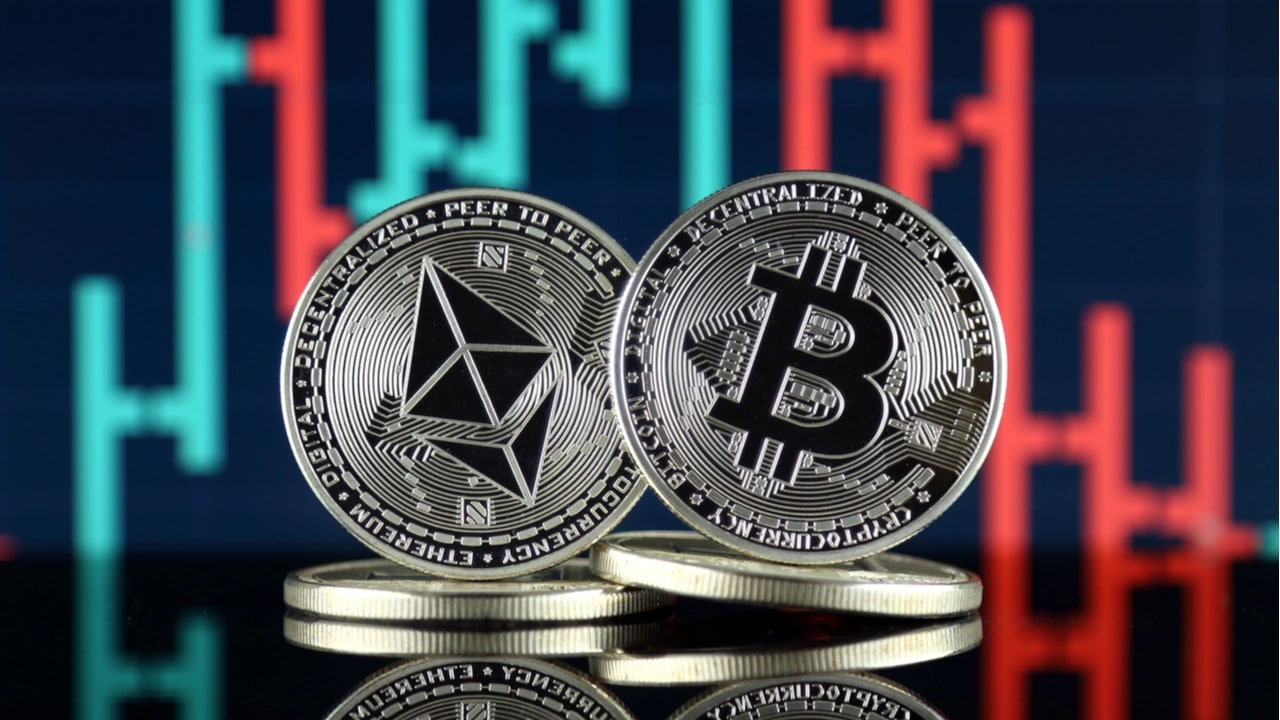
Bitcoin, Ethereum Technical Analysis: ETH Stays Above $2,900 as Traders Eye $3,000 Ceiling
Ethereum remained above $2,900 to start the week, as the world’s second largest cryptocurrency consolidated its recent gains. Bitcoin was also consolidating, as it continued to trade above $41,000 during Monday’s session.
Despite a selloff to end last week, prices of BTC continued to hover above $41,000 on Monday, as market bulls appear to still be holding onto their positions.
Following a low of $40,668.04 earlier in today’s session, BTC/USD rose to an intraday high of $41,607.47 on Monday.
Although BTC is now trading around the $41,379 area, it remains 0.45% lower than yesterday’s high above the $42,200 ceiling.
Today’s session saw bitcoin fall below its floor of $40,580, which is its lowest level since last Friday, as markets were preparing for the weekend.
Looking at the chart, the reversal in price momentum came as BTC hit its long-term resistance point of $42,200, leading to bears re-entering the market.
In addition to this ceiling, the 14-day RSI was also unable to move past its own ceiling of 55, and now sits at 51.5.
Should this momentum persist, we could see bitcoin below $40,000 in the upcoming days.
Although BTC fell, ETH remained marginally higher as of writing, as prices continued to trade above the $2,900 level.
On Monday, ETH/USD hit an intraday high of $2,934.69, as prices rebounded following a selloff during Sunday’s session.
The price of ETH fell as the asset approached the $3,010 ceiling, which comes as traders appear to have closed positions, leading to a turnaround, as seen before at this level.
Despite the reversal which came, there was enough bullish pressure in ETH to keep prices from falling below $2,900, with ETH/USD now up over 14% in the last seven days.
This momentum could see further gains come this week, as bulls seem to still be present at this level.

Sphere Finance aims to do governance acquisitions using a treasury amassed by investors, for investors. The profits from the investments are then sent to investors as dividends in the form of the $SPHERE token every 30 minutes, 48 times a day. The treasury is amassed through taxes that users agree to pay for buying, selling & transferring their tokens, including the "Dynamic" tax, an additional tax for every % of the LP that you hold and sell on a transactional basis. Later, the project will take the form of an index fund, like an S&P 500 of crypto, airdropping tokens as dividends to holders. Join the movement.
Telegram: https://t.me/SphereDeFi
Discord: https://discord.gg/spheredefi
Twitter: https://twitter.com/SphereDeFi
Telegram: https://t.me/SphereDeFi
Discord: https://discord.gg/spheredefi
Twitter: https://twitter.com/SphereDeFi
Coinbase Now Allows Cardano Staking Services, Firm ‘Plans to Continue to Scale Staking Portfolio’
On March 23, the cryptocurrency exchange Coinbase announced the platform will now allow cardano staking services. The company’s senior product manager Rupmalini Sahu mentioned that cardano is one of the top ten crypto assets by market cap and its proof-of-stake (PoS) blockchain “seeks to be more flexible, sustainable, and scalable.”
Cardano (ADA) holders can now leverage the cryptocurrency trading platform Coinbase to stake their ADA, according to an announcement from the Coinbase executive Rupmalini Sahu. The firm’s senior product manager said that while people can stake on their own by delegation, Coinbase’s staking is “easy and secure.”
According to Sahu, the current staking annual percentage yield (APY) on Coinbase is 3.75% and after a probation period of 20-25 days, users can then obtain rewards with the exchange. The Coinbase blog post stresses that the users “always maintain control” and claims “your Cardano always stays in your account; you just earn rewards while keeping your crypto safely on Coinbase.” Furthermore, the company says ADA stakers can opt-out at any time. Sahu’s blog post adds:
The Cardano network sets the underlying return rate depending on the number of staking participants. Coinbase distributes the return to customers, less a commission.
The trading platform’s latest product addition follows a class-action lawsuit that has been filed against the Nasdaq-listed cryptocurrency exchange. Coinbase is being sued for allegedly listing 79 unregistered securities and cardano (ADA) is mentioned in the list. After the ADA staking announcement, the crypto asset cardano jumped roughly 20% higher during the last 24 hours.
The cardano (ADA) staking product from Coinbase is the company’s fifth staking service to date. Currently, besides ADA, Coinbase customers can stake tezos, ethereum, cosmos, and algorand. According to the Coinbase senior product manager, more coins will be added to the firm’s “staking portfolio in 2022.”

European Union’s MiCA Proposal Progresses to Trilogue Stage Without Bitcoin Ban Provision
The Markets in Crypto Assets (MiCA) regulatory package passed another potential hurdle this week and is moving to the next stage of the EU’s legislative process. Proponents of a controversial text prohibiting proof-of-work (PoW) cryptocurrencies, which was recently dropped from the draft, did not take an opportunity to block the draft’s progress.
Wording proposed by members of the European Parliament (MEPs) which aimed to impose a ban on cryptocurrencies relying on PoW mining was removed from MiCA before a recent vote. In mid-March the Committee on Economic and Monetary Affairs (ECON) approved the regulations without a provision that would have effectively prohibited the offering of services for bitcoin and the like.
However, the crypto community couldn’t greet the development with relief as it was still possible to prevent the draft from progressing to the next stage of the legislative process – the trilogue between the European Parliament, the European Commission, the executive arm in Brussels, and the Council of the EU, the other legislative body of the Union.
The deadline by which an objection could be filed expired at midnight on Thursday, March 24, the German crypto news outlet BTC Echo noted in a report. Until then, the factions of the Greens, Left and Social Democrats, the supporters of the de facto bitcoin ban, could halt the advance of MiCA and attempt to reintroduce the text which had sparked negative reactions from the crypto community.
Stefan Berger, the rapporteur for the legislation, confirmed on social media that MiCA will now be subjected to negotiations between the three leading EU institutions. Berger who is also a member of ECON, thanked his colleagues at the committee and other supporters of his efforts.
The MEP also pointed out that he had suggested connecting MiCA to the EU Taxonomy for Sustainable Finance. With its taxonomy classification system, the EU is evaluating economic activities according to their sustainability and trying to direct investments towards sustainable projects. “I am optimistic that this proposal will be approved by the Commission and the Council,” Berger emphasized.
Regulatory bodies and officials from several EU member states called for a Union-wide ban on the energy-intensive PoW crypto mining, citing environmental reasons. The group includes the bloc’s economic powerhouse, Germany, and Sweden which warned that the increasing use of renewable energy to mint bitcoin comes at the expense of climate neutrality goals in other sectors.
EU institutions have been working to regulate the European crypto space in the light of concerns that Russia may use cryptocurrencies to evade sanctions imposed over its invasion of Ukraine and crypto assets were targeted in a recent agreement to expand the restrictive measures. In February, President of the European Central Bank Christine Lagarde urged the Union to quickly approve the new crypto regulations with the same motive.

UK Regulator Moves Deadline For Crypto Firms To Register
The U.K.'s Financial Conduct Authority (FCA) has moved its March 31st deadline for select crypto firms under its jurisdiction, in line with some revisions to its guidelines on the registration process.
The regulatory authority said that it will be moving the deadline to April 1st, but that this would only apply to a select number of crypto firms who would need to attain full registration status.
"We have concluded our assessments, and the TRR will close on 1 April, for all but for a small number of firms where it is strictly necessary to continue to have temporary registration. This is necessary where a firm may be pursuing an appeal or may have particular winding-down circumstances," the FCA stated regarding its revision of the deadline.
A temporary registry has been set in place by the FCA to allow crypto firms to operate despite their current status. The FCA is currently processing and reviewing applications to its anti-money laundering and counter-terrorist financing (AML/CTF) regulatory framework. U.K. crypto firms such as Monolith, Coindirect, Copper, and Revolut are part of the Temporary Registration Regime (TRR), with a handful of other firms also placed in the list.
Crypto firms who have not registered with the FCA are at risk of being subject to the financial watchdog's criminal and civil enforcement powers. Firms who have not achieved temporary registration must have ceased trading since January 10th 2021.
With over a hundred crypto firms in the U.K. applying for the FCA's regulation, only 33 have so far been approved, with 60 other crypto firms either facing rejection from the regulator, or deciding to withdraw their application altogether. Most recently, Wirex, a crypto payments firm, withdrew their application just days before the initial deadline. Prior to this decision, Wirex started operating in the U.S. in February.
The FCA has been ramping up its crypto regulatory efforts recently, with new rules set to come into effect in April that will require crypto exchanges and wallets to identify their users. The authority also published a consultation paper in December seeking input on crypto asset derivatives.
The FCA's revised deadline for crypto firms to register comes as the agency looks to make sure that it is well-positioned to handle the accelerated growth in the crypto space. The crypto industry has been facing increased scrutiny from global regulators in the past year, with countries such as China and India taking a hardline stance against crypto-related activities.
This media is not supported in your browser
VIEW IN TELEGRAM
KunciCoin keeps on pushing their way to succeed in DeFi and we are proud to see that they are listed in @BitrueOfficial
Since we posted for the first time, over 14 top exchanges were listed, over $3M of daily trading volume and a game studio with 20 million downloads.
Congratulations to the team for the achievements, join @KunciGlobalOfficial to know further.
Since we posted for the first time, over 14 top exchanges were listed, over $3M of daily trading volume and a game studio with 20 million downloads.
Congratulations to the team for the achievements, join @KunciGlobalOfficial to know further.
Vaneck Report Calculates Bitcoin Price Could Tap $4.8M if BTC Becomes the Global Reserve Currency
On Thursday, the investment firm Vaneck published a blog post that calculates how much gold or bitcoin would be worth if the two assets became global reserve assets. Vaneck’s report explained that the investment team “attempted to quantify the emergence of new gold or bitcoin-backed currency regimes.” The study’s calculations estimate that gold could reach $31,000 per ounce and bitcoin could potentially hit $1.3 million per coin. If the assets became M2 monetary supplies, then the values of bitcoin and gold could be much higher.
Executives from Vaneck’s emerging markets (EM) bond investment team, Eric Fine and Natalia Gurushina, published a report on March 30, 2022, that touches on “extreme scenarios” where gold or bitcoin theoretically become M0 or M2 money supplies. While a monetary base (M0 or narrow money) equates to all the physical currency and coins, M2 measures both cash and checking deposits and broad money as well.
Vaneck’s Insights blog post says “money has changed,” and highlights the recent sanctions against Russia which froze the country’s USD, EUR, and JPY fiat reserves. Fine and Gurushina write that Vaneck’s EM bond investment team thinks the world’s central banks “will act, as will private individual actors.” The team attempts to quantify the emergence of gold and bitcoin-backed regimes and after the calculations, both estimates are quite substantial in terms of price value.
“We built a simple framework to value gold and bitcoin. For gold, we divide global money supply (M0 and M2) by global gold reserves,” the Vaneck EM bond investment team blog post explains. “The money liability is divided by the reserve asset. We used current reserve holdings in troy ounces for gold, and we used the current exchange rate to convert the monetary base liability into U.S. dollars.”
The EM bond investment team explains that the implied global price for gold using M0 “divided by global gold reserves, for countries with the largest gold holdings is $31,000 per ounce (average) and $21,000 per ounce (median).” Additionally, the implied global price for gold using M2 data divided by global gold reserves is “around $105,000 per ounce,” Vaneck’s report notes.
Vaneck’s team did the same calculations for bitcoin (BTC), in contrast to cryptocurrencies, because the potential supply of crypto is infinite while BTC has a 21 million coin supply cap. The report notes that the upside would be higher with bitcoin (33x) than gold (16x). “The implied price of bitcoin using the same aggregate M0 that we used for gold is around $1,300,000 per coin,” the authors noted in the report. Vaneck’s “extreme” scenario calculations further estimate:
The implied price of bitcoin using global M2 is $4,800,000 per coin.
The report’s authors stress that the circumstances required for this to happen would be an unusual event and “assumptions are based on the probability of that ‘extreme’ scenario occurring, or on the portion bitcoin will be fulfilling in any new reserve status,” Vaneck’s report states. At the end of Vaneck’s Insights blog post, the authors say that something big has happened, and they are attempting to quantify the impact.
“‘Stories’ about the future of money are interesting, but if one agrees that this is a potentially new paradigm, an attempt at quantification is needed,” Vaneck’s report concludes. “That was our intent with this exercise – to be as specific as possible about a nebulous and complicated issue. The key asset-price implication of the big change is significant upside in gold and bitcoin.”

Feds Seize $34 Million in Crypto From Unidentified Florida Man
On April 4, 2022, the Department of Justice (DOJ) and the U.S. Attorney’s Office of South Florida revealed that law enforcement seized $34 million in crypto assets from an unidentified man living in Florida. According to the DOJ, the man allegedly conducted more than 100,000 sales on darknet markets, selling online account information tied to people’s Netflix, HBO, and Uber accounts.
The DOJ and U.S. Attorney’s Office of South Florida announced on Monday that $34 million in cryptocurrencies were forfeited to the federal government. The funds stem from a South Florida resident that allegedly sold online information like financial details tied to specific web services like Netflix, Uber, HBO, and many others.
Reportedly, the man took the private information to darknet markets on the deep web using the privacy-enhancing Tor browser and sold the data for crypto. The unidentified man is accused of conducting more than 100,000 sales with stolen information. While the federal authorities seized the $34 million in digital assets, the suspect from the suburban city of Parkland, Florida was not named or charged in the official press release.
U.S. law enforcement did say it was “one of the largest cryptocurrency forfeiture actions ever filed by the United States.” According to the DOJ press release, the unidentified Parkland suspect allegedly used “tumblers,” “crypto mixers,” and “chain hopping” to conceal his proceeds. The DOJ says the man leveraged mixers and chain hops to “obscure the original source of funds.”
The forfeiture action stemmed from a special operation dubbed “TORnado,” and it involves a great number of federal, state, and local law enforcement agencies. In addition to the DOJ, the “RS-CI, FBI, DEA, Homeland Security Investigations (HSI), and U.S. Postal Inspection Service (USPIS) investigated the case” as well.
U.S. law enforcement, particularly the DOJ, has been busy with various criminal cases that involve digital assets in recent times. At the end of March, the DOJ revealed the agency charged two individuals in a million-dollar “NFT rug pull” scam.
In mid-November 2021, the DOJ was dealing with the sale of $56 million in seized Bitconnect funds stemming from the crypto Ponzi’s “number one promoter.” The DOJ was also involved with the recent seizure of 94,636 BTC that came from the 2016 Bitfinex hack.
Robinhood Crypto Wallets Rolled Out to Over 2 Million Customers
Trading platform Robinhood has rolled out its new crypto wallets to more than two million customers. In addition, Robinhood CEO Vlad Tenev announced that the platform will integrate with the Lightning Network “to bring even lower costs to our customers.”
Popular trading platform Robinhood made an announcement Thursday about its new crypto wallets at the Bitcoin conference in Miami, Florida. Robinhood Chief Product Officer Aparna Chennapragada shared:
We’ve rolled out crypto wallets to every eligible person on the Wenwallets waitlist of more than two million people.
“Now, all eligible customers who signed up for the waitlist will be able to send and receive any of the cryptocurrencies currently available on Robinhood,” the executive added. The company began rolling out its crypto wallets to selected customers in January.
However, “Due to local regulations, crypto wallets aren’t yet available in Hawaii, Nevada, or New York, and we’ll inform those customers when this changes,” Chennapragada said.
Vlad Tenev, CEO and co-founder of Robinhood, also announced:
Our goal is to make Robinhood the most trusted and easiest to use crypto platform. We’re excited to bring even lower costs to our customers by integrating with the Lightning network.
The trading platform currently supports buying, selling, and real-time market data for bitcoin (BTC), bitcoin cash (BCH), bitcoin sv (BSV), dogecoin (DOGE), ethereum (ETH), ethereum classic (ETC), and litecoin (LTC). Shiba inu crypto supporters have been petitioning for Robinhood to list SHIB but the platform repeatedly said that it is in no hurry to add more coins.
Robinhood’s announcement further notes:
Unlike some other crypto platforms, there is no fee to withdraw crypto from Robinhood.

Biggest Movers: RUNE and THETA Fall by Over 10% on Monday
THETA and RUNE are trading over 10% lower to start the week, as recent declines in the crypto market extended during Monday’s session. As of writing, the global cryptocurrency market cap is down nearly 5%.
In addition to BTC and ETH, RUNE also fell to a three-week low to start the week, as bearish pressure mounted in crypto markets.
Following a high of $9.47 on Sunday, RUNE/USD fell to an intraday low of $8.06 during today’s session, as prices fell to their lowest point since March 25.
This drop sees RUNE hit its long-term support point at $8.08, after trading near its resistance of $12 almost a week ago.
Looking at the chart, today’s move comes as price strength failed to move beyond the ceiling of 50, which then prompted bears to send prices lower.
The decline in price strength came as momentum also declined, with the 10-day and 25-day moving averages preparing for a downwards crossover.
As of writing, the Relative Strength Index (RSI) is sitting at its lowest point since February 27, however some still expect further falls in price.
Like RUNE, THETA was also down by over 10% during Monday’s session, as it fell for a second consecutive session itself.
THETA/USD hit a bottom of $3.03 to start the week, which is its lowest point since March 25, and this comes as the long-term floor was broken.
This support level at $3.30 caved in as prices fell for the ninth time in eleven sessions, as THETA’s value dropped by over 20% in the last week.
As a result of this descending pressure on price, we are now on the cusp of a downside cross between the moving averages of 10 and 25 days, respectively.
Should this happen, we could see even more upcoming lows, with bears likely to target the $2.65 level as the next long-term floor.
Despite the 14-day RSI currently tracking near multi-month lows, should the floor of 40 give way, we may head to 34, which will be enough to see the $2.65 level hit.

Bitcoin Mining Difficulty Drops for the Third Time in 2022, Just Over 100K Blocks to Go Until the Halving
Bitcoin miners have received their third break this year as the network’s mining difficulty adjusted downward by 1.26% on April 14 at block height 731,808. Currently, miners have more than 200 exahash per second (EH/s) in computational power dedicated to mining the Bitcoin blockchain as hashrate increased after the difficulty reduction. Additionally, bitcoin miners have another 108,160 blocks to go until the bitcoin reward halving that’s estimated to occur on or around May 3, 2024.
Bitcoin’s mining difficulty adjustment algorithm (DAA) dropped on Thursday, as the parameter slid by 1.26% at block height 731,808. The reduction is the third DAA drop in 2022, as the difficulty slid by 0.35% on March 17 and by 1.49% on March 3. In 2021, the DAA dropped seven times and saw one of the largest reductions over the course of Bitcoin’s lifetime on March 7, 2021, sliding 27.94% lower that day. Since the change, BTC’s hashrate has increased and is presently hovering just over the 200 EH/s zone.
The 1.26% drop makes it easier for miners to find blocks as the difficulty was 28.59 trillion two weeks ago and today, the metric is now 28.23 trillion. At the time of writing, there are 1,982 blocks left until the next DAA change. Currently, it is expected to increase but being that it’s roughly two weeks away, the estimate could be very different by then. The next DAA change is estimated to occur on April 28, 2022. The current block subsidy of 6.25 BTC is worth $252,781 using today’s BTC exchange rate and in 751 days, that will change.
Bitcoin miners are getting closer every day toward the block reward halving that is expected to occur on or around May 4, 2022 (however, some estimates assume it may be on May 3, 2022). After that date, BTC miners will see their 6.25 BTC per block shaved in half to 3.125 BTC per block. Right now the network produces 900 BTC per day (144 blocks) and Bitcoin’s inflation rate per annum is 1.74% at the time of writing. So far, 90.53% of all the bitcoins that will ever exist have been minted and there are 1,988,481.23 BTC left to issue.
With the difficulty change making it easier to find blocks in comparison to the last two weeks, Foundry USA is the top mining pool over the last three days with 72 blocks found and 16.63% or 33.54 EH/s of hashpower. A few more pools have joined in recent days as there are now 14 known pools while two weeks ago there were only 11 known pools mining bitcoin. Currently, unknown hashrate or stealth miners command 1.39% of the global hashrate or 2.8 EH/s. Unknown hashpower has managed to acquire six blocks during the last three days.

This media is not supported in your browser
VIEW IN TELEGRAM
KunciCoin keeps on pushing their way to succeed in DeFi and we are proud to see that they are listed in big exchanges @BitrueOfficial and @Bitmartexchange
They have listed in 18 exchanges in last one month and with lot of Utilities
Now they will keep listing until they reach 100 exchange , next listing is Hotcoin Global.
Since we posted for the first time, over 14 top exchanges were listed, over 8M$ to $11M of daily trading volume and a game studio with downloads,They Launched their own NFT MARKETPLACE
With World Famous MUSIC ARTISTS
On the Occasion of their NFT platform they 2nd time burned 10% of their supply
They are Coming with their OWN BLOCKCHAIN ECOSYSTEM AND 3 BIG EXCHANGES
U need to check this Wonderful coin from Indonesia
It had best utilities more than any token in the world
This is something that we've been waiting for.
Wait for more announcement coming in, should be epic in upcoming months
JOIN
@KunciGlobalOfficial
Contract address
0x6cf271270662be1c4fc1b7bb7d7d7fc60cc19125
#DYOR
Tony Hawk’s Latest NFTs to Come With Signed Physical Skateboard
Last December, the renowned professional skateboarder Tony Hawk released his “Last Trick” non-fungible token (NFT) collection via the NFT marketplace Autograph. Next week, Hawk will be auctioning the skateboards he used during his last tricks, and each of the NFTs will come with the physical skateboards signed by Hawk.
Tony Hawk has plans to launch another NFT collection tied to the skateboards he used in his “Last Trick” NFT collection launched in December. The “Last Trick” digital collectibles compilation was sold on the Autograph NFT marketplace, a platform launched by the seven-time Super Bowl champion Tom Brady.
Hawk announced the latest NFT sale of the last trick skateboards on Saturday, and explained that an individual named Garry DeBoer was randomly chosen to win his Frontside Cab board.
Autograph tweeted about the event as well on Saturday and said: “Congrats to Autograph collector Garry DeBoer. A piece of Tony Hawk history is now yours to cherish forever. The remaining boards Tony used to retire five signature moves will be auctioned starting Tuesday of next week.”
There are five skateboards revealed in the latest Autograph-based Tony Hawk NFT collection and the first one (Frontside Cab board) will be dropped to DeBoer on Monday.
The signed Finger Flip skateboard will be auctioned on Tuesday at 12 p.m. (ET) and the signed Gymnast Plant skateboard will be auctioned the same day. In addition to those two NFTs, the signed Magic Dance skateboard and signed Varial 540 skateboard will be sold on Tuesday as well.
The management of the auction, Autograph’s terms explain, will be administered by the Draftkings Marketplace. The terms also note that after the Tony Hawk skateboard NFT auctions complete, Autograph will be obligated to send the physical skateboards via the USPS, Fedex, or UPS.
Hawk’s NFTs are popular on the Autograph platform among other popular athletes such as Wayne Gretsky, Derek Jeter, Tom Brady, and Simone Biles. The top Tony Hawk NFT collector on Autograph is a user named “laukialovforeve” with a score of 188,640.

🚨🚨🚨BREAKING NEWS (For #AQRU)🚨🚨🚨
🤩🤩🤩The critically acclaimed (By the economic times and many more) AQRU is launching an AMA coming this Friday!
Founder Phil Blows will be taking all your questions and answering them.
This will be your chance to ask any #AQRU questions, that will hopefully get answered!
In addition to speaking to a crypto project founder🚀🔥
Follow our accounts for more details.
Telegram: https://t.me/AQRU_Official
Twitter: https://bit.ly/AMAAQRU

Makerdao Plans to Integrate Ethereum L2 Solution Starknet to Lower DAI Transaction Costs
The decentralized finance (defi) project Makerdao has announced its plans to support the zero-knowledge (ZK) rollup solution Starknet in order to make DAI transactions faster and network costs cheaper. Starknet will be integrated into the defi protocol on April 28, 2022, as part of Makerdao’s multichain strategy expansion.
On Wednesday, the development team behind the Makerdao project revealed plans to integrate the Ethereum layer two (L2) scaling solution Starknet. The protocol Starknet is a product developed by the startup Starkware and it offers an L2 scaling solution with ZK-based computations that utilize validity proofs.
Makerdao is the issuer of the stablecoin DAI, and after Starknet is supported the team believes it will make DAI “minting, trading and liquidation significantly faster.” Starknet’s Makerdao integration follows the project’s bridge deployments on Arbitrum and Optimism. A project contributor from Starknet Core Unit at Makerdao detailed that cross-chain bridge technology has swelled because of expensive gas fees.
“As we see unsustainable gas fees drive more activity and users to a wider variety of blockchains, security challenges that come with bridging will continue to grow,” the Starknet Core Unit contributor said. Projects must move on to Layer-2 to continue to serve users, and Makerdao is partnering with Starknet to do exactly that.”
The Starknet Core Unit team member added:
With this strategy, we are positioned to cement the Maker’s Protocol’s position as the leading decentralized lending protocol in the industry, and also the status of DAI as the most decentralized, secure stablecoin. Through this development, Makerdao will increase its product offerings and grow alongside Ethereum.
Makerdao’s DAI stablecoin is currently the fifth-largest stablecoin crypto asset today with an $8.7 billion market capitalization. For quite some time following DAI’s inception, Makerdao’s stablecoin was the largest decentralized stablecoin by market capitalization, but recently Terra’s UST has surpassed DAI’s overall valuation.
Makerdao also has its own native coin maker (MKR), which is the 73rd largest market capitalization today with $1.7 billion. During the announcement on Wednesday, the team further said that the upcoming improvements “will likely also increase the number of Makerdao users.”
Retail users will be able to leverage Maker Vaults again as well in order to deposit collateral and generate DAI. Currently, the engineering team has started to implement a multiphase roadmap for the integration by first creating a simple cross-chain bridge tethered to a wallet.
“Subsequent phases include the release of fast withdrawals in Q2, followed by near-instant teleportation of DAI across Layer-2,” Makerdao’s announcement concludes. “Finally the implementation of the entirety of Makerdao on Starkware—heralding multi-collateral DAI (MCD) contracts and an interface to migrate bad debt to the Ethereum Layer-1.”

Forwarded from B2BROKER | Fintech Infrastructure & Liquidity Solutions
💸 If you have ever thought about opening your crypto exchange, here are the top 10 things you should consider before starting. Check out must-have points and gain advanced knowledge of exchange business launches.
https://b2broker.com/news/10-things-you-need-to-know-before-starting-your-own-cryptocurrency-exchange/
https://b2broker.com/news/10-things-you-need-to-know-before-starting-your-own-cryptocurrency-exchange/
B2Broker
10 Things You Need to Know Before Starting Your Own Cryptocurrency Exchange - B2Broker
A well-built cryptocurrency exchange is a crucial part of the bitcoin business. It not only pays well, but also allows you to be your own boss and choose your own working hours.
KunciCoin (BSC) || 🟨⬜️
Thrilled to announce our staking feature for KunciCoin will open soon You can get up to 15% APY, by staking you $KUNCI on doyanrebahan.com
KunciCoin keeps on pushing their way to succeed in DeFi and we are proud to see that they are going to be listed on
3 Big Exchanges
SOON THEY ARE RELEASING THEIR 2ND BATCH OF NFT ARTISTS AND MUSIC ALBUMS FROM BAND IFAN SEVENTEEN AS THEIR FIRST NFT RELEASE SOLD IN 7 MINUTES On
http://kuncinft.com
They have listed in 18 exchanges in last one month and with lot of Utilities
Now they will keep listing until they reach 100 exchanges
Since we posted for the first time, over 14 top exchanges were listed, over 8M$ to $11M of daily trading volume and a game studio with downloads
They are Coming with their OWN BLOCKCHAIN ECOSYSTEM AND 3 BIG EXCHANGES
U need to check this Wonderful coin from Indonesia
JOIN TG
@KunciGlobalOfficial
Announcement channel
@kunciglobalchannel
CA
0x6cf271270662be1c4fc1b7bb7d7d7fc60cc19125
Kadena Launches $100 Million Grant Fund to Develop Web3 Experiences
Kadena, a proof-of-work-based cryptocurrency that also has the possibility of supporting smart contracts, has announced a new set of grants directed to incentivize the creation of Web3 experiences. This $100 million grant fund is part of the Kadena Eco initiative, whose objective is to offer builders a complete suite to deploy their solutions on top of the chain.
Kadena, a top-100 cryptocurrency project that is based on proof-of-work (PoW) consensus but also offers the possibility of executing smart contracts, has revealed a new set of developer grants seeking to attract builders to its chain. The grant program, which will have $100 million available for interested teams, is part of the Kadena Eco program, which presents a set of other initiatives directed to help teams, companies, and startups to produce Web3 experiences.
The Kadena Eco program includes several other aspects that are to be developed in the near future. Among them are an incubator for growing the skills of more developers in different projects, an accelerator to power other projects, and even a venture fund that aims to “propel companies using or pivoting to Kadena’s blockchain platform to realize their vision.”
Regarding this full global support that Kadena seeks to offer builders, Stuart Popejoy, founder and CEO of Kadena, stated:
We’re empowering builders to pioneer new projects that transform the world, and we’re doubling down on our promise to make that happen by actively and responsibly deploying our treasury resources to ensure long-term sustainability of our ecosystem.
The grants program is already open and receiving proposals. The press release from the Kadena team explains that each of the proposals will be examined taking several key aspects into consideration that include: technical strength, detail of specifications, team experience, and usefulness for its ecosystem. The team will be receiving proposals in the areas of gaming, metaverse, NFT, Web3, DeFi, and DAOs.
However, recipients of this grant will have to also abide by Kadena’s requirements, and contribute to the ecosystem by producing material directed to teaching other members of the community about the programming of their products.
Web3 has become a very important focal point for many companies and funds that are investing and offering incentives for builders. Griffin Gaming Partners announced one of the biggest funds for Web3 and gaming in March, raising $750 million at that time. The Avalanche Foundation also launched a $200 million fund called Blizzard last November, which seeks to invest $200 million in innovations built on top of Avalanche.