
Next weekend, Amsterdam will host 'Mystical Dinners' — the first event of a new dot and salt project by the multidisciplinary artist Luba Matyunina. In it, she collaborates with other artists to devise and create profound and meaningful activities inspired by mythology.
A Mystical Dinner is a unique immersive experience, a three-hour performance in which every detail has been carefully thought out: from the space, the ceramics, the aromatherapy, and the soundscape to the food itself. The secret menu (including a vegetarian option) consists of six meals created by the chef duo AXE&PORRIDGE live in front of you, paired with two glasses of wine and three homemade soft drinks. Seating is limited and ticket sales unfortunately close on Wednesday.
Dates: April 14, 15 and 16
Adress: Frans de Wollantstraat 84, 1018 SC Amsterdam (NeverNeverLand gallery)
Cost: 120 euros
Booking link: https://linktr.ee/dot.and.salt
Linktree
experience-based events | Instagram | Linktree
that are unique and immersive, inspired by mythology and archetypes.
An Easter miracle happened in Amsterdam
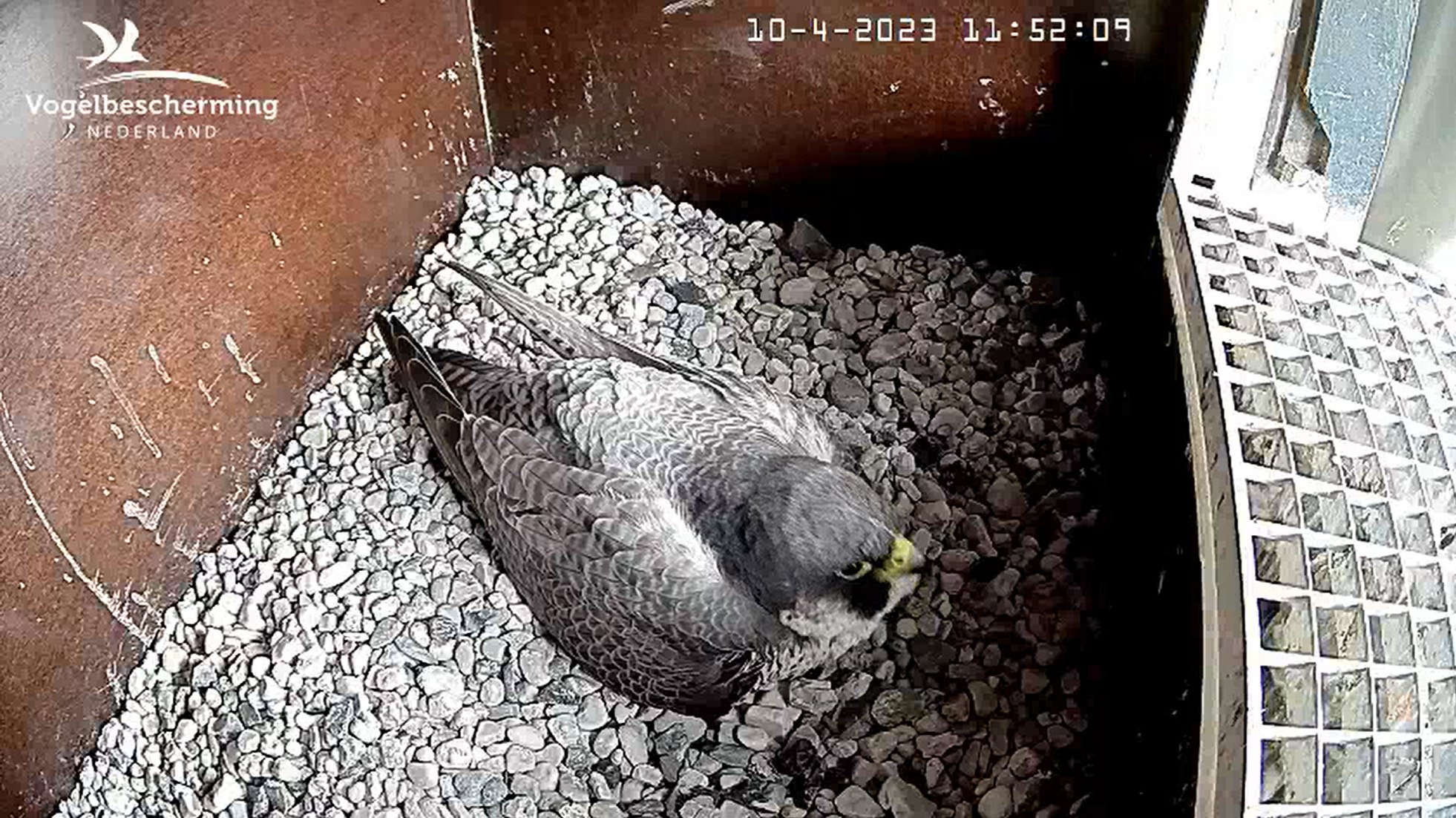
Since last year, webcams have been installed on the roof of the Rijksmuseum to observe peregrine falcons nesting in its clock tower. After the first pair of those was spotted here in March 2020, one of the oldest existing bird conservation societies, Vogelbescherming Nederland, set the equipment up for its Beleef het Lente project, which focuses on the nesting season. The website of this national non-governmental organisation provides an opportunity to observe different species of birds across the country, such as barn owls, bald eagles, storks and blackbirds.
The April peregrine falcon 'Easter eggs' at the Rijksmuseum became a true miracle after the previous clutch in March had failed to produce offspring. Then, without much hope of a new one, Vogelbescherming Nederland turned off the webcams. But the female and male, identified as V and BTR, had enough hormones for another attempt — a new egg appeared in the nest on Good Friday and another 49 hours later a second one followed. The cameras are back on and hundreds of people are once again watching this 'Amsterdam couple'.
In total, ornithologists know of six pairs of peregrine falcons in Amsterdam, with only one risking to nest in the inner city. Rijksmuseum management is proud that the birds choose this particular site: full of enthusiasm in 2020, when the first peregrine falcons arrived, they decided to install nesting boxes in both towers and even turned off the moving figurines that used to strike the bell in the clock tower with a hammer every hour. And for good reason: in 2021, two peregrine falcons hatched here! Moreover, the museum has long been doing its bit to contribute to the conservation of flora and fauna in the city and is deservedly on the list of the most eco-friendly buildings in the Netherlands.
King’s Day’23
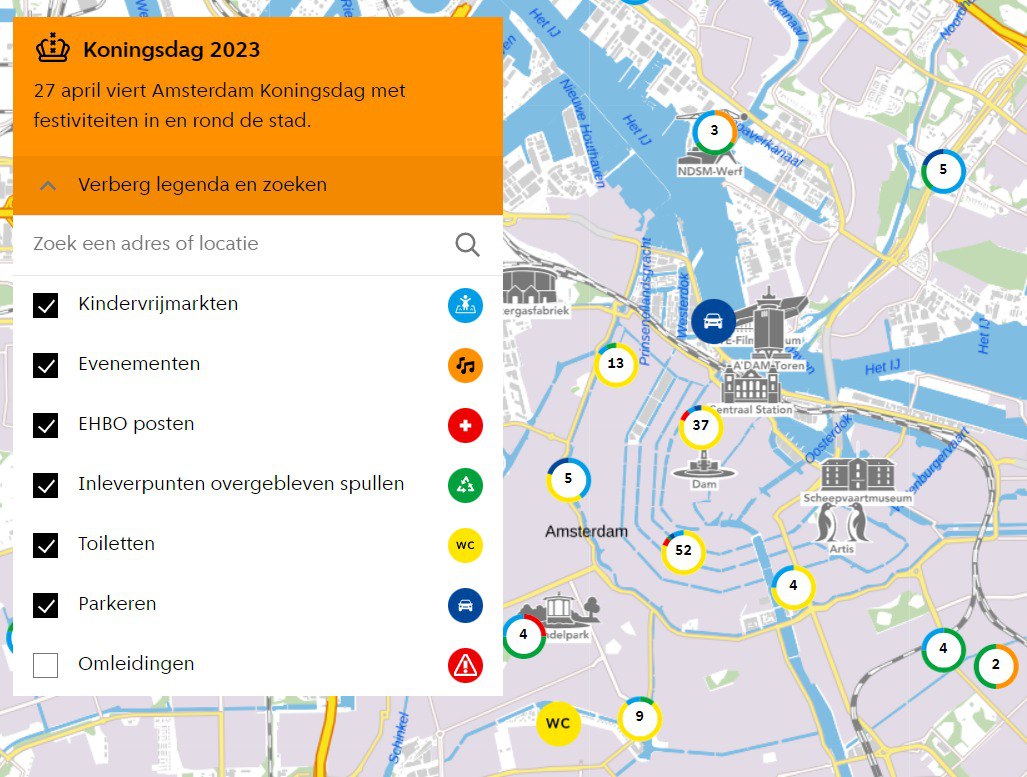
I won't be compiling a guide to this year's King's Day celebrations — since the coronameasures have been lifted, the country celebrates it in the same widespread and diverse way as before, and it's impossible to keep track of all the events. Even though King Willem-Alexander and his family will be visiting Rotterdam this time, the celebrations in Amsterdam are expected to be lively and still attract around 200,000 people. To ensure that residents and visitors to the capital are as prepared as possible, the municipality of Amsterdam has assembled all important information here and even marked some important points on a map, such as first aid stations and public toilets. Apart from the usual rules, like the fact that almost the whole centre will be closed to traffic and that alcohol consumption is limited to one drink per person at a time, it is important to keep the following in mind: on April 27 public transport will run on a Saturday schedule, RAI and Sciencepark stations will be closed all day, and, I can't imagine who thought it was a good idea, but the Johan Cruijff Arena will also host a concert by Metallica.
I won't be compiling a guide to this year's King's Day celebrations — since the coronameasures have been lifted, the country celebrates it in the same widespread and diverse way as before, and it's impossible to keep track of all the events. Even though King Willem-Alexander and his family will be visiting Rotterdam this time, the celebrations in Amsterdam are expected to be lively and still attract around 200,000 people. To ensure that residents and visitors to the capital are as prepared as possible, the municipality of Amsterdam has assembled all important information here and even marked some important points on a map, such as first aid stations and public toilets. Apart from the usual rules, like the fact that almost the whole centre will be closed to traffic and that alcohol consumption is limited to one drink per person at a time, it is important to keep the following in mind: on April 27 public transport will run on a Saturday schedule, RAI and Sciencepark stations will be closed all day, and, I can't imagine who thought it was a good idea, but the Johan Cruijff Arena will also host a concert by Metallica.
I finally updated the memo, written last March for Ukrainians temporary relocated to the Netherlands. A lot has changed over this time, most of the initiatives and support projects have been closed down and I had to remove them from the article. Of course, there are also some organisations which are still functioning or, alternatively, have only recently started to develop. Here are three of them.
The Samen hier initiative of the non-profit human rights organisation Justice&Peace Nederland offers assistance to Ukrainians in The Hague and its region so they could meet locals for informational support, some Dutch language practice or just a good time. They are also looking for volunteers among locals and expats.
In Rotterdam, the Ukrainian Lounge, a centre for meetings and simultaneously for the promotion of Ukrainian cuisine in the Netherlands, has moved to a new address (Gaffelstraat 1), but continues to operate. For example, every weekend they hold special events, where you can have a meal of, for example, borscht or deruny (potato pancakes) for just 5 euros.
Another way to learn about contemporary Ukrainian culture, designers and brands is the Lucht Pop-up festival. I missed its launch in Amsterdam this February, but the good news is that it's a travelling project — it will be in Bratislava in May and will return to Amsterdam again in June, stay tuned to their Instagram for updates.
Days of Remembrance and Liberation
May 4 and 5 are very important dates in the Netherlands, when the whole country first stands in two-minute silence to commemorate the victims of World War II, and then celebrates liberation from the German occupation in a truly nationwide feast with 'freedom soup'. There was a big post about this here on Amsterdammer last year.
I can't stop thinking that one day (hopefully, as soon as possible) a similar celebration will take place in Ukraine, and many of its cities will have museums of this war that you and I are forced to witness. Precisely because most witnesses still have their eyes closed, I feel it important to talk about the latest project of the Finnish newspaper Helsingin Sanomat, which in March 2022 started to also publish news in Russian. HS, like many other media, is blocked in Russia, but for World Press Freedom Day (celebrated on May 3) its editorial board came up with a roundabout way to reach Russians — through Counter-Strike, a popular computer game. To that end, Helsingin Sanomat created a virtual city, roughly resembling any existing Soviet city, and in it, a secret room with a map of Russian strikes against Ukrainian civilian targets and non-propaganda news in Russian. "Many Russians don't know what's really going on in Ukraine. In this room they will have to face the truth about this war," Helsingin Sanomat writes about their project. To find out more, download the game map and support the spread of independent journalism, follow this link.
Nationaal Comité 4 en 5 mei
Op 4 en 5 mei staan we samen stil bij vrijheid.
OVpay or contactless fare payment
Guys, this is no news by now, but as it turns out, not everyone knows about it yet. Since the end of last year, the use of public transport in the Netherlands has been revolutionised: passengers no longer need to buy a ticket or possess an OV-chipkaart. In buses, trams, the underground, riverboats and trains of all transport companies in the country, it is now possible to pay with a bank card!
The new OVpay method is being tried out in stages with the addition of new regions and so far only works for trips without season tickets or discounts. This means that if you commute at regular fares, you can check in and check out by applying the following to the validator:
- a contactless debit card from ABN AMRO, ASN bank, bunq, ING, Knab, Rabobank, Regiobank or SNS;
- a contactless Mastercard or Visa credit card;
- a smartphone set up for contactless card payment, Apple Pay or Google Wallet;
- a foreign contactless Maestro, V pay, Mastercard or Visa debit or credit card.
The app has been created for tracking and paying for rides. Travelling with the good old OV-chipkaart is still possible. However, the system behind it will also be changed in the future.
www.ovpay.nl
Home | OVpay
OVpay: the new way to check in on public transport. Check in with the new OV-pas or your payment card – together, they replace the OV-chipkaart.
And to follow up, I want to share an incredible discovery: a map that not only shows the real-time traffic of all Dutch public transport (with the exception of waterways), but also provides complete information about the route with itinerary, schedule and possibility to filter out deviations from it at the moment (!), the registration number and operator of each vehicle, all stopping places in the country and even the number of remaining OV-fiets there — in short, a fabulously useful resource: https://www.ovzoeker.nl/
Over 500,000 free bus, tram and metro tickets
Staying on topic :) Vervoerregio Amsterdam, i.e. the cooperation of 14 municipalities regarding traffic and public transport, in partnership with Connexxion, EBS and GVB are running a campaign for people on low incomes and living within the Amsterdam transport region.
Terms and conditions:
- Participants receive 8 free tickets for one address;
- With 1 ticket you can travel for 1.5 hours by bus, tram or metro;
- It is only valid in the Amsterdam transport region until December 31, 2023.
There are over 500,000 tickets left at the moment, but clearly, the demand for them is high, so, as is usually the case here, Op=Op.
UPD: all tickets were gone in a day
50th anniversary of National Mill Days
This weekend will be the fiftieth time the Netherlands celebrate Mill Days, an annual opportunity to get an inside look at one of the country's main symbols and meet modern millers. To mark the milestone, Her Royal Highness Princess Beatrix of the Netherlands, patron of the De Hollandsche Molen association, is visiting the De Roos windmill in Delft on May 12.
De Hollandsche Molen is committed to preserving the monumental windmills and watermills in the Netherlands, and this year it is also celebrating its anniversary, only it's centenary. So in addition to the usual, the association has extra events planned, including the NK Molenkruien, which can be translated as 'National Windmill Blade Turning Championships', and if you think that is a rather strange activity, read this post.
De Hollandsche Molen
50ste Nationale Molendag op 13 en 14 mei!
Kom naar de molen! Op 13 en 14 mei 2023 is het weer VriendenLoterij Nationale Molendag, het grootste molenfeest van Nederland. Honderden wind- en watermolens in heel Nederland openen hun deuren om bezoek te ontvangen. De eerste Nationale Molendag was in 1973…
Last chance to see Vermeer
The Rijksmuseum, which has repeatedly promised that there would be no more tickets for the most popular exhibition in its history, is doing it again. Now, by means of a lottery, the museum will be raffling off the opportunity to see practically all the works of the Dutch master at once on the last days of the exhibition — June 2 and 3. Tickets for visits during regular opening hours are long gone, so the museum will be open until 2.00 on those two days!
If you would like to compete for this opportunity alongside the estimated 2,600 people, fill in this form by 17.00 (CEST) on Friday, May 12. All participants will receive an email with the result no later than May 16. Those lucky enough to be selected by an automated process overseen by a notary (!) will be able to purchase a maximum of 2 tickets by 10.00 (CEST) on Wednesday, May 17. Best of luck to you!
Amsterdam allocated 100 million euros to build a bicycle bridge over the IJ
Oostbrug, i.e. the Eastern Bridge that will connect Azartplein (KNSM island) and Hamerkwartier (the Nord district) in 10 years, has received a budgeting decision from the municipality of Amsterdam: the city has reserved 100 million euros for it. The Amsterdam transport region will add 75 million. But it is estimated that at least 300 million will be needed to build the bridge, meaning that another 125 million must be found before construction starts in 2029.
Oostbrug is needed because the northern district of Amsterdam is growing strongly, and the city's ferries are getting busier and busier. After the Eastern Bridge, the Western one will also be built, probably in 2040 — both are being implemented as part of the big 'Sprong over het IJ' project . In the meantime, the city wants to add extra ferries: five more by 2030. Not right now simply because there are not enough skippers, and it takes four years to train them.
Telegram
Amsterdammer in English
New phase of the 'Sprong over het IJ' project
The Amsterdam authorities have finally decided where the 2 new bridges and underwater tunnel are to be built to link the Noord district to the city.
🔹The Western Bridge (Westbrug): Danzigerkade - NDSM
🔹The…
The Amsterdam authorities have finally decided where the 2 new bridges and underwater tunnel are to be built to link the Noord district to the city.
🔹The Western Bridge (Westbrug): Danzigerkade - NDSM
🔹The…
The poor man's Rembrandt, or Unexpected museum marketing
In March, the Rembrandt House Museum reopened after a four-month renovation. The building, where one of the most famous artists lived from 1639 to 1658, has become more environmentally friendly and its public space has been increased by 30%. With these changes, the museum wants to attract new audiences and has therefore taken on an unexpected marketing move: from 19 to 25 of June, the famous Amsterdam tattoo studio Schiffmacher & Veldhoen will be tattooing here!
Why? Here's what Henk Schiffmacher, the founder of the studio himself, has to say: «Worldwide, more tattoos are sold than artworks for the wall. An old tattoo artist once called tattoos 'The Poor Man's Rembrandt': a work of art that is more affordable than a painting by an old master, but no less carefully chosen and executed. Many people also build up real collections of tattoos from specific artists. They come to us because they want to add a Schiffmacher & Veldhoen to their lifelong collection».
The price per tattoo ranges from €100 to €250. Customers can choose from several designs, including Rembrandt's original etchings, his signature or monogram. Here you can check out the available options in advance, choose a master and book a time slot.
Marijuana smoking banned in Amsterdam's red light district from May 25
Starting next Thursday, it will no longer be possible to use light drugs on the street in Amsterdam's old centre. The ban concerns the Burgwallen Oude-Sijde area, better known as the red light district. It should reduce the inconvenience caused by smoking marijuana in public places, especially by tourists.
The fine for violation is €100. At the moment there is no ban on smoking on the terraces of coffee shops, but it could also be introduced if necessary. For the record, alcohol, laughing gas and hard drugs are already banned in the same area.
These measures are part of the Aanpak Binnenstad strategy which aims to reinvigorate the social life of the city centre, to support its residents — despite popular opinion, this area is still predominantly residential — and to structurally combat mass tourism and its associated nuisances. Although I support the decision of the authorities, because I myself have been crossing the red light district only if absolutely necessary for several years now, this weekend marks the end of a historical era: the time of Amsterdam's popular image as a city of freedom is, alas, passing with it.
Today, the last Saturday when Amsterdam city centre looks like it used to, the red light district hosts Pop-up Culture Day. There are concerts, exhibitions and meetings at various venues until 19.00 — choose what to visit using this map.
Amsterdam.nl
Aanpak Binnenstad
Met het uitvoeringsprogramma Aanpak Binnenstad willen we de binnenstad klaarmaken voor de toekomst. Dat kost tijd en doen we niet alleen.
Amsterdam got an app for surviving on the street
Streetlife, a special app created for Amsterdam's homeless people, provides important practical information on where to get medical and psychological help or find lodging, food and clean clothes. This virtual version of the Blauwe Boekje booklet, which has been produced for several years by the non-profit organisation De Regenboog Groep, came about because around 70% of those seeking help have a smartphone. De Regenboog Groep says this is not surprising, as more and more things can only be done online, plus the internet makes it easier to communicate with people who do not have a fixed residential address.
The app is available for free at the following links: for Android and for Apple.

Decomposable coffin company launches new products
Yesterday, on the International Day for Biological Diversity, one of my favourite and fastest-growing Dutch companies, Loop Biotech, presented new products made from mycelium: apart from coffins, it now makes Loop Earthrise™ urns and Loop ForestBed™ stretchers. In addition, it is now possible to personalise the chosen item with a set of biodegradable paints, replace the moss lining with a linen one or add a linen shroud. The design of the Loop Living Cocoon™ coffin has also been revised, by the way, and the price has dropped to €995. In 2021, when it all started, one of the company's goals was to reduce the cost of its flagship product.
Loop Biotech produces everything from 100% natural materials: mycelium, i.e. the underground root network of mushrooms, and recycled hemp. The coffin, urn and stretcher are all manufactured in just 7 days, and decompose a human body in 45. The new products have been developed in collaboration with Natuurbegraven Nederland, an organisation dedicated to promoting an environmentally friendly way of burial in nature, which is gaining popularity in the Netherlands, partly because the right to such a grave is indefinite. If you didn't understand what you just read at first and then were very surprised, get reading this post as well.

Under 'Better late than never' headline: ARTIS, a zoo in Amsterdam, is celebrating its 185th anniversary with special events throughout May, and a bonus added to the purchase of a ticket to ARTIS-Park itself includes free admission to ARTIS-Micropia, a museum of microbes, and ARTIS-Groote, a museum about life on earth: https://www.artis.nl/nl/te-doen-artis/dagagenda-activiteiten/185-jaar-artis/
If you haven't yet adjusted to the fact that there are almost year-round ''days of something'' happening in the Netherlands, here's a hint for the coming month:
- Today is Castle Day;
- June 1-4 - Rotterdam Roof Days;
- June 10 - Garden Days in Amsterdam West;
- June 15-18 - Architecture Days;
- June 16-18 - Amsterdam Garden Days.
- Today is Castle Day;
- June 1-4 - Rotterdam Roof Days;
- June 10 - Garden Days in Amsterdam West;
- June 15-18 - Architecture Days;
- June 16-18 - Amsterdam Garden Days.
Bunker Day
Another event that opens doors to normally inaccessible sites is Bunker Day, taking place this year on June 3 at various locations along the Dutch coast. This line of defence, which the Germans built during the Second World War, is called De Atlantikwall ('the Atlantic Wall') and stretches 6200 kilometres from Norway to Spain. In the Netherlands, its construction particularly affected South Holland and Zealand, where buildings were demolished and land was flooded, so that hundreds of thousands of people were forced to evacuate.
A pass for Bunker Day costs €7.5 and allows you to visit all participating locations (pdf programme). The closest one to Amsterdam, which protected access to the capital's port during World War II, is the Bunker Museum in IJmuiden. It consists of several defence items, including trenches and a mini-submarine, as well as soldiers' living quarters with original furnishings. On June 3, additionally, authentic WWII military vehicles will be on display here, and a group of veterans will share their stories.
Bunkerdag
Bunkers - Bunkerdag
the bunkers Discover the Atlantic Wall heritage Discover which bunkers you can visit during Bunker Day. Use the filter to show your favorite location or use the map underneath. FILTER BY LOCATION Locatie ‘s-Gravenzande Alkmaar Ameland Borssele Breskens Burgh…
The fate of the bicycle parking lot De fietsflat
Today is World Bicycle Day — a good excuse to talk about the fate of Amsterdam's most famous bicycle parking lot. De fietsflat, which was installed in 2001 as a temporary solution to unload the square in front of the capital's Central Station and for the next 22 years remained not only the largest in the city, but also a real landmark, is no longer needed after the opening of two new underwater parking halls on both sides of the station this February. It wasn't dismantled straight away because it was kept as a backup in case the 11,000 spaces in the new parking lots were not enough. But they are enough, so De fietsflat, which was cleared of bicycles back in February, is now awaiting its fate. Incidentally, about 500 of the 2,500 vehicles parked there, i.e. 20% of the total capacity, have never been picked up by their owners, so they have been sent to a depot where abandoned bikes are stored. Among them are several Swapfiets with blue tyres and three VanMoofs worth several thousand euros.
According to the authorities, De fietsflat can last another 50 years, but where and how has not yet been decided. I kept waiting for an update from the municipality on its future, but instead, I came across an open petition from an initiative group at Het Parool. In it, 8 mobility experts call on Amsterdam to give De fietsflat as a symbol, "like France gave the Statue of Liberty to the United States", to another European city working on its cycling policy — Paris, Berlin or even Ljubljana. The committee proposes organising a competition and selecting the winner with the most ambitious plan, from which everyone would benefit: a parking lot for 2500 spaces could serve as a great prize where cycling infrastructure is lacking, and Amsterdam would once again prove its leadership in this field and its commitment to the circular economy.
Het Parool
Opinie: ‘Schenk de fietsflat aan een andere stad, als voorbeeld van hoe je fiets en trein combineert’
De fietsflat is niet meer, maar dat hoeft niet het einde van zijn leven te betekenen. Acht mobiliteitsexperts roepen Amsterdam op de fietsflat, lan...
⚡️ The Dutch non-profit organisation Zeilen van Vrijheid has launched a campaign for flood victims in the Kherson region. The donations will be used to buy water testing kits as well as water cleaning pills. The former will help control water quality and protect people from outbreaks of epidemics, while the latter will make contaminated water safe to drink and allow it to be stored for a longer period of time when there is no permanent supply. Both kits and pills are needed in plenty.
Support the campaign: on GoFundMe, on Instagram, on Facebook. Thank you in advance!
Support the campaign: on GoFundMe, on Instagram, on Facebook. Thank you in advance!