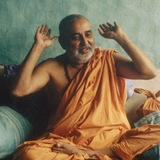
A Real Sadhu
The sadhu visited one village after another to propagate satsang. They cared not whether it was day or night. Wherever they went, they collected flour and cooked their meals from whatever they managed to get.
Once the sadhus had halted at a village called Sankarda. Every morning, they would go round the village to beg foodstuff (bhiksha). Yogiji Maharaj, accompanied by the blind sadhu Bhagwatswarupdasji, would also go around to beg food. Holding one of his hands, he led Bhagwatswarupdasji along the road. A bag hung from Yogij Maharaj's other shoulder. When anybody offered flour, grain, etc., he would open his bag. As he walked, he kept searching the road so that no stone or thorn or pit could get in the way of Bhagwatswarupdasji. After the morning round was over, he cooked whatever alms they had received. He first devoutly offered the food to the Lord. Then, after serving everybody else, he would finally sit down to have his meal.
Karsansang Bapu of Adval often saw Yogiji Maharaj leading the blind and aged sadhu Bhagwatswarupdasji while going round for alms. One day, he saw the barefooted Yogiji Maharaj begging for alms in the scorching heat of summer. He felt pity for him. 'Yogiji Maharaj', he asked, 'why don't you take a younger sadhu with you? How difficult it must be with such an aged sadhu to go about asking for bhiksha!' Yogiji Maharaj, smiling, replied quietly, 'Bapu, it is my good fortune to have such an aged sadhu with me. I am extremely fortunate to learn from a revered old sadhu! While moving about with him I get the benefit of his vast knowledge, experience and wisdom. I also get the benefit of serving the mandir by bringing in bhiksha.' Karsansang Bapu could not but admire the good sense and kindliness of Yogiji Maharaj. He bowed to him silently as a token of respect.
Flame of Knowledge
In 1990, the climax of Swamishri's four month stay in UK were the celebrations of the Diwali and Annakut Festival in London.
After the festivities, Swamishri sat down for his lunch in the kitchen. The youths had decorated the kitchen with lighted candles and lamps ('divas'). As Swamishri was eating, one of the youths sang a prayer in Gujarati and said, 'Swamishri we have lit this room with candles and lamps. Now please help us to illuminate our hearts with your light.'
Swamishri was pleased with the youth's prayer and said, 'The flame of knowledge (gnan) is already lit within your heart. Now you have to ensure it doesn't blow out.'
'But how do we know whether the flame is still glowing?' asked one of the youths.
Swamishri stopped eating and explained, 'The flame of knowledge is said to be glowing if you can remain steady in Satsang through times of tears and laughter, honor and insult. If we keep this flame aglow at all times we will experience the bliss of God.'
Swamishri is an illuminated personality because the flame of knowledge is constantly glowing within his heart. He is in constant communion with God.
Control Of Instincts
In the Samvat Year 1869, there was a severe drought in Kathiawad. In order to lessen the consequent burden, Maharaj sent Muktanand Swami to Surat with a group of two hundred sadhus. Gunatitanand Swami was also included in this group. Somebody had tied a monkey in the ruins just opposite the lodging of the sadhu. Everybody's attention was naturally drawn towards that monkey due to its incessant movements.
One night, whilst giving a discourse, Muktanand Swami addressed all the sadhu, 'Look, how vagrant are our senses! They always beguile us. There is no need for us to look there, but there is hardly anyone among us who has not seen that monkey. If there is anybody, please stand up.' Everyone was astonished when they listened to Muktanand Swami. Only Gunatitanand Swami stood up with folded hands from amongst the two hundred sadhus.
Seeing this, Muktanand Swami was also surprised and he said, 'Oh! You are the only one amongst this group who could control his instincts. Even I once looked at that monkey.' But Swami could do it because he constantly looked inward and there was nothing in his heart, except the murti of Maharaj. Muktanand Swami was all praise for this brahmic state of Swami.
The Enlightened Have Innumerable Eyes
Yagnapurushdasji went to Surat from Vartal and engaged himself in the service of his guru and the mandir. In the month of Fagun of the same year, a festival was organized in Surat to mark the installation of the murti of Ghanshyam Maharaj. Hence Acharya Maharaj, sadhus and the devotees from various places had arrived in Surat. Pragji Bhakta had also come from Mahuva on this occasion. Spiritual discourses by Pragji Bhakta were going on till late night and sadhus and devotees listened to him with rapt attention. Yagnapurushdas used to go to the seats of all the sadhus and listen to them. Seeing a large assembly in front of Pragji Bhakta, he also went to his seat for hearing his discourses.
He found his discourse to be distinct from other discourses. While giving the discourses, Pragji Bhakta, a tailor by trade, simultaneously carried on his work of stitching. And the listeners, too, listened to him with rapt attention. Nobody moved from his seat. Everyone had joy writ on their faces. Yagnapurushdasji was surprised to see this. He felt Pragji Bhakta to be an extraordinary person, for he was talking and giving discourses while looking at all the people in the gathering and stitching a cloth at the same time. How was he able to do all these activities at the same time? Pragji Bhakta immediately read Yagnapurushdasji's mind and said, 'Sadhuram (good sadhu)! Every creature has two eyes, the learned have three, the religious have seven but the gnani (enlightened) has innumerable eyes. Hence, I can see with my fingers, I can see with my back, in fact I can see everywhere.'
Akshar Deri is Here
At the end of an evening assembly, Swamishri was blessing the devotees. A youth with shoulder-length hair came to Swamishri.
'Why have you kept long hair?' inquired Swamishri.
'Fashion,' the youth replied. Swamishri held the youth's wrist and drew him closer. 'Understand one thing, young man,' Swamishri said lovingly, 'if we begin wearing the fads and fashions of this country, we will gradually drift away from the values taught in the Satsang. As Yogi Bapa's youth one has to set a good example for others to follow. It doesn't suit us to keep long hair.'
The youth admitted his mistake and said, 'I take a vow to get it cut after I have darshan of the Akshar Deri in Gondal (India).'
Hearing the youth's vow, said, 'But the Akshar Deri is right here before you. Cut your hair right away.' The youth agreed to change his ways quickly.
We all know that the Akshar Deri is the wish-fulfilling and peace-giving shrine dedicated to Gunatitanand swami.
But Swamishri is the living embodiment of Akshar Deri because he too can give us peace and help us fulfil our wishes through his blessings. The scriptures also state that all the pilgrimage places, holy rivers and sacred mountains culminate in the God-communion sadhu.
Devotion Par Excellence
Yogiji Maharaj had the small murti of Shri Harikrishna Maharaj (small metallic murti of Shriji Maharaj, formerly worshipped by Gunatitanand Swami). The time to offer water to Shri Harikrishna Maharaj was fast approaching but there was no water anywhere. Yogiji Maharaj became worried and upset. 'My Lord must be very thirsty. What shall I do?' he said to himself.
It was six in the evening when they came to a river. Yogiji Maharaj asked the cart-driver to stop by the river side. He took the murti of Shri Harikrishna Maharaj, bathed it in the river water and offered it filtered water to drink. Yogiji Maharaj was still not fully satisfied. He prostrated and prayed repeatedly before the murti, 'Oh Maharaj, please forgive me. Today, I have failed to give You water on time. Please forgive me.' On hearing this, Swami Nirgundasji who was standing nearby casually said, 'It wasn't your fault that we couldn't get any water on the way. You are not to blame.'
Still, Yogiji Maharaj kept bowing to the murti repeatedly and prayed for forgiveness. Words fail to describe the full measure of his dedication, devotion and humility. We should also cultivate these same virtues.
The All-Knower'
Looking at a youth named Tarun, Swamishri said, 'You reached here before us because you are familiar with the roads in London.'
Tarun took this opportunity to tell Swamishri, 'I may be familiar with London but you are the knower of millions of universes.' Swamishri laughed and said, 'Millions of universes yes, but in London, even I need a guide!'
Sometimes Swamishri reveals his true identity to us like a flash in the pan. He mixes so freely and readily with us that we seldom realize his true glory.
Service of ill Sadhus
Once Shriji Maharaj arrived at Kariyani from Gadhada. From here Maharaj wanted to go to Vartal for the festival of Ram Navmi. But here nineteen sadhus were taken ill. So Maharaj said, 'I'll give the fruit and benefit of one hundred festival to the person who serves these ailing sadhus.' But nobody was prepared to leave Maharaj and serve the ailing sadhus. Gunatitanand Swami knew Maharaj's desire and duly volunteered. Maharaj was very happy and said, 'Kudos to this sadhu. He did not let me down.' Maharaj then left for Vartal. Swami served the ailing sadhus with enthusiasm. By the grace of Maharaj all the sadhus recovered fully. Moreover, there was still a few days before the festival, so Swami expressed his desire to go. All the sadhus gave their consent willingly and requested Swami to embrace Maharaj on their behalf. Swami reached Vartal, remembering Maharaj. Maharaj was very happy to see Swami who had come after serving the ailing sadhus and thereby pleasing Him. Maharaj embraced Swami nineteen times.
Once Shriji Maharaj arrived at Kariyani from Gadhada. From here Maharaj wanted to go to Vartal for the festival of Ram Navmi. But here nineteen sadhus were taken ill. So Maharaj said, 'I'll give the fruit and benefit of one hundred festival to the person who serves these ailing sadhus.' But nobody was prepared to leave Maharaj and serve the ailing sadhus. Gunatitanand Swami knew Maharaj's desire and duly volunteered. Maharaj was very happy and said, 'Kudos to this sadhu. He did not let me down.' Maharaj then left for Vartal. Swami served the ailing sadhus with enthusiasm. By the grace of Maharaj all the sadhus recovered fully. Moreover, there was still a few days before the festival, so Swami expressed his desire to go. All the sadhus gave their consent willingly and requested Swami to embrace Maharaj on their behalf. Swami reached Vartal, remembering Maharaj. Maharaj was very happy to see Swami who had come after serving the ailing sadhus and thereby pleasing Him. Maharaj embraced Swami nineteen times.
Pilgrimage at the Feet of Gunatitanand Swami
Once, after the festival of Annakut Pragji Bhakta was washing the utensils. There was a pit of dirty water. Gunatitanand Swami came there and stood there watching Pragji at work. He put his foot on the edge of the pit. The dirty water touched his toes. At that time Swami asked Pragji, 'Where can one find all the sixty-eight places of pilgrimage?' Pragji Bhakta understood the deeper meaning of Swami's words and directly jumped into the pit of dirty water. It was a spiritual bath for him. He knew that all the sixty-eight holy places lay in that pit of dirty water because Swami's toes were dipped into it. For some time Swami watched his devotee taking the holy bath in the dirty pit, then he said, 'Pragji, come out, go and wash yourself with clean water.' Such was the devotion of Pragji Bhakta.
Once, after the festival of Annakut Pragji Bhakta was washing the utensils. There was a pit of dirty water. Gunatitanand Swami came there and stood there watching Pragji at work. He put his foot on the edge of the pit. The dirty water touched his toes. At that time Swami asked Pragji, 'Where can one find all the sixty-eight places of pilgrimage?' Pragji Bhakta understood the deeper meaning of Swami's words and directly jumped into the pit of dirty water. It was a spiritual bath for him. He knew that all the sixty-eight holy places lay in that pit of dirty water because Swami's toes were dipped into it. For some time Swami watched his devotee taking the holy bath in the dirty pit, then he said, 'Pragji, come out, go and wash yourself with clean water.' Such was the devotion of Pragji Bhakta.
'An Hour is Better than Births'
After a lengthy journey of more than three hours by car, Swamishri arrived from Hartlepool (North-East England) to Preston. A gathering of devotees had been waiting eagerly at the mandir to receive Swamishri and his entourage.
As Swamishri got out of the car, a devotee said, 'Swamishri, we have been waiting for over an hour for you.'
Swamishri's response was instant, 'A one hour wait is still better than waiting for many births.'
We sometimes forget how fortunate we are to have the contact of a God-communion sadhu. From time to time, Swamishri reminds us of the good fortune that we are blessed with.