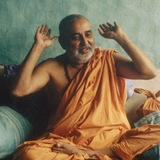
'God is Truth'
A man came to see Swamishri at the mandir and asked a few questions.
Q. 'What is truth?'
A. 'God is truth and this materialistic world is temporary and fleeting.'
Q. 'How can one attain God?'
A. 'One has to seek the company of a God-communion sadhu who has the wisdom to differentiate between the real and unreal. The next step is to repose faith in his words and live according to his commands. Through time, one will experience the true joy of God.'
Q. 'Do you experience the joy of God? If so, how can I tell?'
A. 'Yes. One who has truly realized God always remains blissful in the knowledge of God. Before such knowledge, the materialistic pleasures of this world appear cheap and artificial. Yogiji Maharaj had such knowledge and that is why he always had inner happiness.'
Fearlessness
Dungar Bhakta was fearless from childhood. One night his father went to the farm leaving him asleep. After a while, he woke up and found his father's bed empty. It was midnight. He thought of going to the farm. He took a stick in his hand and went alone to the farm at midnight, chanting the name of Swaminarayan. Having seen him arrive alone on such a dark night, his father asked him, 'Weren't you afraid of coming here alone at such a late hour, my dear?' There was a common belief that the road to the farm was haunted by ghosts.
Dungar Bhakta replied in his simple and innocent language, 'Haven't you told me, father, that Maharaj accompanies him who walks chanting the name 'Swaminarayan, Swaminarayan,' and protects him? I have thus brought Maharaj with me. If the ghost had accosted me I would have driven him away with this stick.' Dhoribhai was greatly pleased to hear such brave words from his son. By now Dungar Bhakta had cultivated a habit of listening to religious stories. He could not find himself at ease without listening to them. When his father would ask him to prepare bundles of tobacco leaves in the field, he would make a precondition, 'I shall make the bundles if you tell me stories of God.' Thus, he found pleasure in nothing but God.
'Swami's Happiness'
One of our youths, Bharat Patel, is a magician. He came to the mandir to perform a few of his tricks in Swamishri's presence. In his first trick, he had a few blank cards and numbered them from one to four. He placed these on the table and explained, 'On one of these cards I have written the words, 'Swami's Happiness.' The other three are blank. Before I pick a card, I want three sadhus to pick a number each to see if they get 'Swami's Happiness.''
Two of the sadhus picked card numbers one and two. The third sadhu was unsure of his choice so he decided to pick card number three but then changed his mind and settled for card number four leaving card number three for Bharat. When Bharat turned the cards over, all of them were blank except for his which had 'Swami's Happiness' written on it.
Swamishri laughed and told the sadhu, 'You lost 'Swami's Happiness' because you changed your mind.'
We learn an important lesson from Swamishri's words which come from the depth of truth. We have to train our mind to obey Swamishri's commands and the rules laid down in the Shikshapatri because that is the path to attain 'Swami's Happiness'. It is only when we change our mind from this path that we lose 'Swami's Happiness.'
Jinabhai in Meditation
There is a confluence of three rivers on the outskirts of Dhari. The place of confluence is known as Triveni Sangam, and the resulting river is called the river Shetrunji. The Shetrunji narrows on reaching a bridge, and shrinks to the size of a small rivulet under the bridge. The inhabitants of Dhari call it 'Patalio Zaro'.
Exactly at this spot near the bridge, Jinabhai used to have his daily bath in the morning. He would wear clean clothes after his bath, and then sit in an upright posture and perform meditation for hours together. He meditated upon the divine form of Shriji Maharaj. To many who saw Jinabhai seated in meditation at such a lonely place, it seemed as if Dhruv himself was meditating! They invariably stood and watched the young Jina steeped in meditation.
Sometimes, friends of Jinabhai would come to have their bath at 'Patalio Zaro'. They were amazed to find Jinabhai rapt in meditation. They would wait for him till he came out of his meditation. And then they would always enquire, 'What were you doing?' And Jinabhai would reply, 'I try to remember God. Will you join me? I will teach you the art of meditation.'
From his childhood Jinabhai never failed to do his meditation every morning. He advised everybody to start their morning work only after remembering Shriji Maharaj.
Love of Devotees
During the tour of North-East England, Swamishri spent a night at a devotee's house in Leeds, Yorkshire.
In the morning, a few devotees had come to have darshan of Swami performing puja. The room in which sadhus had arranged for Swamishri to perform puja was a dining room. The room wasn't very large and with only the sadhus and a few devotees inside, the rest had to sit outdoors in the garden. With a view to keep the cold out, a sadhu had shut the sliding patio door through which the devotees were going to have darshan of Swamishri. When Swamishri came to perform his puja, his eyes fell on the devotees sitting outside and he instructed the sadhu, 'Open the patio door slightly.'
'But it is cold out there,' said the sadhu.
'It doesn't matter,' replied Swamishri.
'At least they can hear the bhajans (devotional songs) if the door is kept open.'
The sadhu did as he was told and slid the patio door just enough as to enable the devotees to hear the bhajans. With this, he sat down beside the door.
As Swamishri's puja progressed, the sadhu began to feel the effects of the chilly wind. He became increasingly worried that Swamishri, too, must be feeling the cold so he shut the patio door.
Towards the end of the puja Swamishri asked the sadhu why he had closed the patio door?'
'I was feeling cold,' replied the sadhu, 'and I thought you must be feeling the cold too.'
'But we are sitting in the warmth of the room,' said Swamishri. 'It is the devotees out there who are suffering the cold. We should always think about the difficulties of the devotees.'
Swamishri willingly suffered the chilly wind to keep his devotees happy. Swamishri's greatness lies in the way in which he looks after the needs of the smallest of devotees.
Craving for Darshan
The glory of great people lies in their very living. The divine virtues of Gunatitanand Swami, described by Shriji Maharaj, revealed themselves on many an occasion. The year was Samvat 1869. Light showers of rain were falling from the sky on that dark night. The sky was covered with clouds and was illuminated with intermittent thunderbolts. All the sadhus had retired to sleep after a session with Maharaj, in which they had enjoyed the company and the darshan of Maharaj. Then Maharaj went to the palace to talk to the devotees.
It was at that time that Gunatitanand Swami was standing under some shade beside the wall, half-drenched, trying to save himself from the rain, in order to have the glimpse of Maharaj's darshan. Meanwhile Muktanand Swami came out of his room for some work and saw somebody standing there. So he enquired as to who it was. Swami modestly replied, 'It is me, Nirgunanand, I am standing here with a view to have the darshan of Maharaj when He returns from the darbar after the spiritual discourse.'
Muktanand Swami was surprised when he saw Swami craving for the darshan. He thought to himself, 'Oh! Look at his faith, he cares neither for his body nor for sleep. Although the murti of Maharaj is constantly in his heart, he craves so much for His darshan.' Muktanand Swami then went into his room but Swami stood there till late in the night, shivering in a half-drenched condition. When Maharaj returned, Swami had a glimpse in the light of a thunderbolt. Thereafter, he went outside the village to sleep under the shade of a tree on the banks of the river Ghela.
Pragji Bhakta Serves as a Barber
A barber named Karsan used to serve the sadhus at Junagadh mandir. He increased his rates by one paise per head. Gunatitanand Swami refused to pay him the increased rates. But soon the sadhus felt uncomfortable without the monthly shaving and tonsuring. Swami asked Pragji Bhakta to do the barber's job. He was always eager to obey his guru.
He bought a razor from the town and first served Swami and then for nearly six months he performed the role of a barber without feeling belittled of what he was doing. He worked as a torch-bearer too. This, too, was the job of the barber. Swami deeply loved him and always offered him food from his own wooden eating bowl.
'The Guru has Seen Us'
'What was it like?' enquired Swamishri.
'It was reddish in color with a faint dot in the middle and a ring all the way round,' replied the sadhu.
Swamishri paused and said, 'You saw Saturn but has Saturn seen you?'
'No,' replied another sadhu, 'but the Guru has seen us.' Hearing this, the previous sadhu added,
'Yes, we are fortunate in that the Guru has seen us. That is all we require.'
'That's right,' said Swamishri.
'Now that we have the contact of a bona fide Guru, we have to remain happy and joyful.'
Sometimes our heart is filled with the joy of knowing somebody great or famous in this world. But does that person know us? Has he ever called us by our name?
Swamishri knows us and loves us. He takes keen interest in our lives. How rare it is to get such close contact of a God-communion sadhu.
This fact alone should be a constant source of joy and fulfillment in our hearts.
Schooling
Dungar Bhakta (Shastriji Maharaj) studied at the village school under Gangaram Mehtaji in Samvat year 1930. His memory was very sharp and his intelligence was high which enabled him to memorise all the lessons immediately. The teacher too became very fond of him and began to give more and more attention to him. Dungar Bhakta, of course, was determined to stand first in his studies, and if he became a sadhu he would attain the first rank in that order as well. Thus, he learnt a lot in a short time. Besides learning in school, he began to study all the scriptures of the Satsang (Fellowship) and also the Shrimad Bhagvat from the sadhus visiting the Mahelav mandir. Even at the tender age of nine, whenever there was no sadhu available in the mandir, it was he who gave discourses to the devout gathering. Everyone listened to him spell-bound. All the residents of Mahelav showered affection on him because of such virtues.
Dungar Bhakta (Shastriji Maharaj) studied at the village school under Gangaram Mehtaji in Samvat year 1930. His memory was very sharp and his intelligence was high which enabled him to memorise all the lessons immediately. The teacher too became very fond of him and began to give more and more attention to him. Dungar Bhakta, of course, was determined to stand first in his studies, and if he became a sadhu he would attain the first rank in that order as well. Thus, he learnt a lot in a short time. Besides learning in school, he began to study all the scriptures of the Satsang (Fellowship) and also the Shrimad Bhagvat from the sadhus visiting the Mahelav mandir. Even at the tender age of nine, whenever there was no sadhu available in the mandir, it was he who gave discourses to the devout gathering. Everyone listened to him spell-bound. All the residents of Mahelav showered affection on him because of such virtues.
'If Only One has Faith'
After lunch, a group of devotees and youths were in Swamishri's room for the afternoon discourse. One of the youths said, 'Swamishri, please show us Akshardham.'
Before Swamishri could say anything a devotee said, 'But Akshardham is sitting before your very eyes. Everything is here if only one has faith.'
Swamishri frequently says, 'We cannot see the Lord in Akshardham and we fail to realize the true greatness of the form of God that is sitting, walking, talking and eating before us.'
So what do we do?
It requires of us to keep faith in the form of God that is before us. Through such firm faith and the divine grace of a God-communion Sadhu we will be blessed with boundless bliss.