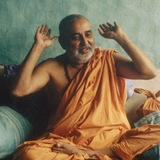
If one Develops Deep Affection for the Great Sant like one has for God…
“… If someone who is deficient in vairãgya does renounce, then his renunciation will not endure throughout his life. After one year, two years, or after even ten years, difficulties will definitely arise in his renunciation.”
[Gadhadã III-29]
“… If someone who is deficient in vairãgya does renounce, then his renunciation will not endure throughout his life. After one year, two years, or after even ten years, difficulties will definitely arise in his renunciation.”
[Gadhadã III-29]
Only Behaving as the Atma does one Become Happy
“… Thus, as long as the influence of the gunas remains within a person, he will never experience happiness; only when he behaves as the ãtmã does he become happy.”
[Gadhadã II-51]
“… Thus, as long as the influence of the gunas remains within a person, he will never experience happiness; only when he behaves as the ãtmã does he become happy.”
[Gadhadã II-51]
What can one do to Earn the Trust of God and His Saint?
Then Ãtmãnand Swãmi asked, “In one’s mind, one is resolute in behaving according to the wishes of God for the rest of one’s life. Still, one feels, ‘What can one do for God and His Sant to earn their trust?’”
Shriji Mahãrãj explained, “A person earns the trust of God and His Sant when, firstly, even if he falls severely ill and is not cared for very well during that illness, he still does not bear an aversion towards anyone, nor does he feel disheartened. Secondly, even if he is harshly insulted by God and His Sant without any fault of his own, he still does not bear an aversion towards anyone. Thirdly, if there were to be the slightest infringement in his observance of the niyams of this Satsang, he would feel extremely repentant and would immediately perform atonement. Also, even if he were to entertain an evil thought in his mind, he would feel just as repentant and distressed as someone who had happened to physically infringe the observance of religious vows. One with such characteristics earns the complete trust of God and His Sant; i.e., they feel of him, ‘This person will never fall back from Satsang.’”
[Gadhadã III-14]
A Paradox to Resolve
“… Only when he attains a spiritual state similar to that of the great Purush does he behave like the great Purush, and only then does he understand the great Purush’s behaviour. However, as long as one has not realised the greatness of the Satpurush, one does not attain the state of being brahmaswarup; yet, without ãtmã-realisation, one cannot realise the greatness of the Satpurush. Hence, there seems to be a paradox. Now please explain how this paradox can be reconciled?”
[Vartãl-11]
Knowing What is True and False
“After a person has thoroughly known that which needs to be known – that this is true and this is false – he realises that except God’s form, all worldly forms are full of terrible miseries, and that they are all perishable. Also, he realises himself to be the ãtmã, distinct from his body, his indriyas and his antahkaran. After this, there is no object that would be strong enough to seduce him. This is because he sees all worldly forms as worthless. So, even if all of the indriyas of a person in whose heart such understanding has become firmly rooted were to extend outwards on the path of pravrutti, still he would not be disturbed by lust, anger, etc.”
[Vartãl-20]
Cultivating the Mind, No Small Feat
“However, one whose mind remains unmoved – that is, it does not become ‘hot’ upon experiencing repulsive vishays and does not become ‘cold’ upon experiencing pleasurable vishays – should be known as a Param-Bhãgwat Sant. But indeed, it is no small feat to cultivate one’s mind in this manner.”
[Gadhadã II-23]
The Vastness of Akshar
“… Countless millions of brahmãnds dwell like mere atoms in each and every hair of that Akshar. It is not that those brahmãnds become small compared to Akshar; they still remain encircled by the eight barriers. Rather, it is because of the extreme vastness of Akshar that those brahmãnds appear so small…”
[Gadhadã II-42]
My Intense Aversion: Egotism, Jealousy and Anger
“Egotism, jealousy and anger – these three vicious natures are much more detrimental than even lust. Why? Because the Sant may have compassion on a lustful person, but he will not have compassion on an egotistical person. In addition, jealousy and anger are evolved from egotism. Therefore, egotism is a major vice. Furthermore, one does not fall from Satsang due to lust as one does due to egotism. For example, there are many householder devotees in our Satsang – and they continue to remain in Satsang. So, I always have an intense aversion for these three: egotism, jealousy and anger. You will find this verified in My spoken words which have been written down. Also, if you reflect upon them, then you will realise this to be true as well. Therefore, one should eradicate egotism by realising the greatness of God.”
[Gadhadã III-27]
Burning One's Sins to Ashes
Thereupon Ayodhyãprasãdji first asked, “In life, a man may be engrossed in the entanglements of worldly affairs all day long, and during that time, he may well perform some pious as well as impious karmas. Moreover, he may engage in worship for only half an hour or so. Is this enough to burn all of the sins he has committed during the day, or not? That is my question.”
Shriji Maharaj replied, 'Even if a person has spent the whole day in pravrutti, regardless of whatever type of activities he may have been involved in, if, when he engages in the worship of God his indriyas, antahkaran and jiva all unite and become engrossed in worship, then even if he does so for half an hour, or even for a few minutes, all of his sins will be burnt to ashes. However, if his indriyas, antahkaran and jiva do not unitedly engage in worship, then his sins cannot be burned by worshipping for such a short while. Such a person can attain liberation only by the grace of God. This is the answer to the question.'
[Gadhadã II-62]
Never Becoming Satiated with Spiritual Discourses
“… My mind never becomes satiated with spiritual discourses, devotional songs, talks related to God or meditation of God. All of you should also do the same.”
[Gadhadã II-49]
“… My mind never becomes satiated with spiritual discourses, devotional songs, talks related to God or meditation of God. All of you should also do the same.”
[Gadhadã II-49]