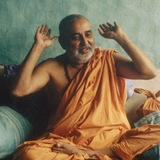
Considering the Virtues of the Sadhu who Speaks Harshly
“… Furthermore, one should consider the virtues of the sãdhu who speaks to one harshly and should not think ill of him…”
[Gadhadã II-47]
“… Furthermore, one should consider the virtues of the sãdhu who speaks to one harshly and should not think ill of him…”
[Gadhadã II-47]
Three Inclinations for Extreme Bliss
“Since the day I began pondering over it, I have noticed that there are three inclinations which lead to liberation and which lead to extreme bliss. Of these, one is profound ãtmã-realisation, which is to believe one’s true self to be the ãtmã and engage in the worship of God, like Shukji. The second is the inclination of a woman who observes the vow of fidelity, which is to worship God as if He is one’s husband, just as the gopis did. The third is the inclination of servitude, which is to worship God as His servant, just like Hanumãnji and Uddhavji. Without these three inclinations, there is no way in which the jiva can attain liberation. In fact, I, Myself, have firmly cultivated all three of these inclinations. Even if a person possesses one of these inclinations firmly, he becomes absolutely fulfilled.”
[Gadhadã II-62]
Shriji Maharaj's Nature
“Now I shall describe My own nature. Even though I have a compassionate nature, if a person spites devotees of God, then I develop an aversion towards that person. If I hear someone speaking ill of devotees, then I would not feel like speaking to him, even if I had to. On the other hand, I become extremely pleased with one who menially serves the devotees of God…”
[Gadhadã II-28]
An Ekantik Bhakta?
“Who can be called an ekãntik bhakta of Vãsudev Bhagwãn? Well, one who possesses the qualities of swadharma, gnãn, vairãgya, and unparalleled bhakti towards Vãsudev Bhagwãn coupled with knowledge of his greatness can be called an ekãntik bhakta.”
[Gadhadã III-33]
“Who can be called an ekãntik bhakta of Vãsudev Bhagwãn? Well, one who possesses the qualities of swadharma, gnãn, vairãgya, and unparalleled bhakti towards Vãsudev Bhagwãn coupled with knowledge of his greatness can be called an ekãntik bhakta.”
[Gadhadã III-33]
For Whom is There no Means for Redemption?
“… there are no means to be redeemed for one who has maligned the Satpurush…”
[Vartãl-14 ]
“… there are no means to be redeemed for one who has maligned the Satpurush…”
[Vartãl-14 ]
The Characteristics of one with and one Free of Worldly Desires
“… In the same way, a person free of worldly desires engages himself in activities only to the extent of God’s wish, but never does he do anything which transgresses that. On the other hand, when a person with worldly desires engages in activities, he is unable to detach himself from those activities of his own accord; he is unable to do so even when God instructs him to do so. Such are the characteristics of a person free of worldly desires and a person with worldly desires.”
[Gadhadã III-18]
The Unhindered Devotee
“… Such a devotee of God is never enticed by any object other than the form of God. He realises, ‘With the exception of God’s Akshardhãm, the form of God in that Akshardhãm and His devotees in that Akshardhãm, everything else – all of the realms, the demigods, and the opulence of the demigods – is perishable.’ Realising this, he maintains profound love only for God. Such a devotee never experiences any sort of hindrances whatsoever.”
[Gadhadã II-24]
Destroying the Jiva!
“… However, by maligning God or His Bhakta, the jiva is also destroyed. Someone may ask though, ‘How can the jiva be destroyed?’ Well, for example, just as a eunuch cannot be called a man or a woman – he can only be called a eunuch, similarly, the jiva of a person who maligns God or His Bhakta also becomes impotent; i.e., it is never able to endeavour for its own liberation. Therefore, his jiva should be known as having been destroyed. Knowing this, one should never malign God or His Bhakta.”
[Gadhadã III-12]
Acting Only to the Extent of God's Instructions
“… Similarly, one who is free of worldly desires engages in activities only to the extent of the instructions given by God…”
[Gadhadã III-18]
“… Similarly, one who is free of worldly desires engages in activities only to the extent of the instructions given by God…”
[Gadhadã III-18]
If one cannot Understand Anything Else
Upon hearing this, Muktãnand Swãmi asked a question: “Mahãrãj, the discourse in which You have just described the three inclinations is very subtle and difficult to put into practise. Only a few can understand it and only a few can actually live by it; not everyone can do so. However, there are hundreds of thousands of people in this Satsang fellowship, and it would be difficult for all of them to understand this principle. So, how can they progress?” Shriji Mahãrãj explained, “If a person behaves as a servant of the servants of a devotee who possesses one of these three inclinations, and if he also follows his commands, then despite not understanding anything else, he would certainly become an attendant of God after this very life and would thus become fulfilled.”
[Gadhadã II-62]