
This MIT CS class teaches you things that all the other classes don't teach you, like...
🖥 Shell tools and scripting
🖥Vim
🖥Data wrangling
🖥Command-line environment
🖥Version control
#shell #computerscience #beginners
🆓Course 🔗Link 🔗
📒Lecture Notes: 🔗Link 🔗
🖥 Shell tools and scripting
🖥Vim
🖥Data wrangling
🖥Command-line environment
🖥Version control
#shell #computerscience #beginners
🆓Course 🔗Link 🔗
📒Lecture Notes: 🔗Link 🔗
Practitioner’s Guide to Statistical Tests
CoreML team at VK
If you want to learn how to choose the right statistical test from the many available and run it on your own data you can find the answer at this article.
The two most essential things in A/B tests are the design of the experiments and accurate analysis of the experiments’ results. In this article, the authors stuck to the most common design and compare various statistical analysis procedures, from the very standard t-test and Mann-Whitney test to state-of-the-art approaches like the reweighted bootstrap.
article: https://medium.com/@vktech/practitioners-guide-to-statistical-tests-ed2d580ef04f
github: https://github.com/marnikitta/stattests
#statistic #ab #tests #vktech
ᅠᅠ
Team
@OpenArchiveBooks
@data_entusiasts
End-to-End Object Detection with Transformers
Authors present a new method that views object detection as a direct set prediction problem.
This approach simplifies the detection pipeline, effectively removing the need for many hand-designed components like a non-maximum suppression procedure or anchor generation that explicitly encode our prior knowledge about the task.
The main ingredients of the new framework, called DEtection TRansformer or DETR, are a set-based global loss that forces unique predictions via bipartite matching, and a transformer encoder-decoder architecture
DETR demonstrates accuracy and run-time performance on par with the well-established and highly-optimized Faster RCNN baseline on the challenging COCO object detection dataset. Moreover, DETR can be easily generalized to produce panoptic segmentation in a unified manner
Paper: https://arxiv.org/abs/2005.12872
Code: https://github.com/facebookresearch/detr
#deeplearning #objectdetection #transformer #coco
ᅠᅠ
Team
@OpenArchiveBooks
@data_entusiasts
Unseen Object Amodal Instance Segmentation (UOAIS)
Github: https://github.com/gist-ailab/uoais
Paper: https://arxiv.org/abs/2109.11103
Dataset: https://paperswithcode.com/dataset/ocid
Project: https://sites.google.com/view/uoais
Team
@OpenArchiveBooks
@data_entusiasts
Github: https://github.com/gist-ailab/uoais
Paper: https://arxiv.org/abs/2109.11103
Dataset: https://paperswithcode.com/dataset/ocid
Project: https://sites.google.com/view/uoais
Team
@OpenArchiveBooks
@data_entusiasts
AlphaRotate: A Rotation Detection Benchmark using TensorFlow
Github: https://github.com/yangxue0827/RotationDetection
Paper: https://arxiv.org/abs/2109.11906v1
Dataset: https://paperswithcode.com/dataset/dota
Documentation: https://rotationdetection.readthedocs.io/en/latest/
ᅠᅠ
Team
@OpenArchiveBooks
@data_entusiasts
Github: https://github.com/yangxue0827/RotationDetection
Paper: https://arxiv.org/abs/2109.11906v1
Dataset: https://paperswithcode.com/dataset/dota
Documentation: https://rotationdetection.readthedocs.io/en/latest/
ᅠᅠ
Team
@OpenArchiveBooks
@data_entusiasts
S2IGAN — Speech-to-Image Generation via Adversarial Learning
Authors present a framework that translates speech to images bypassing text information, thus allowing unwritten languages to potentially benefit from this technology.
ArXiV: https://arxiv.org/abs/2005.06968
Project: https://xinshengwang.github.io/project/s2igan/
#DL #audiolearning #speechrecognition
Team
@OpenArchiveBooks
@data_entusiasts
王新升
S2IGAN | 王新升
A framework that translates speech descriptions to photo-realistic images without using any text information.
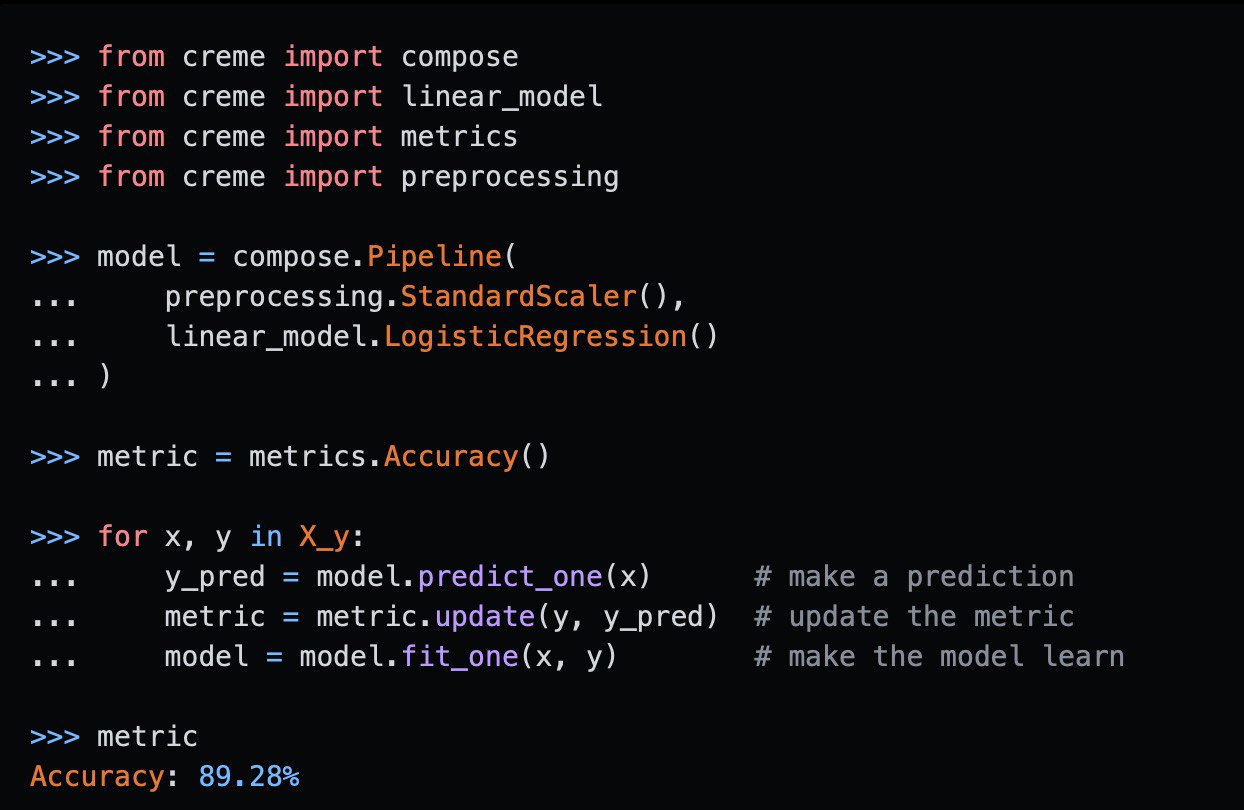
CREME – python library for online ML
All the tools in the library can be updated with a single observation at a time, and can therefore be used to learn from streaming data.
The model learns from one observation at a time, and can therefore be updated on the fly. This allows to learn from massive datasets that don't fit in main memory. Online machine learning also integrates nicely in cases where new data is constantly arriving. It shines in many use cases, such as time series forecasting, spam filtering, recommender systems, CTR prediction, and IoT applications. If you're bored with retraining models and want to instead build dynamic models, then online machine learning might be what you're looking for.
Here are some benefits of using creme (and online machine learning in general):
• incremental – models can update themselves in real-time
• adaptive – models can adapt to concept drift
• production-ready – working with data streams makes it simple to replicate production scenarios during model development
• efficient – models don't have to be retrained and require little compute power, which lowers their carbon footprint
api reference: https://creme-ml.github.io/content/api.html
github: https://github.com/creme-ml/creme
#ml #online #learning
Team
@OpenArchiveBooks
@data_entusiasts
The Cost of Training NLP Models: A Concise Overview
The authors review the cost of training large-scale language models, and the drivers of these costs.
More at the paper: https://arxiv.org/pdf/2004.08900
#nlp #language
ᅠᅠ
Team
@OpenArchiveBooks
@data_entusiasts
The authors review the cost of training large-scale language models, and the drivers of these costs.
More at the paper: https://arxiv.org/pdf/2004.08900
#nlp #language
ᅠᅠ
Team
@OpenArchiveBooks
@data_entusiasts
🤖 The NetHack Learning Environment
#Facebook launched new Reinforcement Learning environment for training agents based on #NetHack game. Nethack has nothing to do with what is considered common cybersecurity now, but it is an early terminal-based Minecraft (as a matter of fact one might say «console NetHack game» to go ‘all in’ in a word pun game).
NetHack is a wonderful RPG adventure game, happening in dungeon. Players control
#NLE uses python and ZeroMQ and we are looking forward to interesting applications or showcases to arise from this release.
Github: https://github.com/facebookresearch/nle
NetHack official page: http://nethack.org
#RL
Team
@OpenArchiveBooks
@data_entusiasts
#Facebook launched new Reinforcement Learning environment for training agents based on #NetHack game. Nethack has nothing to do with what is considered common cybersecurity now, but it is an early terminal-based Minecraft (as a matter of fact one might say «console NetHack game» to go ‘all in’ in a word pun game).
NetHack is a wonderful RPG adventure game, happening in dungeon. Players control
@ sign moving in ASCII-based environment, fighting enemies and doing quests. If you haven’t played it you are missing a whole piece of gaming culture and our editorial team kindly cheers you on at least trying to play it. Though now there lots of wikis and playing guides, canonicial way to play it is to dive into source code for looking up the keys and getting the whole idea of what to expect from different situations.#NLE uses python and ZeroMQ and we are looking forward to interesting applications or showcases to arise from this release.
Github: https://github.com/facebookresearch/nle
NetHack official page: http://nethack.org
#RL
Team
@OpenArchiveBooks
@data_entusiasts
One of the best reference book is definately "Deep Learning with Python" (1st edition) by François Chollet (creator of Keras)
Deep Learning with Python (2nd edition) has been released with 500 pages of code examples, theory, context, practical tips...
Book:
https://www.manning.com/books/deep-learning-with-python-second-edition?a_aid=keras
For online reading:
https://livebook.manning.com/book/deep-learning-with-python-second-edition/chapter-1/
Jupyter notebooks on Github:
https://github.com/fchollet/deep-learning-with-python-notebooks
#DL #ML
ᅠᅠ
Team
@OpenArchiveBooks
@data_entusiasts
PyCM 3.3 released: Multi-class confusion matrix library in Python
https://github.com/sepandhaghighi/pycm
Team
@OpenArchiveBooks
@data_entusiasts
https://github.com/sepandhaghighi/pycm
Team
@OpenArchiveBooks
@data_entusiasts
GitHub
GitHub - sepandhaghighi/pycm: Multi-class confusion matrix library in Python
Multi-class confusion matrix library in Python. Contribute to sepandhaghighi/pycm development by creating an account on GitHub.
🔥Consistent Video Depth Estimation
New algorithm for reconstructing dense, geometrically consistent depth for all pixels in a monocular video.
Obviously, later there will be various VR/AR effects based on this research. Looking forward to it.
Paper: https://arxiv.org/abs/2004.15021
Project site: https://roxanneluo.github.io/Consistent-Video-Depth-Estimation/
Video: https://www.youtube.com/watch?v=5Tia2oblJAg
Team
@OpenArchiveBooks
@data_entusiasts
GoEmotions: A Dataset for Fine-Grained Emotion Classification
http://ai.googleblog.com/2021/10/goemotions-dataset-for-fine-grained.html
Team
@OpenArchiveBooks
@data_entusiasts
http://ai.googleblog.com/2021/10/goemotions-dataset-for-fine-grained.html
Team
@OpenArchiveBooks
@data_entusiasts
research.google
GoEmotions: A Dataset for Fine-Grained Emotion Classification
Posted by Dana Alon and Jeongwoo Ko, Software Engineers, Google Research Emotions are a key aspect of social interactions, influencing the way peop...
Rethinking Generalization of Neural Models: A Named Entity Recognition Case Study
Authors use the NER task to analyze the generalization behavior of existing models from different perspectives. Experiments with in-depth analyses diagnose the bottleneck of existing neural NER models in terms of breakdown performance analysis, annotation errors, dataset bias, and category relationships, which suggest directions for improvement.
The authors also release two datasets for future research: ReCoNLL and PLONER.
The main findings of the paper:
– the performance of existing models (including the state-of-the-art model) heavily influenced by the degree to which test entities have been seen in the training set with the same label
– the proposed measure enables to detect human annotation errors.
Once these errors are fixed, previous models can achieve new state-of-the-art results
– authors introduce two measures to characterize the data bias and the cross-dataset generalization experiment shows that the performance of NER systems is influenced not only by whether the test entity has been seen in the training set but also by whether the context of the test entity has been observed
– providing more training samples is not a guarantee of better results. A targeted increase in training samples will make it more profitable
– the relationship between entity categories influences the difficulty of model learning, which leads to some hard test samples that are difficult to solve using common learning methods
Paper: https://arxiv.org/abs/2001.03844
Github: https://github.com/pfliu-nlp/Named-Entity-Recognition-NER-Papers
Website: http://pfliu.com/InterpretNER/
#nlp #generalization #NER #annotations #dataset
ᅠᅠ
Team
@OpenArchiveBooks
@data_entusiasts
Data Science for Beginners - A Curriculum by MICROSOFT
A project-based data science curriculum for beginners with great lessons, notes, and assignments.
10 weeks, 20 lessons, using Python.
#beginner #datascience
https://github.com/microsoft/Data-Science-For-Beginners
A project-based data science curriculum for beginners with great lessons, notes, and assignments.
10 weeks, 20 lessons, using Python.
#beginner #datascience
https://github.com/microsoft/Data-Science-For-Beginners
This media is not supported in your browser
VIEW IN TELEGRAM
Believe it or not, this is not originally a video. It was made from a collection of photos. Sounds interesting?
Learn more about video from this paper:
AI Synthesizes Smooth Videos from a Couple of Images!
Paper link: https://arxiv.org/pdf/2110.06635.pdf.
Code: https://github.com/darglein/ADOP
ᅠᅠ
Team
@OpenArchiveBooks
@data_entusiasts
Learn more about video from this paper:
AI Synthesizes Smooth Videos from a Couple of Images!
Paper link: https://arxiv.org/pdf/2110.06635.pdf.
Code: https://github.com/darglein/ADOP
ᅠᅠ
Team
@OpenArchiveBooks
@data_entusiasts
Counting Happiness and Where it Comes From
Researchers asked 10,000 Mechanical Turk participants to name 10 things which are making them happy, resulting in creation of HappyDB.
And since that DB is open, Nathan Yau analyzed and vizualized this database in the perspective of subjects and actions, producing intersting visualization.
Hope that daily reading @data_enthusiasts makes you at least content, if not happy.
• Happines reason visualization link: https://flowingdata.com/2021/07/29/counting-happiness
• HappyDB link: https://megagon.ai/projects/happydb-a-happiness-database-of-100000-happy-moments/
• Research Paper: https://arxiv.org/pdf/1801.07746.pdf
#dataset #emotions #visualization
Team
@OpenArchiveBooks
@data_enthusiasts
FlowingData
Counting Happiness and Where it Comes From
Researchers asked 10,000 participants to list ten things that recently made them happy. I counted and connected the dots.
Learning to Simulate Dynamic Environments with GameGAN
#Nvidia designed a GAN that able to recreate games without any game engine. To train it, authors of the model use experience collected by reinforcement learning and other techniques.
GameGAN successfully reconstructed all mechanics of #Pacman game. Moreover, the trained model can generate new mazes that have never appeared in the original game. It can even replace background (static objects) and foreground (dynamic objects) with different images!
As the authors say, applying reinforcement learning algorithms to real world tasks requires accurate simulation of that task. Currently designing such simulations is expensive and time-consuming. Using neural networks instead of hand-written simulations may help to solve these problems.
Paper: https://cdn.arstechnica.net/wp-content/uploads/2020/05/Nvidia_GameGAN_Research.pdf
Blog: https://blogs.nvidia.com/blog/2020/05/22/gamegan-research-pacman-anniversary/
Github Page: https://nv-tlabs.github.io/gameGAN/
Code: https://github.com/nv-tlabs/GameGAN_code
#GAN #RL
Team
@OpenArchiveBooks
@data_enthusiasts

🎙🎶Improved audio generative model from OpenAI
Wow! OpenAI just released Jukebox – neural net and service that generates music from genre, artist name, and some lyrics that you can supply. It is can generate even some singing like from corrupted magnet compact cassette.
Some of the sounds seem it is from hell. Agonizing Michel Jakson for example or Creepy Eminiem or Celien Dion
#OpenAI 's approach is to use 3 levels of quantized variational autoencoders VQVAE-2 to learn discrete representations of audio and compress audio by 8x, 32x, and 128x and use the spectral loss to reconstruct spectrograms. And after that, they use sparse transformers conditioned on lyrics to generate new patterns and upsample it to higher discrete samples and decode it to the song.
The net can even learn and generates some solo parts during the track.
explore some creepy songs: https://jukebox.openai.com/
code: https://github.com/openai/jukebox/
paper: https://cdn.openai.com/papers/jukebox.pdf
blog: https://openai.com/blog/jukebox/
#openAI #music #sound #cool #fan #creepy #vae #audiolearning #soundlearning
Team
@OpenArchiveBooks
@data_enthusiasts