CREME – python library for online ML
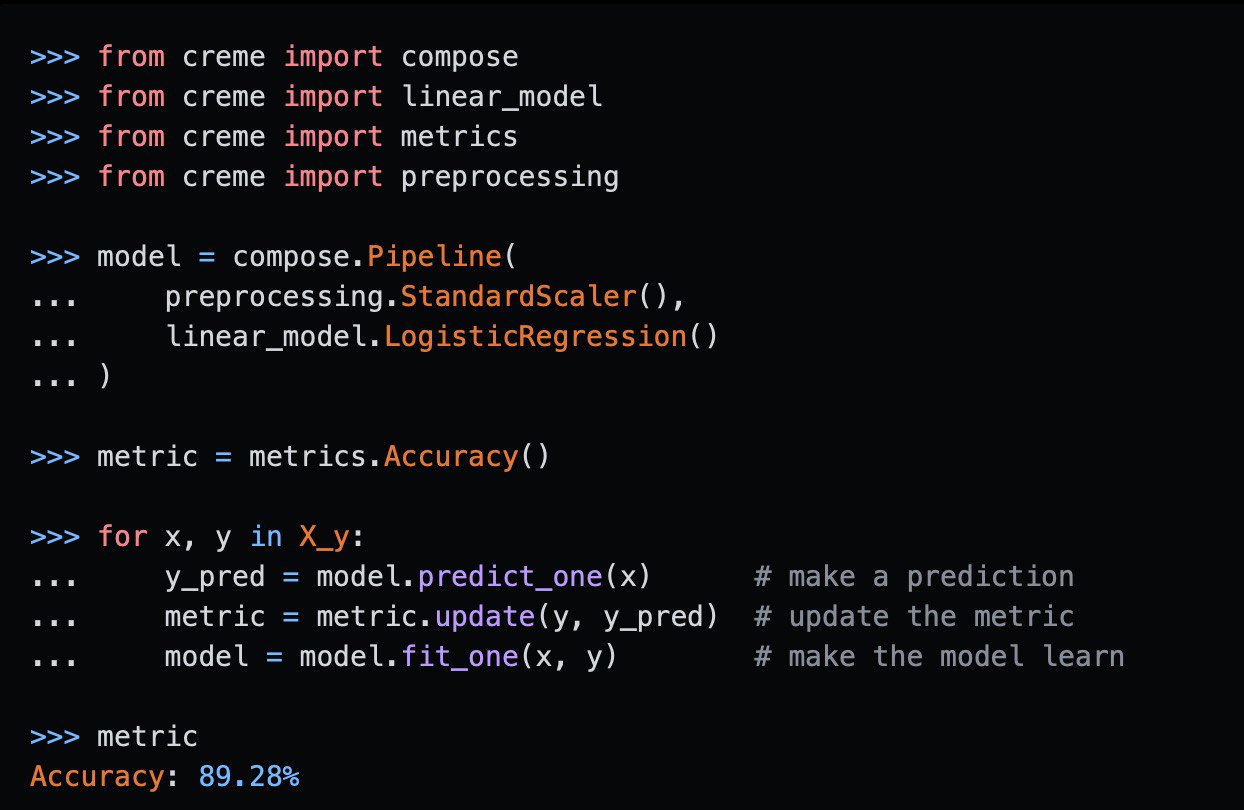
All the tools in the library can be updated with a single observation at a time, and can therefore be used to learn from streaming data.
The model learns from one observation at a time, and can therefore be updated on the fly. This allows to learn from massive datasets that don't fit in main memory. Online machine learning also integrates nicely in cases where new data is constantly arriving. It shines in many use cases, such as time series forecasting, spam filtering, recommender systems, CTR prediction, and IoT applications. If you're bored with retraining models and want to instead build dynamic models, then online machine learning might be what you're looking for.
Here are some benefits of using creme (and online machine learning in general):
• incremental – models can update themselves in real-time
• adaptive – models can adapt to concept drift
• production-ready – working with data streams makes it simple to replicate production scenarios during model development
• efficient – models don't have to be retrained and require little compute power, which lowers their carbon footprint
api reference: https://creme-ml.github.io/content/api.html
github: https://github.com/creme-ml/creme
#ml #online #learning
Team
@OpenArchiveBooks
@data_entusiasts
One of the best reference book is definately "Deep Learning with Python" (1st edition) by François Chollet (creator of Keras)
Deep Learning with Python (2nd edition) has been released with 500 pages of code examples, theory, context, practical tips...
Book:
https://www.manning.com/books/deep-learning-with-python-second-edition?a_aid=keras
For online reading:
https://livebook.manning.com/book/deep-learning-with-python-second-edition/chapter-1/
Jupyter notebooks on Github:
https://github.com/fchollet/deep-learning-with-python-notebooks
#DL #ML
ᅠᅠ
Team
@OpenArchiveBooks
@data_entusiasts
Mathematics for Machine Learning
This is a 400-page free book about the mathematics needed for machine learning. It covers the things you need to know in order to get started with machine learning.
Website: https://mml-book.github.io/
PDF: https://mml-book.github.io/book/mml-book.pdf
#ML #Mathematics #FreeBook
Team
@data_enthusiasts
@OpenArchiveBooks
An overview of the fundamental data science/AI libraries:
• numpy is the quintessential library for scientific computing in Python, in that in supports high-performance arithmetic in batches via its array data structure.
• pandas builds on numpy in that it supports SQL-style manipulation of tabular data.
Numpy and pandas encourage you to conceptualize your data as "one thing". Unlike the rest of Python, writing "explicit" for loops for numpy and pandas operations is actually less communicative than using the provided functions and methods (which are optimized), and should be avoided as much as possible.
• sklearn has general-purpose machine learning tools as well as ready-made implementations of popular algorithms that you can fit to your data.
• scipy implements functions that are useful for scientific computing that aren't found in numpy.
• matplotlib is used for data visualization.
• PyTorch and Tensorflow are both used for deep learning that can benefit from GPU computation.
#python #libraries #DS #AI #ML #DL
Team
@data_enthusiasts
@OpenArchiveBooks
Fashion MNIST.pdf
876.8 KB
A classification model using KNN algorithm to identify correct labels based on the fashion images. Fashion-MNIST is a dataset of Zalando's article images consisting of a training set of 60,000 examples and a test set of 10,000 examples.
Each example is a 28x28 grayscale image, associated with a label from 10 classes. Each training and test example is assigned to one of the following labels: T-shirt/top, Trouser, Pullover, Dress, Coat, Sandal, Shirt, Sneaker, Bag, Ankle boot.
#machinelearning #ml #classification #zalando #fashion #tech
Credit: Fazil Mohammed
Team
@data_enthusiasts
❤3
Math of ML.pdf
3.1 MB
Mathematics of Machine Learning by Philippe Rigollet.
These lecture notes would teach you all that you need about the math behind machine learning!
#math #ml #datascience
Team
@data_enthusiasts
These lecture notes would teach you all that you need about the math behind machine learning!
#math #ml #datascience
Team
@data_enthusiasts
❤2