
🇩🇪⛔️ Cons of living in Germany
Each country has its own pros and cons. Sometimes it’s just little things, and sometimes quite big flaws. I would like to talk about such a few "annoying minuses" in Germany today. Let's go!
💶 Inability to pay by credit card
In large stores and supermarkets, cards are most often accepted. We don’t even have to talk about small shops, cafes and vending machines for paying for public transport - cash only. A trifle? Of course, but it can obviously cause inconvenience.
🚾 Paid toilets (even at McDonald's)!
Probably everyone knows the joke about the "worldwide free network of public toilets" - McDonald's. That's just not about the German branches. Most often there is a person sitting there with a plate in which it is supposed to put coins. The exception, of course, are cafes and restaurants where you are threated like a guest - then you can use the restroom without paying.
❄️Cold in houses during winter
Probably one of the most famous "disadvantages" of Germany, due to the widespread saving traditions of the Germans. And they can be understood - heating bills can come in a quite hefty amount. Therefore, in order not to go broke, you have to freeze ...
📅 "Dead Sunday"
On Sundays, everybody in Germany has a rest. All large shops, shopping centers and any institutions are closed. In other countries, Sunday often becomes a “day of shopping,” but in Germany such a tradition is not possible; you have to invent other activities.
🇬🇧 No one speaks English
Of course, this is an exaggeration, and it does not apply to large international cities. Even in foreign affairs agencies and other important departments. Of course, it is clear that if a person is going to live in the country, you need to learn its language. But it often happens that you just arrived, not knowing the langauge and all sorts of bureaucratic problems are to be solved immediately - this is a hassle.
🎹GEMA
GEMA (Gesellschaft für musikalische Aufführungs-und mechanische Vervielfältigungsrechte) is a copyright society for composers, poets and music publishers in Germany. In general, it is committed to protecting the rights of musicians and restricting the viewing of certain videos on YouTube in Germany.😒
📺Pay for television and radio
And again we return to the topic that in Germany you have to pay for all services. Even if you don’t have a TV or radio at home, you have to pay the so-called GEZ-Gebühren.
👷♀️ Permanent strikes
The Germans would not be Germans if they did not like to assert their rights to a better life and a higher salary. Sometimes it seems that strikes are their favorite pastime. And during them, moving inside and between cities becomes very problematic. In addition, the country suffers huge losses.
⭐️ An ideal country does not exist. And if you delve around, then everyone can find more than a dozen "minuses" of Germany for themselves. However, everything can be reconciled.
🇩🇪 And if the “pros” for you outweigh the “cons” - congratulations, Germany is your to-go country! Well, if not, then the search for yourself and “your country” can continue.
👍59❤25💯4🤡3
😬 Special German words
😉 Compound words are typical of the German language. Thanks to this, creative combinations are born that are difficult to translate. Get to know some of them:
🍄Waldeinsamkeit (forest loneliness) - Melancholy-romantic feeling of voluntary loneliness in the forest.
🥓Kummerspeck - literally - "bacon of grief." In general, this is when you start immoderately eating everything in order to drown out your depression. A word describing the inevitable weight gain when someone actively seizes on their sad mood.
👳Sandkastenfreund (sandbox friend) - A friend you have known since childhood.
🐉Drachenfutter (dragon food) - Indicates gifts that the guilty husband makes in order to regain his wife’s disposition.
😓Fremdschämen - means ashamed of someone else.
🐧Rabenmutter (crow mother) is a derogatory term for a mother. Often used for mothers who allegedly do not care enough about children.
📶Treppenwitz (staircase joke) is originally a term for a good thought that doesn’t occur to someone immediately (when leaving the house, on the stairs). Today, the expression Treppenwitz also means “irony of fate”, “flat wit” or “inappropriate, ridiculous behavior”.
👊Backpfeifengesicht - the face to be punched into. In just one word. A derogatory term for someone who provokes or is unsympathetic.
⛩️Torschlusspanik (panic before closing gates) - fear of missing something important in life associated with increasing age.
🌄Fernweh (longing for distant lands) - in many languages there is the expression "homesickness." Fernweh means the opposite: the desire to be in distant lands.
🎶Ohrwurm (earworm) is one of our favorites describing the phenomenon when a melody sounds long and obsessively in the ears.
☃️Handschuhschneeballwerfer (throwing snowballs with gloves) is one of the most unusual words on this list. Denotes a cowardly person.
😈Schadenfreude is the pleasure of seeing someone fail.
🤭Fachidiot is a competent expert in one field, but by and large an idiot.
Klug scheißer / -in - the one who with pleasure explains everything, clarifies and corrects, often right from the point of view of facts, but quickly causes antipathy to others by the way he / she does this and, often, by what insignificant reasons. Roughly speaking - a smart turd.
Sometimes jokingly called erudite
👍38❤18💯1
🇩🇪 Cologne(Köln) Cathedral: interesting facts!
📍 Cologne Cathedral is located 50 meters from the main railway station of the city, so it meets every guest arriving in the metropolis by rail. This impressive building of worship is the third largest Christian cathedral in the world and is a UNESCO World Heritage Site.
⠀
🔺 The main carhedral of the city is considered its main attraction and an unofficial symbol. At the time of completion in 1880, the building was the tallest in the world.
⠀
🔺 The first stone in the foundation of Cologne Cathedral, built on the site of more older Christian churches, was laid in 1228 by Konrad von Hochstaden - Archbishop of Cologne. From this on, the grandiose construction of a cathedral masterpiece began, which, according to the plan of the city’s fathers, was supposed to eclipse other churches.
⠀
🔺 From Emperor Frederick I Barbarossa, the Cologne Archbishop Rainald von Dassel received the remains of the holy magicians - the very ones who came to bow to the infant Jesus. For the relic, a sarcophagus was made of precious stones, silver and gold, and the cathedral was to achieve the same greatness as Cologne was seen in the Western Christian world. The casket with the remains of the Magi still occupies a central place in the cathedral.
⠀
🔺 In Cologne Cathedral, you can see the symbols of episcopal authority, a collection of brocade church clothes, shop windows with finds from Franconian burials discovered during excavations under the foundation of the cathedral, and a two-meter oak cross with the crucifixion of Jesus Christ. The envoy of Emperor Otto I, archbishop of Cologne Hero (969–976), gifted it to the cathedral.
⠀
🔺 The first century of our era - and a realistic, stunning image of Christ at the time of his death! The original cross and halo are preserved.
⠀
🔺 During the war, after the Allied bombing, almost the whole of Cologne turned into ruins, but the cathedral survived. People say that the pilots cherished it as a geographical landmark. Cologne Cathedral is visible from anywhere in the city!
❓ Have you been to Cologne?
👍13❤4😢3
💥 25 useful phrases and phrases with the word "das Glück" = happiness
To unwind this day, I suggest you learn some useful expressions with the well-known (often even with those who don’t learn German 😅) German word - Glück!
📌 Let's go:
Glück auf den Weg! - Bon Voyage! good afternoon!
▫️Glück ab! - have a good flight! happy landing! (for pilots), Bon Voyage!
▫️Glück auf! - I wish you good luck!, happy return!, mostly used by miners
▫️Glück zu! - I wish you good luck! (reassurance)
▫️das Glück im Winkel - modest happiness
▫️ein Schoßkind ein Kind des Glücks sein - to be a minion of fate
▫️das Glück ist ihm hold gnädig, gewogen, ihm lacht das Glück - happiness is smiling on him
▫️das Glück hat ihn verlassen im Stich gelassen, das Glück hat ihm den Rücken gekehrt - happiness left him, happiness turned away from him
▫️er hat Glück - he is lucky
▫️er hat kein Glück, er hat weder Glück noch Stern - he is unlucky
▫️damit hast du bei mir kein Glück - you won’t get anything from me
▫️sein Glück machen - succeed in happiness
▫️sein Glück versäumen - miss your happiness; miss a happy chance
▫️sein Glück verscherzen - (frivolously) miss your happiness
▫️j-m Glück wünschen - wish smb. happiness; congratulate smb.
▫️j-s Glück im Wege stehen - interfere with smb. happy
▫️etw. auf gut Glück versuchen - try smth. random chance
▫️in Glück und Unglück zusammenhalten - to share joy and sorrow
▫️du kannst von Glück sagen - you're lucky; you got off easy
▫️vom Glück begünstigt sein - be the darling of fate
▫️zum Glück - fortunately
▫️er hat mehr Glück als Verstand, dumm hat's meiste Glück ≈ talk fools are lucky
▫️Glück im Unglück haben - to get out of trouble successfully (cf. there would be no happiness, but misfortune would help)
▫️Glück und Unglück wandern auf einem Steig ≈ last happiness with unhappiness on
sleigh ride alone
▫️Glück und Unglück sind zwei Nachbarn, Glück und Unglück wohnen unter einem Dach - last happiness and unhappiness yard about yard live.
🤖 Wenn sie wissen nicht, habe ich einen Bot, die sie benutzen können um besser Deutsch zu sprechen. Alle Verbesserungsvorschläge sind Willkommen!
🤖 If you didn't know, I have a bot that you can use to speak better German. All suggestions for improvement are welcome!
👍20❤11
📌 Interjections in the German language
Interjections (Interjektionen) are very widely used in modern German. They give the speech emotional brightness and make it more lively, so today we will learn the most popular interjections:
Hurra! - Hooray!
Ach! - Oh!
Ach so! - Ah, here it is!
Mist! - pancake!
Oh! - OU!
Ah! - Ah!
Aha! - yeah!
Pfui! / Igitt! - Fu! / Ugh!
Au! / Aua! Autsch! - Ay! / Oh!
Ups! / Huch! / Hoppla! - Oops! / Wow! / Oh!
Oje! - Oh my God!
Mein Gott! - Oh my God!
Wow! / Guck an! - Wow!
Das gibt’s doch nicht! “That can't be!”
Verdammt nochmal! - Hell!
Na so was! - Well well!
Na und? - So what?
Na gut! / Also gut! - Okay!
Hatschi! - Apchi!
Und ob! - Still would!
Ehht ?! - Yah?!
Ach du meine Güte! - My father!
Bravo! - Bravo!
Zum Teufel! - Hell!
❤16👍9🔥2
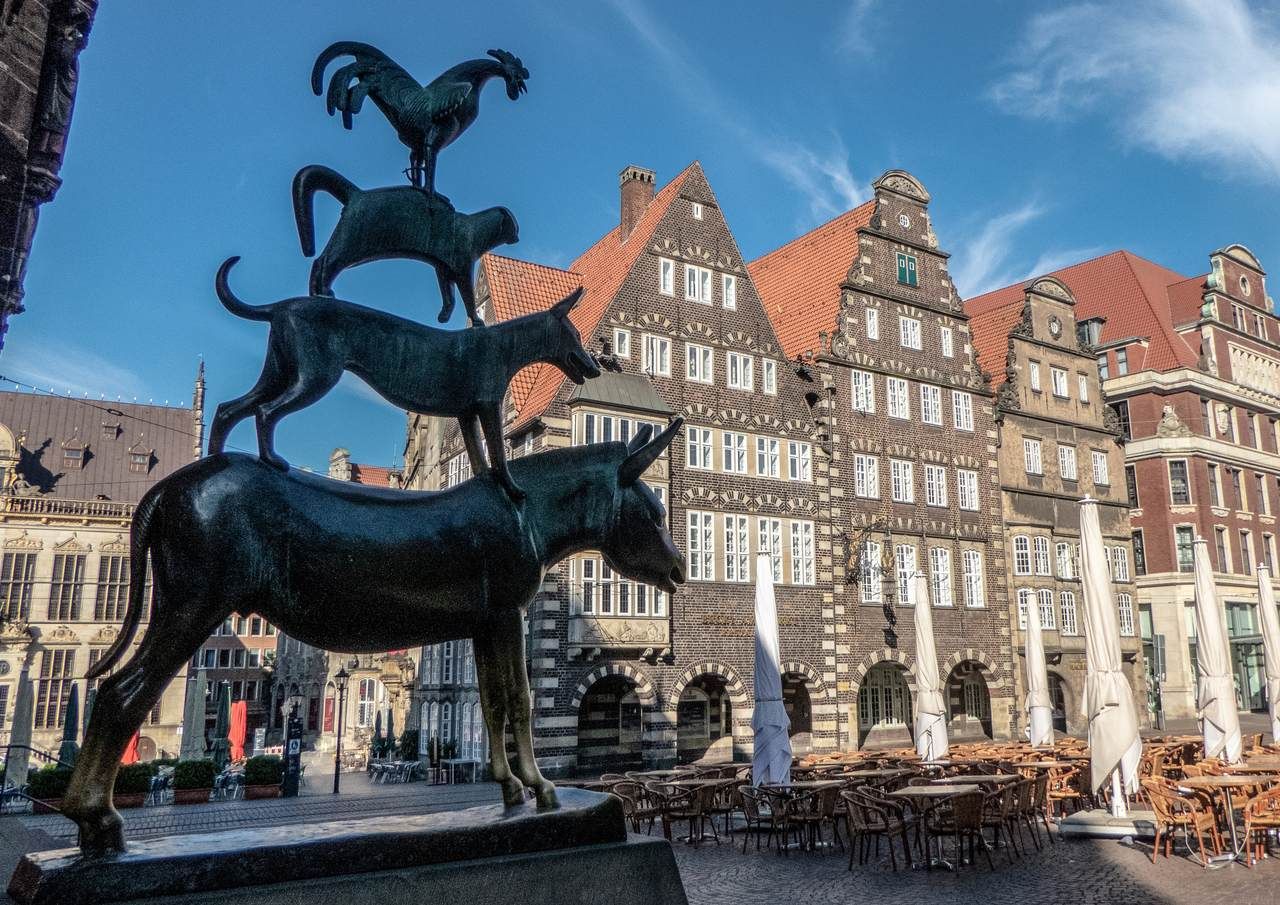
⭐️ Bremen became known all over the world thanks to a fairy tale about stray musicians. Actually, he himself looks like he wants to draw illustrations for fairy tales from him.
🔺It seems as though tourists square every square meter, in fact, interesting hidden sights in Bremen can be seen even on the busiest streets.
⠀
🔺 A great example is the so-called “Bremen hole” - a sewer manhole located in the central square, opposite the Town Hall building. At first glance, it is not much different from all the others, except for the incomprehensible inscriptions on the cover (for those who do not know German at all). In fact, this sewer hatch with a secret, under it is a music piggy bank.
⠀
🔺 It was installed here in 2007 at the initiative of one of the charitable foundations. Four coins need to be lowered into this unusual piggy bank, and then the famous song of the Bremen musicians quartet will play.
⠀
🔺 One of the most popular tourist streets of Bremen is Böttherstrasse. While walking along it, you can stumble upon many interesting sights and architectural monuments. Here you will see the house of Robinson Crusoe, and the fountain of the Seven Sloths and other buildings from famous fairy tales.
⠀
🔺The most mysterious house on the street is House No. 4, also known as The House with the ringing of bells. Many people consider miniature bells to be the usual decoration of the facade, in fact, 30 bells are an important part of the carillon instrument built into the building.
⠀
🔺A few times a day at certain hours, he plays, from March to January, music plays from 12-00 to 18-00, every hour. Not far from the bells you can see a rotating tower, the sashes of which open at a certain time, and you can observe 10 changing panels with interesting images.
⠀
❓ Have you been to Bremen?
🇩🇪✨ Bremen!
⭐️ Bremen wurde dank eines Märchens über streunende Musiker auf der ganzen Welt bekannt. Eigentlich sieht er selbst so aus, als wollte er Illustrationen für Märchen von ihm zeichnen.
🔺Es scheint, als würden Touristen jeden Quadratmeter auf den Platz durchschauen. Interessante versteckte Sehenswürdigkeiten in Bremen sind sogar auf den belebtesten Straßen zu sehen.
⠀
🔺 Ein gutes Beispiel ist das sogenannte „Bremer Loch“ - ein Kanalschacht auf dem zentralen Platz gegenüber dem Rathausgebäude. Auf den ersten Blick unterscheidet es sich nicht wesentlich von allen anderen, abgesehen von den unverständlichen Inschriften auf dem Verkleidung (für diejenigen, die überhaupt kein Deutsch können). In der Tat ist diese Kanalluke mit einem Geheimnis, darunter ist ein musikalisches Sparschwein.
⠀
🔺 Es wurde hier 2007 auf Initiative einer der gemeinnützigen Stiftungen installiert. Vier Münzen müssen in dieses ungewöhnliche Sparschwein gesenkt werden, und dann wird das berühmte Lied des Bremer Musikerquartetts gespielt.
⠀
🔺 Eine der beliebtesten Touristenstraßen Bremens ist die Böttherstraße. Bei einem Spaziergang können Sie auf viele interessante Sehenswürdigkeiten und Baudenkmäler stoßen. Hier sehen Sie das Haus von Robinson Crusoe, den Brunnen der sieben Faultiere und andere Gebäude aus berühmten Märchen.
⠀
🔺Das mysteriöseste Haus auf der Straße ist das Haus Nr. 4, auch bekannt als Das Haus mit dem Läuten der Glocken. Viele Menschen betrachten Miniaturglocken als die übliche Dekoration der Fassade. Tatsächlich sind 30 Glocken ein wichtiger Bestandteil des in das Gebäude eingebauten Glockenspielinstruments.
⠀
🔺Einmal am Tag zu bestimmten Zeiten spielt er von März bis Januar stündlich Musik von 12:00 bis 18:00 Uhr. Unweit der Glocken sehen Sie einen rotierenden Turm, dessen Flügel sich zu einem bestimmten Zeitpunkt öffnen, und Sie können 10 wechselnde Tafeln mit interessanten Bildern beobachten.
⠀
❓ Waren Sie schon in Bremen?
❤8👍4
🤨 How to express our opinion in the German!
It’s hard to say. - Schwer zu sagen.
Of course! - Natürlich!
Of course! - Selbstverständlich!
Agreed! - Abgemacht!
It's simple. - Das ist einfach.
I hope so. - Hoffentlich. Ich hoffe.
I agree. - Einverstanden.
You're right. You're right. - Du hast Recht. Sie haben Recht.
I have a different opinion. - Ich vertrete eine andere Meinung.
I hold the same opinion as you (you). - Ich bin deiner (Ihrer Meinung).
This option is good (better). - Diese Variante ist gut (besser).
Exactly! Right! - Genau!
I have nothing against it. - Ich habe nichts dagegen.
Probably (perhaps). - Wahrscheinlich.
On the contrary (vice versa)! - Im Gegenteil!
What do you mean? - Was meinst du? Was meinen Sie?
This is true. This is not true. - Das stimmt. Das stimmt nicht.
I'm sure. - Ich bin sicher.
I believe you. I believe you. - Ich glaube dir. Ich glaube Ihnen.
Nonsense (bullshit)! - Quatsch!
Not at all. - Gar nicht.
Super! Fine! - Super!
What does this have to mean? - Was soll es (das) bedeuten?
Do not be afraid! (Don't be scared!) - Keine Angst!
It is practical (impractical). - Das ist praktisch (unpraktisch).
I agree with you - Ich stimme dir / Ihnen zu.
👍31❤10
🇩🇪🤯 One German word with more than one meaning
✅ The most important of these words:
die Bank - 1. bench, 2. bank
die Mutter - 1. mother, 2. nut
das Gericht - 1. dish, 2. court
die Scheibe - 1. glass (window), 2. piece / slice 3. disk
die Schiene - 1. rail, 2. tire
der Wurf - 1. throw, 2. offspring
die Tafel - 1. board, 2. bar (chocolate)
der Stock - 1. stick, 2. floor
der Nagel - 1. hobnail🔨, 2. nail💅
die Schale - 1. bowl, 2. shell / peel
der Schalter - 1. switch, 2. window (in the bank, at the station)
der Absatz - 1. paragraph, 2. sales, 3. heel
der Ball - 1. ball(football ball⚽), 2. ball(where people dance💃🕺)
die Decke - 1. blanket / bedspread, 2. ceiling
die Blume - 1. flower, 2. foam (beer)
✅ Some words have different meanings, but there is something in common between them. For example:
das Glas - 1. glass, 2. glass(like a glass cup)
die Birne - 1. pear, 2. light bulb
das Eis - 1. ice, 2. ice cream
das Schloss - 1. castle (palace), 2. lock (at the door)
das Tor - 1. gateway⛩️, 2. goal
das Rad - 1. wheel, 2. bike
der Löffel - 1. spoon, 2. hare / rabbit ear
der Ring - 1. ring💍, 2. boxing ring🤼
das Becken - 1. sink, 2. pelvis (anatomy), 3. cymbals (musical instrument)
das Blatt - 1. sheet (botany), 1. sheet of paper
die Geschichte - 1. history, 2. story
✅ Names and classes of people who have other meanings:
der Hamburger - 1. Hamburger (a person who lives in Hamburg, Germany), 2. Hamburger
der Läufer - 1. runner, 2. elephant (chess), 3. midfielder (in football)
die Dame - 1. queen, 2. drafts 3. queen (in chess)
✅ Animals with a second value:
die Fliege - 1. fly, 2. bow tie (tie)
der Strauß - 1. ostrich, 2. bouquet
der Hahn - 1. cock, 2. water tap
der Kater - 1. cat, 2. hangover
die Schlange - 1. snake, 2. waiting line
✅ Body parts of animals with other meanings:
der Löwenzahn - 1. lion tooth, 2. dandelion
das Katzenauge - 1. cat's eye, 2. reflective light (that thing that glows when light hits)
der Fuchsschwanz - 1. fox tail, 2. hand saw
die Feder - 1. feather, 2. spring
📌P.S. I specifically did not include words in this collection that change their meaning depending on the article, for example: die Kiefer - pine, der Kiefer - jaw. This is a completely different story.
It was also quite hard to find the translations in English😂
👍19❤8🤔1
🌹🙏🏻 Express gratitude. Today we will analyze stylistically elevated forms of gratitude
Turnovers with a short adjective “grateful” - zu Dank verpflichtet sein:
I am very (so deeply, extremely) grateful to you! Ich bin Ihnen sehr zu Dank (so zu Dank, zu tiefem Dank, zu äußerstem Dank) verpflichtet!
How grateful am I to you! Ich bin Ihnen zutiefst dankbar!
👉🏻 For example:
“You have done a lot for me.” I am deeply grateful to you. - Sie haben sehr viel für mich getan. Ich bin Ihnen zu tiefem Dank verpflichtet.
The same can be expressed in a complex sentence indicating the causal justification of gratitude:
I thank you for ... Ich bin Ihnen für + Akk (zu Dank verpflichtet)
I am grateful to you that ... Ich bin Ihnen dankbar (zu Dank verpflichtet) dafür, dass ... / Ich bin Ihnen dankbar (zu Dank verpflichtet), weil ...
👉🏻 For example:
- I am very grateful to you for the provided service. - Ich bin Ihnen sehr dankbar für die erwiesene Hilfe.
- I am very grateful to you for reading my article. - Ich bin Ihnen sehr zu Dank verpflichtet, weil Sie meinen Artikel gelesen haben.
🌸 Statements with the word “grateful” - dankbar sein, as stylistically elevated, are applicable in a formal communication environment.
👍6❤2
❓🤔 haben oder sein?
The choice of the auxiliary verb sein or haben for the past/future tense depends on the meaning of the main verb.
It is enough to remember the rules for verbs with sein, and use the rest of the verbs with haben.
💥 The auxiliary verb sein is used:
1) with verbs of movement: Anna ist in die Stadt gefahren. - Anna left for the city.
🤔 Examples of such verbs: kommen, gehen, schwimmen, springen, laufen ...
2) with verbs denoting transitional states: Ich bin gestern um 23 Uhr eingeschlafen. - Yesterday I fell asleep at 11 o’clock in the evening.
🤔 Examples of such verbs: sterben, aufstehen, wachsen ...
3) with a number of verbs: sein, werden, bleiben, gelingen, geschehen, passieren: Was ist passiert? Was ist los? - What happened?
💥 With the rest of most verbs, the auxiliary verb haben is used:
1) with all transitive verbs (having a direct object and the Akkusativ case): Ich habe den Schlüssel vergessen. - I forgot the key.
2) with verbs describing natural phenomena: Es hat gestern geregnet. - It was raining yesterday.
3) with reflexive verbs (with sich): Ich habe mich gut erholt. - I am well rested.
4) with most other verbs: Ich habe ihm immer geholfen. - I always helped him.
😮 Even Germans sometimes debate whether a particular verb requires haben or sein.
Often this is all due to regional differences. For example, in the north of Germany they say “Ich HABE gesessen” (I sat), while in the south they say “Ich BIN gesessen”. According to the dictionary and the set of rules for grammar "Duden" both options are correct.
🔥 There are verbs that change their meaning depending on use with haben or sein.
For example:
fahren + haben: Ich habe den Sohn nach München gefahren. “I took my son to Munich.”
fahren + sein: Ich bin nach München gefahren. - I went to Munich.
❗The difference is that with haben, the emphasis is on the fact that you drive a car and carry your son, but this is not exactly the “movement” that requires the verb sein, which is why haben is used. Do not confuse this!
👍6🤩6
📅 HOW TO READ DATES IN GERMAN
📌 Often, instead of the name of the month, an ordinal number is used:
8. Februar = 8.02 (achter zweiter)
11. Januar = 11.01 (elfter erster)
Date 3.10 can be said like this: der dritte zehnte or der dritte Oktober
Welches datum haben wir? - Wir haben den dritten Oktober.
Wann ist Goethe geboren? - Am 28. August 1794.
When was Goethe born? - August 28th, 1794.
Der Wievielte ist heute? - Heute ist der 9. Dezember.
What is today's date? - Today is the ninth of December.
Den Wievielten haben wir heute? - Heute haben wir den 9. Dezember.
What is our day today? - Today is December 9th.
📌 An indication of the year (date) is read like:
1749 - siebzehnhundertneunundvierzig,
but 2002 - zweitausendzwei
📌 The digital designation of the year in German is a quantitative one, and only the number of hundreds of years and tens is called.
The combination im Jahre is preceded by a year or not at all.
Ich bin 1959 in Moskau gewesen. - In 1959, I was in Moscow.
or
Ich bin im Jahre 1959 in Moskau gewesen. - In 1959, I was in Moscow
❗️ Pay attention:
Anfang August - at the beginning of August
Mitte Juni - early June
Ende Januar - at the end of January
Anfang, Mitte, Ende des Jahres - at the beginning, in the middle, at the end of the year
Mitte Sommer - Midsummer
✅ The date is written in German like this:
Berlin, den 5. Mai 1995 or
Berlin, den 5.5.1995 or: Berlin, den 5.5.
❓ Are you also confused in writing dates in German?
👍11
🇩🇪❗️35 German words that you know for sure!
📌 Yes, today we have an easy selection of German words, so you don’t have to learn anything! Just remember the correct meanings and do not get confused!
der Absatz - paragraph (also: heel)
der Buchhalter - accountant
das Butterbrot - a sandwich
der Büstenhalter - bra
die Wanne - bath
die Waffel - waffle
das Wunderkind - child prodigy
der Waggon - wagon
das Halstuch - tie (also: scarf)
der Gastarbeiter - guest worker
die Glasur - glaze
der Graf - Count
der Dübel - dowel
der Kanzler - Chancellor
der Kurort - resort
die Landschaft - landscape
der Maßstab - scale
das Müsli - muesli
das Postamt - post office
der Rucksack - backpack
der Stuhl - chair
der Torf - peat
das Feuerwerk - fireworks
die Zeitnot - time trouble
das Zifferblatt - dial
der Schacht - mine
die Scheibe - washer (also: disc; chunk)
der Schlagbaum - barrier
das Schnitzel - schnitzel
die Spritze - syringe
die Schrift - font (also: letter; handwriting)
der Stempel - postmark
die Strafe - fine
der Strich - stroke
der Wechsel - bill of exchange (also: exchange; replacement)
👍7❤1
🇩🇪 20 useful phrases about language abilities1. I study German - ich lerne Deutsch
2. Do you speak German? - Sprechen Sie Deutsch?
3. I understand you well - ich verstehe Sie gut
4. I understand you badly - ich verstehe Sie schlecht
5. I don't understand - ich verstehe nicht
6. How to say it in German? - Wie sagt man das auf Deutsch?
7. We speak different languages - wir sprechen eine andere Sprache
8.We speak the same language - wir reden die gleiche Sprache
9.Please speak a little slower - Bitte sprechen Sie etwas langsamer
10.Please Not So Fast - Bitte nicht so schnell
11. I know a little German - ich kann etwas Deutsch
12. I am fluent in German - ich bin in Deutsch fit
13. He speaks broken German - Er spricht Deutsch gebrochen
14. I speak German reasonably well - ich spreche Deutsch passabel
15.She is capable of languages - sie ist sprachbegabt
16. I speak pure German - ich spreche reines Deutsch
17.He has his tongue set - Bei ihm sitzt die Sprache
18.Don't forget German - Lass deine deutschen Kenntnissen nicht einschlafen
19. I learn German myself - ich lerne Deutsch selbst
20.He speaks a German dialect - er spricht Plattdeutsch
❓ Do you learn German yourself?
🔥10❤6👍4
🤗 10 SIMPLE WORDS WHICH WILL IMPROVE MOOD!
🔸 smile (verb) - lächeln
🔸 smile (noun) - das Lächeln
🔸 Rejoice - sich freuen (auf / über)
🔸 joy - die Freude
🔸laugh - lachen
🔸 laughter - das Gelächter
🔸happiness - das Glück
🔸happy - glücklich
🔸love (verb) - lieben
🔸 love (noun) - die Liebe
🔸 smile (verb) - lächeln
🔸 smile (noun) - das Lächeln
🔸 Rejoice - sich freuen (auf / über)
🔸 joy - die Freude
🔸laugh - lachen
🔸 laughter - das Gelächter
🔸happiness - das Glück
🔸happy - glücklich
🔸love (verb) - lieben
🔸 love (noun) - die Liebe
💯2
🇩🇪 Let's talk about the verb glauben
The main forms of this verb are:
glaubte - geglaubt
Let's analyze the values of glauben:
📌 1. think, speculate
Glaubst du, dass er mich anruft? “Do you think he will call me?”
Ich glaubte, die Frau zu kennen. “I thought I knew this woman.”
Ich glaubte dich in München. “I thought you were in Munich.”
📌 2. believe
Er will mich glauben machen, dass ... - He wants to assure me that
Ich kann es nicht glauben. - I can not believe this.
Es ist (einfach) nicht zu glauben! - It's (simply) incredible!
📍And a few more useful expressions with this verb:
es ist kaum zu glauben! - unbelievable!
ich kann es kaum glauben - it's hard for me to believe it
man könnte glauben, dass sie Geschwister sind - you would think that they are brother and sister
er glaubt nicht daran - he does not believe this
das glaubte man allgemein - that was the general opinion
ich glaube du bist traurig - I think you're something sad
ich glaube, er hat recht - it seems to me that he is right
ich glaube seinen worten nicht - i don't believe his words
👍5
😜 Today we'll have some spoken language
Nope!(I'll give you nothing) = Pustekuchen!
Understandable! = Na klar!
Shit!(soft form) = So ein Mist!
Stop it! = Hör (damit) auf!
at times/sometimes = hier und da von Zeit zu Zeit
Spread it out!(show me what you have) = Schieß los!
really = in der Tat
voluntary = aus freien Stücken
Yes! (Military) = Zu Befehl!
backstage = hinter den Kulissen
instantly = im Nu
instantly = in Windeseile
casually, fluently = zwischen Tür und Angel
forever = bis in alle Ewigkeit
forever = für immer (und ewig)
face to face = unter vier Augen
at random = auf gut Glück
I swear! = Ich schwöre!
I bow down! (expression of respect, admiration) = Hut ab!
Get outta here! = Mach den Abflug!
Calm down! = Reg dich ab!
👍6
🚀 German Prepositions and Cases 🇩🇪
📌 With DATIV
aus - from/out of
außer - except for/besides
bei - at/near/with
gegenüber - across from
mit - with/by
nach - after/to
seit - since (some point in the past)
von - from/by
zu - to/at
📌 With AKKUSATIV
für - for
durch - through
bis - before
gegen - against
ohne - without
um - around, in (about time)
📌 With DATIV oder AKKUSATIV
an - at/alongside || to/toward
auf - on/on top of || on/onto
hinter - behind || behind
in - in || into/in
neben - beside/next to || beside/next to
über - above/over || over/across
unter - under/beneath || under
vor - in front of || in front of
zwischen - between || between
👍4❤3
📌 23 useful phrases! Remember them!
beim Arzt - at the doctor
auf der Party - at the party
am Meer - at sea
aus Liebe - for love
mitten in der Nacht - in the middle of the night
am Lenkrad - driving
nach Augenmaß - by eye
auf der Arbeit - at work
auf einer Hochzeit - at the wedding
an der Haltestelle - at the bus stop
im Fernsehen - on tv
aus dem Gedächtnis - from memory
auf einer Kundgebung - in a protest
für einen Augenblick - for a moment
um Mitternacht - at midnight
an der Ecke - on the corner
um die Ecke - around the corner
am Steuer - driving
👍6
🚂🚃 Compound words!
☝🏻 Germans are very fond of compound words - they play words like cubes. Where English speaking people would use a separate definition, a German will often say in one word. Compare:
der Wintersport (Winter + Sport) - winter sport,
der Hauptbahnhof (Haupt + Bahn + Hof) - main railway station.
❓ What kind of compound word will it be, what genus will it receive? The genus is determined by the last word - by the word “train”:
das Benzin + der Preis = der Benzinpreis (gas price),
das Bier + die Flasche = die Bierflasche (beer bottle).
📌 Some compound words use a special combination of - (e) s or (less commonly) - (e) n:
der Liebling + die Speise = die Lieblingsspeise (favorite + food = favorite food),
die Wirtschaft + die Krise = die Wirtschaftskrise (economic crisis),
der Bauer + das Haus = das Bauernhaus (peasant house),
das Ohr + die Schmerzen = die Ohrenschmerzen (ear pains, earaches).
In some cases, two nouns aren't needed, other combinations are possible:
rasieren (shave) + der Apparat = der Rasierapparat (razor),
hoch (high) + das Haus = das Hochhaus (high-rise building),
außen (foreign) + die Politik = die Außenpolitik (foreign policy),
vor (before) + der Name (last name) = der Vorname (name).
⚡️ An interesting feature of the German language is the joining of one or more defining word variants:
West– und Osteuropa - Western and Eastern Europe,
an– und abstellen - turn on and off.
👍5
🇩🇪Mathematical terms in German!
Today we will examine the most important mathematical concepts and terms in German, and also practice reading simple formulas and mathematical expressions.
🔢 Numbers in German.
➕ Addition
die addition - addition, summation
addieren, zusammenzählen - summarize
der Summand - addend
der erste Summand - the first addend
der zweite Summand - second addend
die Summe - sum, the result of addition
das Pluszeichen - addition sign (read as "und" or "plus")
3 + 4 = 7 - drei plus vier ist sieben
X + Y = Z - X und Y ergibt Z
The equal sign (=) is read in the formulas as "ist", "gleich", "macht" or "ergibt"
➖ Subtraction
abziehen, subtrahieren - subtract
der Subtrahend - deductible
der Minuend - minuend
die Differenz - difference
das Minuszeichen - minus sign
7 - 3 = 4 - sieben weniger drei ist vier
X - Y = Z - X minus Y ergibt Z
✖️ Multiplication
die Multiplikation - Multiplication
multiplizieren - multiply
der Multiplikator - multiplier
der Multiplikant - multiplied
das Malzeichen - multiplication sign (read in formulas as "mal")
das Produkt - product
zweimal - twice
dreimal - thrice
2 x 3 = 6 - zwei mal drei macht sechs
X x Y = Z - X mal Y ist Z
➗ Division
die Division - division
dividieren, teilen - share
der Dividend - Divisible
der Divisor - divider
das Divisionszeichen - division sign (read in formulas as "durch")
der Rest - remainder of division
der größte gemeinsame Teiler - largest common factor
10: 5 = 2 - zehn dividiert durch fünf gleich zwei
X: Y = Z - X geteilt durch Y ist Z
↪️Root Extraction
Wurzel ziehen aus ... - extract root from ...
die Wurzel - root
der Radikand - root base
der Wurzelexponent - indicator (degree) of the root
das Wurzelzeichen - sign of the root
die Quadratwurzel - square root
die Kubikwurzel - cubic root
√4 = 2 - Quadratwurzel aus vier ist zwei
👍2❤1