
Damien Hirst’s NFT Art Project: What We’ll Discover When It's Over
English artist Damien Hirst’s latest project, “The Currency”, is an artwork in two forms. Its physical form is 10,000 unique hand-painted A4 sheets covered in colorful dots. In the same way as paper money, each sheet includes a holographic image of Hirst, a signature, a microdot and – in place of a serial number – a small individual message.
The second part of the artwork is that each of these hand-painted sheets has a corresponding NFT (non-fungible token). NFTs are digital certificates of ownership that exist on secure online ledgers that are known as blockchains.
The way that “The Currency” works is that collectors will not be buying the physical artwork immediately. Instead, they will pay USD 2,000 for the NFT and then have a year to decide whether they want the digital or the physical version. Once the collector selects one, the other will be destroyed.
So what is going on here, and what does it tell us about art and money?

S Korean MP Bids to Prevent ‘Crypto Crisis’ While Kimchi Premium Evaporates
A South Korean lawmaker wants to throw struggling crypto exchanges a lifeline by forcing an extension to a fast-approaching regulatory deadline – while the so-called kimchi premium is shriveling away to oblivion.
Per EDaily and Hanguk Kyungjae, Cho Myung-hee, an MP from the main opposition People’s Power Party, announced that she is ready to unveil an amendment to the Specific Financial Information Act, which came into force in March this year.
The act requires all crypto exchanges in South Korea, as well as overseas platforms that target South Korean clients, to obtain operating permits from the Financial Intelligence Unit, an agency of the regulatory Financial Services Commission (FSC).
Exchanges were given a six-month grace period (expiring on September 24) in which to complete their applications.
To obtain permits, exchanges must find a banking partner that will provide their customers with real name-verified bank accounts and fulfill a number of anti-money laundering-related criteria. At present, reportedly, only four exchanges have real name banking contracts in place – all of which expire on September 24.
This has led to widespread fears that what media outlets have termed a “shutdown crisis” is looming in a country where crypto trading has boomed beyond the sector’s wildest dreams this year.
Cho’s measure seeks to delays the enforcement of the bill by three months.
Some 30 exchanges are reportedly in talks with banks, with no signs of a breakthrough yet. Banks, for their part, have dug their heels in, refusing to accept the FSC’s assertion that they must absorb 100% of the risk involved with dealing with exchange partners – despite the FSC’s clear displeasure.
Henguk Kyungjae quoted an anonymous official at an unnamed exchange as stating:
“We are putting all our effort into finding banks to provide real-name accounts services, but virtual asset operators are confused by the harsh stance being taken by the government and banks. We need more time to hold talks.”
Cho stated that unless something changed, “it is inevitable that the virtual asset exchanges will go out of business, causing considerable damage to users.”
She lashed out at the government’s “negative stance and passive response” to crypto, which she said had “placed a burden on banks.” She concluded:
“It is necessary to temporarily extend the grace period to minimize the damage caused.”
Meanwhile, Kyunghyang Shinmun reported that the kimchi premium, a phenomenon whereby increased demand for tokens in South Korea drives up prices on domestic platforms, shrunk back to well under 1% this week.
Analysts gave their thoughts on possible reasons for the fall, with some suggesting to the newspaper that domestic investors were biding their time before making further investments, despite the recent upturn in prices.
One claimed that the effects of a “long-term sideways trend following the global price drop” were still being felt in South Korea.
But, according to Scolkg data at the time of writing, the situation has actually worsened for anyone still hoping to make a quick buck out of the price discrepancy since Kyunghyang published its report. The price of major cryptoassets like bitcoin (BTC) and ethereum (ETH) is actually very slightly lower on domestic platforms like Upbit than on international exchanges like Binance.
Customs officials and banking regulators have attempted to stamp out kimchi premium opportunist trading – which saw domestic citizens buy crypto overseas (mainly in China) – and then sell it for a profit of up to 20% on domestic platforms.
Some 33 offenders were identified in crackdown earlier this month, with many cases passed on the prosecution service over suspected criminal violations. Others were handed hefty fines.

Take Part in PrimeXBT’s $20,000 Giveaway!
PrimeXBT is excited to present an all-new giveaway designed to reward some of the platform’s users who interact with PrimeXBT on social media and community chanels.
Learn more https://primexbt.com/blog/take-part-in-primexbts-20000-giveaway/
PrimeXBT is excited to present an all-new giveaway designed to reward some of the platform’s users who interact with PrimeXBT on social media and community chanels.
Learn more https://primexbt.com/blog/take-part-in-primexbts-20000-giveaway/
🇬🇧 Crypto Exchange Currency.com joined the British crypto association CryptoUK
Regulated Crypto Exchange of Tokenized Assets Currency.com joined CryptoUK, the UK cryptocurrency association.
CryptoUK is a self-regulating trade association of the United Kingdom, works to raise industry standards, eliminates misconceptions about the cryptocurrency sector and establishes a dialogue with the authorities. Currency.com joins the association as an executive member.
Along with other members of the association, the crypto exchange will provide information to regulatory and policy-making bodies in order to facilitate the development of new regulatory norms in the crypto sector.
Along with Currency.com, CryptoUK’s executive members are Crypto(.)com, CryptoCompare, BCB Group, Electroneum, eToro, Ripple, Simmons & Simmons and others.
Register and trade on Currency.com top cryptocurrencies and tokenized assets!
EU-backed Fund Teases ‘Digital Asset’ Investment Drive in a Surprise Move
A fund that is backed by EU bodies such as the European Investment Bank (EIB) and the European Commission is set to back a project “specializing in blockchain technologies” that will “invest in traditional equity as well as software tokens and other digital assets.” (Updated at 13:12 UTC with quotes from Richard Muirhead, Managing Partner at Fabric Ventures.)
In a press release from the fund, the European Investment Fund (EIF), its operators claimed they had signed off USD 30m, along with the Luxembourg Future Fund on the first close of an initiative run by Fabric Ventures. The latter was described as a “Europe-based venture fund whose core mission is to back the founders of the open economy across the globe,” as well as the “first EIF-backed fund mandated to invest in digital assets.”
The Fabric Ventures fund’s (USD 130m in total) backers include major names from the crypto space, including the head of the Digital Currency Group, Ledger, Mike Novogratz’s Galaxy Digital and more.
The EIB owns over 61% of the EIF’s shares, per its website, with the European Commission holding almost 31% and the remainder owned by “financial institutions from EU member states, the United Kingdom and Turkey.”
The EIF added that the fund “will invest in traditional equity as well as the software tokens and other digital assets native to these new inclusive and collaborative networks and applications.”
It explained:
“These are all underpinned by the recent invention of digital scarcity and hence ownership. The founders of the open economy frequently have the explicit objective of delivering solutions to many of humanity’s most fundamental challenges.”
The European Commission appears to has been pulling out the stops in an effort to crack down on crypto in recent years. The notion of the EU bodies backing a fund that makes crypto buys of tokens such as bitcoin (BTC) and ethereum (ETH) seems fanciful at best – but the vague nature of terms like “software tokens” and “digital assets” means that all may not be as it seems here.
"We invest in software tokens and digital assets that are a necessary and native component of this new wave decentralized digital networks to incentivize good governance; contribution of supply-side resources; user participation; loyalty and much more in the years to come. Investing directly in tokens or coins targeting a 'money' related use-case directly is out of scope for the fund," Richard Muirhead, Managing Partner at Fabric Ventures, told Cryptonews.com.
According to him, the company is "first and foremost 'first cheque' investors i.e. backing outstanding teams by investing in equity well before token design is complete let alone launch."
Regardless, Fabric Ventures has a distinctly crypto-themed track record. Previously named Firestartr, it has invested in the likes of Polkadot (DOT), Sorare, the American crypto exchange giant Coinbase and the Axie Infinity developer Sky Mavis. It is also a sometime Tagomi and Bitstamp investor that has made BTC and ETH buys.
The EIF Chief Executive Alain Godard was quoted as stating:
“This partnership seeks to address that need and unlock financing opportunities for entrepreneurs active in the field of blockchain technologies – a field of particular strategic importance for the EU and our competitiveness on the global stage.”

'Don't Be Lulled' as European Commission Mulls a Crypto KYC Trap
While the European Commission (EC) says it is not targeting non-custodial crypto wallets, their new set of legislative proposals would still affect such users and the whole nascent sector.
Niklas Schmidt, a lawyer and partner with the Austrian law firm Wolf Theiss, told Cryptonews.com that “in the context of an overhaul of the EU's anti-money laundering rules, the European Commission – in a desperate power struggle – wants to tighten the thumbscrews on cryptoassets, such as Bitcoin (BTC).”
“Don't kid yourself and don't let yourself be lulled into sleep,” warned Compliance Advisor at Dutch bitcoin exchange Bitonic, Simon Lelieveldt.
Under these proposed rules, any entity transferring cryptoassets must collect and store details about the senders and recipients, similar to what already applies to wire transfers – and this so-called "travel rule" had been introduced in June 2019 by the Financial Action Task Force (FATF).
Now, the European Commission wants EU Member States to implement it in order to get full traceability of crypto transfers, Schmidt argued.
What he describes as “typical of the EU's bureaucratic approach” is the use of the term CASPs (cryptoasset services providers) in contrast to the FATF's VASPs (virtual asset service providers).
According to Schmidt,
“In the long run, this rule – if adopted – would likely lead to a bifurcation between fully compliant (and thus very expensive) centralized crypto actors such as centralized exchanges (CEXes) and a parallel universe of non-compliance consisting of alternatives such as decentralized exchanges (DEXes).”
The lawyer stressed that, whether the proposal will make it through the legislative process remains to be seen.

Smaller South Korean Crypto Exchanges Begin to Shutdown, Suspend Services
A number of smaller South Korean crypto exchanges have announced their imminent closure – throwing in the towel in their struggle to meet a fast-approaching regulatory deadline that is threatening to derail the nation’s crypto trading platform industry.
Per Joongang Ilbo, the latest exchanges to announce they will be closing their doors in the coming weeks are Darlbit, CPAX and Daybit.
CPAX’s imminent closure, in particular, will raise eyebrows, as the platform has served as the exchange arm of the major blockchain player Coinplug. The latter is a key government partner on a range of contact-free tech solutions.
CPAX confirmed the news on its website, writing that a coming “suspension of the withdrawal services” on September 1 was “not a temporary suspension,” but was being carried out “in accordance with the termination of our exchange services.”
Darlbit and Daybit both made reference to “the government’s enforcement” of the new measures and “regulatory changes” in their own announcements.
Another exchange, Bitsonic, stopped short of announcing it would close, but admitted on its Telegram channel that it was suspending its services for an initial three months. However, it wrote that it would be “difficult to resume normal operations” after its suspension due to “unavoidable” issues both “inside and outside the company.”
By the 24th of next month, all crypto exchanges in the country must obtain information security management system (ISMS) certification, form partnerships with real name-authenticated commercial banking partners, adopt anti-money laundering protocols, and prove their management credentials to financial regulators – along with a range of other compliance measures.
Failure to comply might result in fines and even imprisonment.
The provisions have already led a number of platforms to close, with many fully aware that they do not have the financial resources required to meet the requirements. Some critics of the regulations, including leading politicians, have warned of a looming “shutdown crisis.”
Most expect at least the “big four” exchanges – Korbit, Bithumb, Upbit, and Coinone – to gain approval, although it seems that none of this group has yet secured the key banking contracts they will need in order to keep doing business after September 24.
With overseas exchange trading also facing a decidedly rocky future, the picture is currently bleak for crypto traders in South Korea – a nation where crypto investment and trading volumes soared this year.
Smaller exchanges have also been shaken by an audit of banking procedures that last week uncovered at least 14 “fake” accounts being used by small trading platforms. All 14 cases have been handed over to the police and prosecution services.

🎙AMA Announcement
Gimme the Coin will host an AMA Session with ESP in Gimme the Coin + ESP chat.
⏱START 4PM UTC 04.08.2021
Prepare your best questions and be ready to participate in time, see you soon.
Please make sure to follow Telegram group @espcoin_chat
🌐Website - http://www.espcoin.io
Gimme the Coin will host an AMA Session with ESP in Gimme the Coin + ESP chat.
⏱START 4PM UTC 04.08.2021
Prepare your best questions and be ready to participate in time, see you soon.
Please make sure to follow Telegram group @espcoin_chat
🌐Website - http://www.espcoin.io
The Impossible Becomes a Reality!!
💥🚀Godfather of Microsoft Windows, Wall Street Capital CEO, Respected US economist and Telecoms legend enter the world of cryptocurrencies with their own project.
🔸These gentlemen are now new members of Core Decentralized Technologies, a company that offers Blockchain-based software and technology, mesh network communication solutions, and enterprise blockchain-based software products.
The most important fact ‼️ For the Core Token, which is an Ecosystem enabler and Services payment utility token used in the Core community Smart Contract platform, a pre-sale is still in progress, which means an extremely advantageous purchase !
The pre-sale ends on August 11, so don't hesitate, because after MAINNET the direction is clear, "ONLY UP".
❗️➡️BUY: coretoken.net
⚠️📢⚠️See for yourself. Don’t miss the exclusive interview on Morning Invest, which was published right now:
➡️https://youtu.be/zPx1yxLeRIg
✅COMMUNITY👥
INFO: t.me/coregroupcc
CHAT: t.me/coregroupchat
TWITTER: twitter.com/CoreGroupCC
YouTube
HOLY! This Is The BIGGEST Crypto Opportunity of The Decade (HINT... bigger than Ethereum)
This is a game-changer! Core Decentralized Technologies has developed a prolific software as significant to human connectivity as the telegraph, telephone, cell phone and internet. It is the logical next step progression to connecting everyone in the world.…
'Red Alert' Crypto Campaign Gathers Support to Amend US Infrastructure Bill
Numerous US crypto advocates have launched an ambitious campaign aimed at driving up support for an amendment to a controversial infrastructure bill – claiming that the legislation would usher in “sweeping surveillance of crypto holders.”
An updated version of the bill – which would seek to fund and enshrine billions of dollars worth of public spending commitments into law – has also been slated as “unacceptable” for the crypto sector. Fears remain high that the legislation would seek to squeeze up to USD 28bn from the crypto sector in the United States.
The advocates are urging Twitter followers to back the amendment, launched by a bipartisan group of senators (the Senate Finance Committee Chairman Ron Wyden, as well as the Republican Senators Pat Toomey and the Bitcoin (BTC)-keen Cynthia Lummis). The measure proposes an alternative crypto plan that would seek to force crypto exchanges and other players to relay data to the Internal Revenue Service (IRS).
Coin Center, a crypto lobbying group, claimed that the amendment “explicitly excludes validators, hardware and software wallet makers, and protocol developers from the expanded definition of a broker.”
The three senators’ support is not enough, however, to ensure the amendment passes. The measure needs at least 60 votes if it is to be added to the bill.
Crypto enthusiasts and industry players have rallied behind a tool posted on the Fight for the Future website. Warning that the bill could “kill crypto” if passed, the site’s authors (who also called the issue a “red alert” on Twitter) invited American citizens to enter their phone numbers. The tool then uses this data to identify the phone number of the user’s senator’s offices. They wrote:
“We’ll provide you with a suggestion of what to say and connect you directly with your lawmaker’s office.”
The blockchain and crypto consultant Katherine Wu called the tool a “super easy process.”
However, the General Counsel at Compound Labs Jake Chervinsky wrote that “some people are reporting issues getting through to their Senators” using the link, suggesting other forms of contact if this proved to be the case.”
He called on “everyone” to contact their senators “now.”
The Coinbase chief Brian Armstrong warned that the bill could have dire consequences if approved. He wrote that the bill would mean that “almost anyone in the crypto ecosystem (miners, validators, smart contracts, open-source developers, etc)” could be “treated as a ‘broker,’” which would put “massive reporting obligations” on them. The measure, he added would also “force exchanges like Coinbase and others to surveil its customers’ transactions in a way that is more intrusive than the rest of traditional finance.”
His thoughts were echoed by Coinbase rival Kraken’s CEO Jesse Powell, who wrote that the amendment “isn’t going to pump itself.”
He claimed the process of using the tool to call his senators “took him less than five minutes,” but noted:
“We clearly aren't hitting them hard enough. Get ‘er done!”
The a16z general partner Kathryn Haun, meanwhile, wrote that her firm had written to Chuck Schumer, the New York Senator and Senate Majority Leader, as well as the Senate Republican Leader Mitch McConnell in support of the amendment.
"A proper regulatory strategy needs to reflect one important fact: crypto is not a monolith. The crypto universe extends far beyond its financial origins, encompassing artwork, community development, and new ways of forming organization," a16z wrote, adding that "We can't afford to sacrifice tomorrow's economic opportunity because of a flawed bill that has a simple fix."
Collins Belton, the managing partner of the legal firm Brookwood, claimed that he was “hoping everyone who has had a chance to raise their voices” would back the campaign.

PoS Coins, Lightning, DeFi & DEXes In Danger as US Bill Chaos Intensifies
Mayhem appears to have broken loose in the world of American politics, and the crypto community may be caught in the eye of the storm, as now, proof-of-stake (PoS) networks might be left in danger at a time when Ethereum (ETH) is moving towards PoS. Moreover, the Lightning Network, decentralized exchanges, and DeFi might get hurt too. (Updated at 16:39 UTC: updates throughout the entire text.)
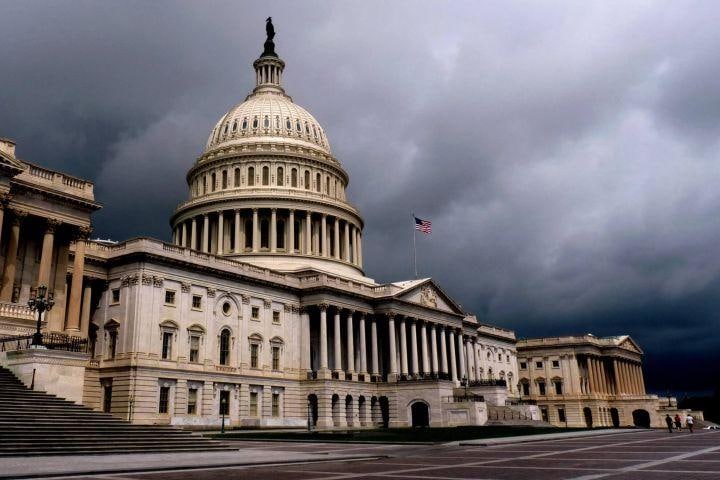
A controversial infrastructure bill being moved with alacrity through the parliamentary system contains a number of clauses that pertain to crypto players and how they are taxed. As previously reported, most of these pertain to the legal definition of a “broker.” This week, the American crypto community has attempted to drive up support for a bipartisan amendment to the bill put forward by three senators, including the crypto-keen Cynthia Lummis.
The original bill could force the crypto mining and trading community to cough up a staggering USD 28 billion – to help fund hundreds of billions worth of USD worth of public spending projects. “Broker” status would force miners and developers to provide exhaustive lists of documents and transaction history records to Internal Revenue Service officials – before paying taxes on their holdings and historic earnings.
Lummis, along with the Senate Finance Committee Chairman Ron Wyden and the Republican Senators Pat Toomey, proposed an amendment that would exempt miners, validators, blockchain developers and wallet-making developers from being classed as “brokers” – and thus subject to all of the provisions of the bill.
Meanwhile, Treasury Secretary Janet L. Yellen spoke with lawmakers Thursday to raise objections to the effort led by Wyden and other senators to weaken the legislation’s proposed crypto overhauls, The Washington Post reported, citing two undisclosed people. Yellen lobbied Wyden about the matter, per the report.
And now, a fresh spanner has been thrown into the works – in the shape of a brand new, rival amendment that appears to have backing from the Presidential office.
The amendment was launched by senators Rob Portman, Mark Warner and Kyrsten Sinema. Confusingly, perhaps, this new amendment proposed the same for of exemption as the original amendment – but only for proof-of-work (PoW) miners, such as Bitcoin (BTC), and (for now), ETH miners. That means developers and validators on proof-of-stake networks like and Cardano (ADA) (or yet-to-be-launched Ethereum 2.0) would be classed as brokers – while Bitcoin protocol professionals would effectively escape unscathed.
Some were quick to point out that in some respects at least, there appeared to be very little difference if at all between at least certain parts of the latest amendment proposal.
Central Bank Admits: Crypto Will Be Used as an Investment Tool
South Korea’s central bank, the Bank of Korea (BOK), has issued a surprisingly crypto-friendly report about the role crypto may play in the economy of the nation going forward – and questioning whether bitcoin (BTC) and altcoins could “replace legal currencies” in the years to come.
There were also some possible words of encouragement for stablecoin developers and decentralized finance (DeFi) advocates.
The BOK published a report on August 8 entitled “The possibility of a paradigm shift in the financial sector brought about by digital innovation” (literal translation). In the paper, the BOK’s researchers forecasted that cryptoassets would continue to be of interest to the private sector in the future, where it would operate as an “investment and speculative” vehicle, and concluded that BTC and the like would probably not completely do away with fiat in the future, mainly due to volatility concerns.
The authors noted that crypto would continue to experience increased “limited-purpose” adoption in the private sector, though, where its functionality would develop separately from fiat currency.
Per SBS and the Segye Ilbo, the BOK report authors wrote,
“The concern is whether or not private cryptographic assets such as bitcoin can replace the role of legal currency in the future.”
Using a familiar argument, they argued that digital assets could become a form of “digital gold,” and win commonplace acceptance in the role of a hedge against inflation.
On the role of stablecoins, the authors wrote:
“Among cryptoassets, stablecoins, which are designed to maintain a stable value by pegging to fiat currency will have a high potential for use in cryptoasset ecosystems, virtual worlds and metaverses, as well as cross-border remittance scenarios.”
The report is not a policy document, but does represent the views of at least some of the BOK’s staff.
The authors also made mention of the growing interest in DeFi, an industry sector they also claim to be on the up, writing that while conventional financial companies will continue to be most people’s go-to resource for “general transactions,” the role of DeFi, which is more specialized “can continue to grow.”

🚀 Robinhood grew by 123% after the IPO
The popular trading platform Robinhood showed an increase of 123% after its IPO, becoming one of the most successful IPOs this year.
Regulated crypto exchange Currency.com conducted a listing of tokenized shares of Robinhood. Investors have the opportunity to buy, sell, store and withdraw token shares from the crypto exchange to a crypto wallet that supports the ERC-20 standard, and trading with leverage up to 20x is also available.
Total for Currency.com there are more than 2000 tokenized assets available, including:
- Top cryptocurrencies.
- Promotions.
- Stock indexes.
- ETF.
- Currencies.
- Raw materials.
- Bonds.
You can top up your account on the crypto exchange by bank transfers, from a Visa/MasterCard card in RUB, EUR, USD and BYN
Register with Currency.com and trade Robinhood token shares!
Poland Should Either Join Eurozone Or Issue Own CBDC - Stock Exchange CEO
To maintain Poland’s capacity to freely conduct its monetary policy, the country’s authorities will need to make a choice: join the eurozone, or launch a national central bank digital currency (CBDC), according to Marek Dietl, CEO of the state-controlled Warsaw Stock Exchange (WSE).
The National Bank of Poland (NBP) may be forced to issue its digital zloty to preserve the country’s monetary sovereignty, according to a recent analysis by Dietl.
While Poland is a European Union member, it's not yet a member of the euro area, and zloty is not yet within the exchange rate mechanism. Per the European Commission website, "Poland does not have a target date to adopt the euro, but aims to do so as soon as possible."
Dietl claims that if Poland does not in the foreseeable future join the euro area, which currently includes its fellow 19 European Union member states, the country should intensify its efforts to launch a CBDC “in a situation in which, in a few years, the architecture of the global financial system will be most likely determined by digital currencies: the dollar, euro and yen”.
“In this new model, the traditional fiat currency and the digital currency would function in parallel, and the Polish central bank would have full control over the base and monetary policy, it could not only defend the zloty, but also create conditions for its expansion,” Dietl said.
In the analysis, which was published by the country’s conservative think tank Jagiellonian Institute, the CEO builds on his earlier remarks made during a panel discussion in May.
“If we don’t introduce the digital zloty, then, whether we want it or not, we will find ourselves using the digital yuan, dollar or euro because it will be more comfortable to use and liquid,” he said.
The digital zloty could introduce a wide range of benefits to Polish consumers, democratizing their access to various segments of the financial market, Dietl argued, adding that “such a digital currency is inevitable, all the more because there will be increasingly efficient safety measures, although there also will be those who will want to override them”.
This said, the current leadership of Poland's central bank has shown little enthusiasm for issuing a CBDC.
Marta Gajęcka, Member of the Management Board of the NBP, said during the same debate that bank was not working on the digital zloty project, but was observing such efforts by its peers across the region.
“Digital currency must be related with safe, reliable systems. Currently, there is no system in the world that would ensure 100% safety,” she said.

Pre-sale in 10minutes, huge marketing campaign the one you've never seen before + a famous rapper is going to advertise our pre-sale shhh🤫!
Pre-Sale link : www.rodtoken.com/presale
✅ Website : https://rodtoken.com
✅ Telegram : https://t.me/rodtoken - beware of scammers.
♛ 2% Rewards to Holders💰
♛ 3% Marketing Contribution💎
♛ 7% Buy-Back Contracts🔥
♛ Long-term marketing strategy
♛ Transparent project🖼
♛ Total Supply: 1 Quadrilion🔥
Presale will be organized on DxSale Platform.
Rodtoken
Rodtoken: Buy Bitcoin & Crypto - Crypto Exchange, App & Wallet
Infra Bill Change Hope Alive as House Disquiet at Crypto Provisions Grows
Pressure is growing in Congress with crypto advocates hopeful of convincing the House of the need to amend a much-maligned infrastructure bill that contains a veritable minefield of reporting obligations for miners, validators and software developers.
Politico called the effort a “long-shot bid,” but noted that the “small but growing coalition” “also includes Republicans.”
Congress members Ro Khanna, Eric Swalwell, Anna Eshoo, Bill Foster and Darren Soto have led calls for an amendment, with Soto quoted as stating:
“Members are starting to pay attention. There is growing bipartisan support to make sure this language is right.”
Jerry Brito, the head of the Coin Center pressure group and a key figure in the campaign to amend the bill, expressed cheer at the fact that a “fourth House Democrat” had said that “the crypto tax reporting provision in the infrastructure bill must be amended.”
He shared Eshoo’s open letter to Nancy Pelosi, the Speaker of the House, where the Congress member wrote that the definition of miners and others as “brokers” was “problematic.” She also criticized what she called “unworkable regulations” proposed in the bill, which has already cleared the Senate, despite a number of proposed amendments.
Khanna, meanwhile, stated that the language in the bill “picks winners and losers.”
Republican support may also be forthcoming in some quarters. Patrick McHenry, a GOP member of the House’s Financial Services Committee, was quoted as saying:
“The current language is completely unacceptable. It needs to be fixed.”
A House leadership aide “who declined to be named” was also quoted as stating that Pelosi “will review the bill’s language.”
Pelosi, Politico noted, “has gone to bat for venture capitalists in the past.”
However, many Democrats are reluctant to amend the bill in any form, due largely to the fact that doing so would result in the legislation returning to the Senate, where it could face yet more delays and opposition.
The same media outlet reported that “ambiguous levels of enthusiasm for the bill among progressives and Republicans” gave the Joe Biden administration little appetite for any sort of amendment.
It also reported that the venture capital powerhouse Andreessen Horowitz has “lobbied to amend the bill in the Senate and is now turning to House offices.” The firm’s global head of policy Tomicah Tillemann was quoted as stating:
“The fascinating thing is that this is an issue that remains largely pre-political, and you saw that in the way the debate played out in the Senate. Regardless of where you fall on the political spectrum, these technologies can help solve problems that you care about.”
The crypto-keen former presidential candidate Andrew Yang tweeted:
“It’s not about paying taxes – but about rules that would drive activity, investment and innovation overseas.”
However, a somewhat sarcastic but nonetheless witty soul replied simply:
“It’s about paying taxes.”

🚀 London hardfork in the Ethereum network - will there be to the moon?
On August 5, the London hardfork took place in the main Ethereum network, which continues the network's transition from the PoW algorithm to the PoS algorithm, which in the future may have a positive impact on the value of ETH. The transition to the new algorithm assumes a slower issue of Ethereum, which can form a shortage of coins on the market.
The potential goal of ETH is to update the historical maximum, which is at $4 380, which is more than 50% higher than the current levels. Do not miss the opportunity to invest in Ethereum and go "to the moon" together with the top cryptocurrency!
Buy the ETH legally and safely, using a bank transfer in RUB, EUR, USD, BYN, as well as using Visa/MasterCard cards on a regulated crypto exchange of tokenized assets Currency.com!
Register and trade on Currency.com!
US Infra Bill Might Prompt Crypto Business Exodus, Treasury Has a Role Too
If the controversial US infrastructure bill is passed in its current form, it may force crypto companies to leave the country as there's no way to comply with the new requirements. However, the industry would also depend on the US Treasury as this institution would need to put the vague language into practice.
The US Senate passed the bill with the original crypto tax provision this week and now it goes to the House next, which is in recess until September 20.
One of the major issues revolves around the use and the definition of the term ‘broker’ for information reporting purposes, as it currently includes node operators, developers, miners, and others who “don't even have access to the information that is needed for tax reporting, and definitely should not be in scope for this reporting,” Wendy Walker, solutions principal at global tax software provider Sovos, told Cryptonews.com.
According to her, the provision presents a risk to a massive segment of the industry and that the word on the street is that businesses, being unable to continue their operations in the US, would move offshore to a country that doesn’t tax them in this respect should the current language remain.
“There's no way that those folks can, not only comply with the requirement, but they won't be able to make a living here doing that,” she said.
Moreover, the US is one of the only jurisdictions that require this third party information reporting, with a similar framework being developed by the Organisation for Economic Co-operation and Development (OECD).
What’s noticeable in other regimes is more real-time tax validation, which is where the IRS and the US, in general, would like to get to as well, Walker said. “They've talked about a more real-time tax system for years.”
However, the bill still might change as the pressure is growing in Congress with crypto advocates hopeful of convincing the House of the need to amend.
In either case, what we’re further going to see is the legislation focusing on centralized exchanges and custodians for whom it is intended. But none of this will happen overnight, as there’ll likely be a period of proposed rulemaking that could take three to six months, while the implementation could take 18 months to three years.
Walker also suggested that there is an interconnectedness on this matter globally. For example, the OECD has been working on a change to the common reporting standards schema to include crypto since before the IRS started working on their issue. And when the OECD heard that IRS was prioritizing this and was going to get some legislative action done, they delayed making their changes, according to Walker.
The reason is that “everybody would flock to the US because the US wouldn’t report any non-US transactions. ... So the idea is that they can't flock to any one country to hide, that everybody will be reporting,” she added.

❗️🔥 How to become MILLIONAIRES in this bullrun 🔥❗️
✅ I will share a hidden gem with you that was recently mentioned by CNBC and Bitboy and also was awarded by the German Government.
The project is called ACRIA and they are building an improved version of Chainlink. Acria is already partnering with the German Government and other big companies and projects like MakerDAO, Litecoin, Polygon.
✅ Acria is building on Cardano (ADA) too
✅ A 100x is possible with this project. I am also invested in the project.
✅ Get in now and get double the amount of ACRIA Tokens (limited time only)
💵 Buy ACRIA here 👉 https://acria.network/
Buy Acria now or you will regret it!
Crypto Sector World’s 3rd Industry in Phishing Attacks Growth - Report
Phishing activities continue to intensify across the world, with their volume for the second quarter of 2021 outpacing the same period last year by 22%. Cryptocurrency increasingly finds itself in attackers’ sight, with a tenfold increase in attacks on exchanges, according to a recent report by cyber threat intelligence company PhishLabs. Due to a spike in attacks, the crypto sector is now ranked as the third industry in terms of growth of phishing attempts.
“In Q2, a combination of brand, executive, and employee impersonation attacks accounted for over half (54.7%) of all social media attacks in the Cryptocurrency sector. This activity identifies threat actor attempts at impersonating cryptocurrency businesses to confuse customers and cash in on the sector’s skyrocketing growth,” the US firm said.
The global crypto industry reported a 13% increase in phishing attacks in the April-June 2021 period compared with the first quarter of this year.
This meant that only two other industries reported a higher growth rate in such attacks in the second quarter of 2021: payment services, with a staggering increase of 561.8%, and broadcast media, up 112.5%, as indicated by data from the report.
“We anticipate cryptocurrency businesses will continue to be aggressively targeted by threat actors through social media in future quarters, due to a majority of their activity and communication taking place through social platforms,” PhishLabs said.
Three site staging methods accounted for all of the phishing attacks targeting crypto exchanges, according to the report.
“Free Hosting solutions hosted 96.5% of the phishing sites, while Compromised Sites accounted for 3.4% of the activity. A small number of sites targeting exchanges abused development tools for staging,” according to PhishLabs.
The remaining 0.1% of such attacks on crypto exchanges were staged with the use of development tools, the analysis said.