🤑 Crypto Exchange Currency.com continues a series of tournaments for traders with a prize fund of $10 000!
In order to participate in the tournament, it is necessary to:
- Register on Currency.com.
- Pass the verification procedure.
- Perform trading operations with leverage.
- Demonstrate the highest profitability.
- Get into the TOP 3 participants and take the prize.
The winners will be determined by the highest yield (P&L) on leveraged trading operations. The rewards are distributed as follows:
🥇1st place - $5 000
🥈 2nd place - $3 000
🥉 3rd place - $2 000
The tournament runs until August 27, 2021. Register and win!
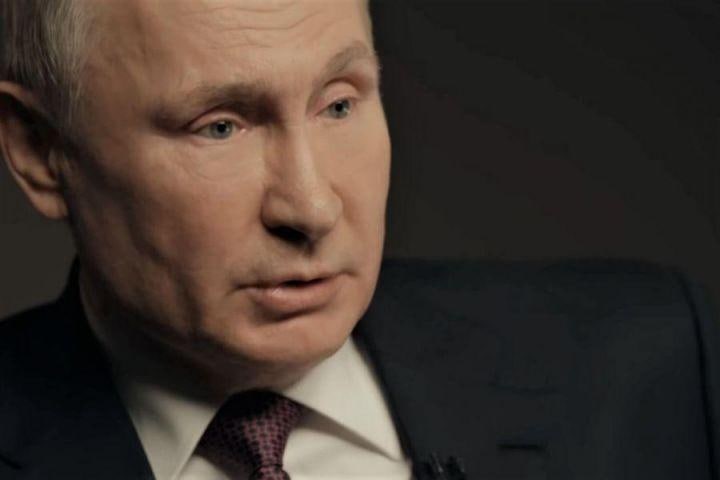
Putin Tells Russian Gov’t to Create a Crypto Holdings Reporting System
The Russian President Vladimir Putin has ordered his government and the Central Bank to prepare a system that will force individuals to declare their crypto holdings.
Per INC-News, Putin has told the bank chiefs, as well as the Ministry of Finance and the Ministry of Labor, to report back to him on their proposals for “verifying the accuracy and completeness of information” on the “ownership of digital financial assets, other digital property and digital currency” by November 15 – and it appears that the President is seeking a joint report, with the finance ministry leading the project.
Putin’s plan is part of the wider “National Anti-Corruption Plan for 2021-2024” – a presidential decree that the head of state signed into law earlier this month. The plan involves placing civil servants under increased scrutiny by forcing them to report on their income and expenses. A number of public officials and private sector individuals are thought to have substantial crypto holdings – a fact that Putin wants to stamp out.
Corruption is rife in Russia, particularly in the public arena, but also in other walks of life – and Putin has attempted to declare war on this with his new measures, the crypto-specific parts of which should come into force by September 2023, per the decree’s roadmap.
Last year, Russia ranked 129 out of 180 countries in Transparency International’s Corruption Perceptions Index ratings – the lowest ranking in Europe. Russia scored just 30 out of 100, with the top-placed nations (Denmark and New Zealand) scoring 88. The lowest-ranked nation was Somalia, with just 12.
Enforcement of these measures will be another matter, however.
However, Russian regulators have previously claimed that they are already arming themselves with tools that could help them do just that. Last year, the Federal Financial Monitoring Service (known locally as Rosfinmonitoring), the government agency that fights money laundering and terrorism funding, reportedly developed a prototype for an AI-powered platform that can “partially” de-anonymize crypto transactions and other related data.
Rosfinmonitoring reportedly believes that its solution works not only for tracing bitcoin (BTC), ethereum (ETH), omni (OMNI) and dash (DASH) users, but also for people making transactions using the privacy coin monero (XMR).
South Korean CBDC Pilot is Now Underway and Samsung is Onboard
The South Korean central bank, the Bank of Korea (BOK), has officially begun testing its prototype of digital KRW.
The bank has decided to carry out a two-stage central bank digital currency (CBDC) pilot, with the first stage running from this week until June next year, tasked with testing focus on tech feasibility and utility. The BOK will then follow this up with a second set of tests to address privacy-related issues and explore possible further usage cases, such as cross-border remittances.
As previously reported, the BOK chose to carry out the pilot with a consortium fronted by a number of Kakao subsidiary firms. Kakao is a fast-growing tech giant with a popular chat app, its own e-pay platform and a number of crypto and blockchain-related interests.
Per Fn News, two Samsung firms are also working on the project, confirming previous reports of the conglomerate’s involvement – divisions or subsidiaries of the mobile maker Samsung Electronics and the IT services arm Samsung SDS.
The United States-based Ethereum (ETH)-focused company ConsenSys is also aboard, as are a number of smaller domestic blockchain and IT players.
The CBDC pilot officially began yesterday, but the BOK, which is still yet to officially commit to issuance, is still distancing itself from the thorny issue of rollout dates – despite the fact that local stablecoin projects and cashless pay incentives are becoming almost ubiquitous in the East Asian nation.
A BOK official was quoted as stating that CBDC drivers were now “beginning globally,” and that Sweden was “at the forefront” of progress.
Sweden’s e-krona project is at a relatively advanced stage, but Seoul likely has its eyes on a much closer nation: China. Beijing’s digital yuan tests are almost complete, and the country is very likely to launch its token either nationwide or in the capital Beijing in time for the 2022 Winter Olympic Games.
South Korea is not used to losing the initiative to China in any aspect of tech innovation – nor is fellow East Asian country Japan. Both the BOK and Japan’s central bank have stepped up the speed of their CBDC projects to a breathtaking pace in recent months as a response – while avoiding direct mention of the digital yuan and instead talking up the need to keep up pace with “global” developments.
The BOK’s governor Lee Ju-yeol last month stated that it would take “two or three years at the earliest” to issue a token should issuance be confirmed.
However, he added that the decision to develop a CBDC prototype was a response to a drop in the demand for cash, rather than “a response to” the challenge of cryptoasset adoption.

🎙AMA Announcement
Gimme The Coin will host an AMA Session with PEAKDEFI in Gimme The Coin + PEAKDEFI chat.
⏱START 4PM UTC 24.08.2021
Prepare your best questions and be ready to participate in time, see you soon.
Please make sure to follow Telegram group @peakdefi_official
🌐Website - https://peakdefi.com/
Gimme The Coin will host an AMA Session with PEAKDEFI in Gimme The Coin + PEAKDEFI chat.
⏱START 4PM UTC 24.08.2021
Prepare your best questions and be ready to participate in time, see you soon.
Please make sure to follow Telegram group @peakdefi_official
🌐Website - https://peakdefi.com/
Starting August 26, 2021, FTX, Raydium and Apollo-X will host the sale of the highly anticipated tokens of the Solana-powered Star Atlas metaverse, ushering in the next era of play-to-earn enabled GameFi revolution. In the two IDOs, additional allocation of ATLAS and POLIS tokens will be available to holders of meta-posters.
FTX:
https://help.ftx.com/hc/en-us/articles/4405371380116-How-to-participate-in-the-Star-Atlas-Sale
Raydium:
https://raydium.medium.com/star-atlas-is-launching-on-acceleraytor-fa35cfe3291f
Appollo-X
https://apollox.paidnetwork.com/project/star-atlas
Official Websites:
* https://StarAtlas.com
* app: https://play.staratlas.com/
Telegram: https://t.me/staratlasgame
✨ Welcome to Manga Token Community ✨
Manga Token is a reward, payment, and staking token for the Manga industry, that can empower manga artists through a new form of digital merchandise called Manga NFTs.
These NFTs are made available to collectors through our Manga NFT Marketplace, TROPHEE.XYZ.
⭐️ $MANGA Key Features
► Main currency to buy NFTs on Trophee Marketplace at 0% transaction fees
► Built on the Binance Smart Chain (BEP-20)
► Users can participate in liquidity pools to earn a yield of $MANGA
► Users can vote for their favorite Manga titles with $MANGA
► Reward manga artists & community's contributions
► Stake $MANGA for new Manga-related projects’ IDO on our Manga Project Starter platform
📌Buy $MANGA
🗓 26-08 (2 PM UTC) - Listing on Pancakeswap
🗓 27-08 (Details Here) - Listing on Bitmart
🗓 27-08 (Details Here) - Listing on P2PB2B
👇 Follow Manga Token👇
• Website • Twitter • Telegram Official Channel • Telegram Official Group • Medium
Recovering Hash Rate, Improving Metrics Indicate Market Rebound - Report
The recovering hash rate indicates that some mining operations are beginning to return online in new locations outside of China, and the worst of the crackdown could be over, according to a recent analysis by crypto financial intelligence provider CoinMetrics.
With mining operations moving out of China following the ongoing government crackdown, Bitcoin hash rate plummeted to its lowest level since 2019. However, after it had hit a local bottom near the end of June, it started recovering in July and August.
Bitcoin’s (BTC) seven-day average spent output profit ratio (SOPR) - a ratio of bitcoin’s price at the time UTXOs are spent to its price at the time they were created - was negative for most of June which signaled that investors were selling the cryptocurrency at loss.
But BTC SOPR has turned positive again in August, a sign that the capitulation period has ended and that the market is back on more solid ground, the report said.
Other cryptocurrencies are also improving their posture this month.
"The rest of the crypto market has bounced back over the past month as well," CoinMetrics said. "Smaller-cap assets have outperformed BTC over the last 30 days led by cardano (ADA) and polkadot (DOT). Other potential ethereum competitors have broken out over the last month, including new all-time highs for solana (SOL)."
Ethereum (ETH) has outperformed bitcoin over the past 30 days, driven by the exploding sales of non-fungible token (NFT) assets such as CryptoPunks, Art Blocks, and others, according to the firm.
Both BTC and ETH usage continued to increase over the past week, growing 4.6% and 4.2% week-over-week, respectively.
Although ETH transactions were up by 3%, total fees dropped by 25.9% for an average of USD 16.3m per day. ETH fees have cooled off since the previous week, but they still remain at the highest level since May, predominantly owing to an avalanche of new NFT drops, the analysis said.
Spot trading volume has also begun to show signs of major improvements, as the “combined trusted trading volume of BTC, ETH, XRP, BNB, DOGE, ADA, DOT, and UNI toppedUSD 25B on August 19th,” according to CoinMetrics.
However, this was still well below the levels seen in April and early May. On May 9, DOGE alone was responsible for more than USD 20bn of trading volume.
Another significant development is linked to a spike in BTC and ETH addresses, as the number of such addresses with relatively small holdings has been increasing throughout this year.
“The total number of BTC addresses holding between 0.001 and 0.1 bitcoin has increased ~15% so far in 2021 but has been somewhat flat since the end of April,” according to the analysis, adding:
“The number of ETH addresses holding 0.01 to 1 ETH is up ~58% YTD and has continued to steadily increase throughout the summer. With NFT summer raging on Ethereum, it is possible that retail interest in NFTs is helping Ethereum adopt new users.”

🔥 Imagine Fair Launches 🚀 with x10 to x500 returns ! 💰
🌟 No scams, No presale, No VC !
It’s the goal of Crypto Factory 💰🚀
All the projects are only fair launches with
✅ verified teams 👱🏻♂️
✅ audited contracts 📃
✅ small market cap 💰
✅ locked liquidy 🔐
✅ transparent tokenomics 📈
JOIN NOW ➡️➡️ https://bit.ly/3mBsB0K
A new coin launched every week 🚀 x10 to x500 is possible each week !
JOIN NOW ➡️➡️ https://bit.ly/3mBsB0K
Telegram
Crypto Factory Incubator
Get an Early Access to a New BSC #FairLaunch
(Locked Liquidity, Audited Contract, Verified Teams, Transparent Tokenomics and $10k initial MC) -
This is NOT financial Advice.
Do Your Own Research.
(Locked Liquidity, Audited Contract, Verified Teams, Transparent Tokenomics and $10k initial MC) -
This is NOT financial Advice.
Do Your Own Research.
South Korean Regulator Creates New Crypto Exchange Policing Unit
The South Korean financial regulator is set to appoint a number of new crypto officials, and forms a new crypto department. But its probable new chief has reiterated assertions that there will be no stay of execution for scores of crypto exchanges that could be forced to close as a result of its actions.
Per News1 and Newsis, the Financial Intelligence Unit (FIU), an agency of the Financial Services Commission (FSC), will establish a “virtual asset inspection division,” which will be charged with the “management and supervision of virtual asset service providers (VASPs),” such as “cryptocurrency exchanges.” The department will also be charged with helping build a regulatory framework for crypto policing and crypto-related anti-money laundering matters.
The division will initially comprise of nine members, but the shake-up will see the FIU hire 14 more staff members and overhaul its structure to accommodate the new crypto division.
The crypto sector will need to pay heed to the new department, as it will be the part of the FIU that conducts crypto exchange operating license application reviews, issues operating permits, and carries out monitoring and on-site inspections efforts.
The FIU also pledged to “improve the existing system” to provide “customer protection” for exchange users.
Meanwhile, Koh Seung-beom, the government’s choice for the soon-to-be-vacant position of FSC chairperson, has sent a stinging warning to the nation’s flagging crypto sector.
Exchanges and political opponents have pleaded with the FSC to grant them six months longer to prepare for new anti-money laundering and banking protocols. These protocols will come into force in under a month – on September 24 – but thus far only one exchange has filed the necessary paperwork.
As things stand, that means that as of the end of next month, South Korea’s 60+-strong crypto exchange sector will be reduced to a de facto monopoly. Even this would not be sure, as the exchange in question – the market-leader Upbit – faces a nervous wait while the FIU reviews its application. The process could take up to three months.
Seoul Kyungjae reported that Ko stated that there would be “no extension” to the deadline. Ko, who appears ready to shoulder the brunt of a looming “shutdown crisis,” added:
“We will quickly share relevant information and make a careful effort to minimize the damage caused to crypto market participants.”

El Salvador: Government Supporters Dismiss Bitcoin ‘Protests’
With just days to go until bitcoin (BTC) becomes legal tender in El Salvador, resistance to crypto adoption is continuing – while pro-BTC advocates are dismissing opposition to adoption and looking forward to the dawn of a new financial paradigm.
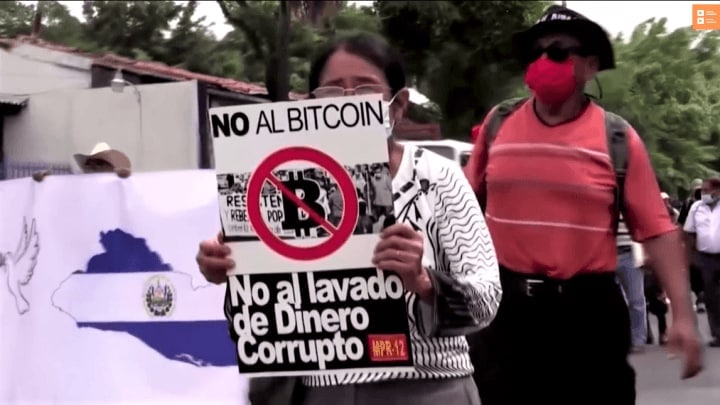
Reuters (via Yahoo) aired images of street protests attended by “Retirees, veterans, disability pensioners, and workers,” which the news agency stated were “expressing their concerns that the government would start paying their pensions in bitcoin instead of USD.”
The footage showed people carrying signs reading: “No to bitcoin” and “No to corrupt money-laundering.”
Some carried placards printed by the left-wing Movement of Popular Resistance (MPR-12) group, while a number of protesters carried a banner that read:
“The working class rejects cryptocurrencies. No to bitcoin.”
Reuters quoted a member of the Supreme Court of Justice’s workers’ union, Stanley Quinteros, as stating:
“We know this coin fluctuates drastically. Its value changes from one second to another and we will have no control over it.”
But some dismissed the protests and argued that the media had sought to blow them out of proportion. The conservative commentator Jose Valdez shared a video of a small group of protestors and wrote on Twitter:
“The traditional media, which is paid to maintain the status quo, and including international media, are selling ‘protests’ with big headlines… But the reality is this: The protests amount to eight people who do not understand what they are opposed to, because they do not even know how it works or what they are they even fighting against.”
Felissa Cristales a popular ARENA party opposition MP, who has famously sided with Bukele on a number of matters, sought to play down talk of protests. She wrote:
“Remember that the government’s opposition will always complain about Bitcoin. Some because they don’t know what it is and others because they want to defend the interests of the banks. Don’t be surprised by this. On September 7, we will start using bitcoin and the doubts will vanish.”
But those who are opposed to the BTC bill will have no doubt taken note of comments from the highest Catholic Church authority in the land – Escobar Alas, the Archbishop of San Salvador – who, in a video shared by La Prensa Gráfica, also expressed crypto doubts.
Alas stated that the public “fears” bitcoin adoption. He urged the government to allay such fears by seeking to educate the public and put an end to the “lack of information” provided to ordinary people on the subject.
El Salvador’s President Nayib Bukele, meanwhile, was in no mood to focus on voices of dissent – instead taking to Twitter to triumphantly post a promotional video for the state-run Chivo bitcoin wallet, which will roll out on September 7.
DeFi Is Not a New Concept and Is Misnamed As Decentralized - SEC Chair
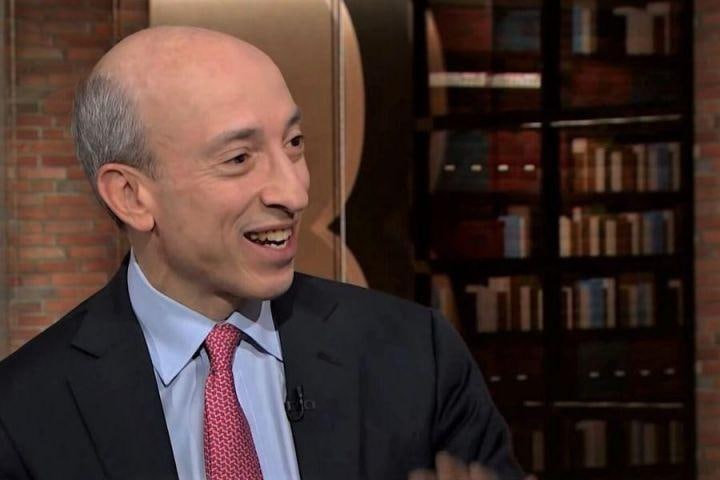
Contrary to a popular belief, decentralized finance (DeFi) is “not really a new concept,” and also a misnomer, as DeFi platforms have “a fair amount of centralization” that includes governance mechanisms, fee models, as well as incentive systems, according to Gary Gensler, Chairman of the US Securities and Exchange Commission (SEC).
“It’s a misnomer to say they are just software they put out in the web,” Gensler told the Financial Times. However, he added that these platforms "are not as centralized as the New York Stock Exchange" and "it’s sort of an interesting thing that is in between."
The latest remarks follow reports that Gensler will not be a “cheerleader” for crypto, and that, after the SEC tightens regulations on crypto exchanges, he plans to turn his attention to policing the world of decentralized finance.
In the interview, Gensler said he remains “technology-neutral,” but cryptoassets are no different than any others in what concerns investor protection, safeguarding against illicit activity, and preserving financial stability.
“At about USD 2tn of value worldwide, it’s at the level and the nature that if it’s going to have any relevance five and 10 years from now, it’s going to be within a public policy framework,” according to Gensler. “History just tells you, it doesn’t last long outside. Finance is about trust, ultimately.”
Gensler said that his focus on crypto trading platforms results from the fact that they accommodate at least 95% of activities in this “highly speculative asset,” but offer “really sparse” protection to investors.
He added that regulators are able to exercise authority over the platforms that he described as supposedly decentralized. However, the chairman also admitted that this posed a challenge for regulators, as such platforms operate without traditional brokers to whom regulations could be easily applied.
Meanwhile, Ryan Selkis, CEO of US-based crypto intelligence firm Messari, criticized Gensler’s stance, taking a quip at the regulator’s past employment as an investment banker with Goldman Sachs.
“Goldman Gary would’ve squashed ETH in 2016 as a security. The US crypto economy would literally not exist had he been in charge,” Selkis said.
According to him, the “SEC’s approach is anti-growth, anti-retail (who would fare worst in the Gensler correction), anti-innovation, and makes the INSANE assumption that it would make sense to wait for government permission.”
Meanwhile, the SEC chairman is scheduled to testify today before the European Parliament’s Economic and Monetary Affairs Committee, discussing transatlantic cooperation in the field of financial services.
UK Students Turn To Crypto Investments Amid Financial Woes
A rising number of UK students are turning to investing in cryptocurrencies to finance their living costs. Since last year, the share of students who make money from crypto has tripled from 2% to 6%, according to a recent survey by British financial advice website Save the Student.
The National Student Money Survey 2021 polled 2,038 university students in the UK between May and August 2021. The obtained results indicate that 76% of the surveyed UK students worry about making ends meet, an increase from 71% in last year’s survey. On average, students face monthly living costs of GBP 810 (USD 1,120), forcing many of them to seek additional sources of income through side hustles or small businesses.
The latest increase came despite the fact that a lower share of students engaged in side activities or businesses to make a living, compared with the previous year. Among students included in the survey, 40% said they had made money from their own business or side hustle, down from 43% who had given the same reply last year.
“There has been a lot of media attention this year about the growing number of new investors getting involved in trading crypto, as the likes of bitcoin and ethereum experienced a 'boom' in the market,” the site said, commenting on the survey’s results.
“With a growing proportion of students saying that they're investing in cryptocurrencies, it's evident that young people need to receive clear, balanced information about crypto to ensure they're making careful financial decisions,” according to the survey.
Among students who declare to have a part-time job, the average amount they earn is GBP 404 per month.
“Despite the proportion of students with a part-time job going down, the amount that students in work are earning from their job has gone up, increasing from GBP 326 per month in 2020,” the site said.

Chinese Banks Bolster Digital Yuan Resources Prior to CBDC Debut
Major Chinese banks are beefing up their digital yuan capacities ahead of the imminent launch of the nation’s central bank digital currency (CBDC).
Per the Securities Daily (via East Money), a number of the commercial banks that have already begun working with the central People’s Bank of China (PBoC) on pilots for the digital CNY are building up infrastructure that will help them offer a range of services to the public once the CBDC rolls out.
As previously reported, the token will almost certainly roll out in the capital in time for the Winter Olympic Games, to be held in February 2022, although the PBoC has refused to issue a timeline for a nationwide release.
But the Postal Savings Bank, which is trialling an offline “hard wallet” for non-smartphone-using digital yuan holders, has “created a new department” dedicated to the CBDC.
The same media outlet noted that the Postal Savings Bank, as well as the China Construction Bank, the Industrial and Commercial Bank of China, the Postal Savings Bank of China and the Bank of Communications had made “repeated mentions” of the digital yuan in their most recent “semi-annual reports and performance briefings.”
And even though the token is still in a pilot stage, millions of Chinese people and companies already have active digital CNY wallets.
By mid-summer, the China Construction Bank had issued 7.23m personal wallets, 1.19m public wallets (for businesses and public organs), and had seen more than 28.45m transactions, worth millions of USD, carried out on its platform.
The Bank of Communications, meanwhile, has opened 1.16m personal digital wallets.
In addition to the Postal Savings Bank of China’s new “major-level” CBDC department, the Industrial and Commercial Bank of China has “signed cooperation agreements with 46 smaller commercial banks” to “jointly create a digital CNY ecosystem” ahead of the rollout.
The Agricultural Bank of China, a member of the “big four” group of (state-owned) commercial banks, has signed a digital yuan partnership deal with the Bank of Xi’an.
The banks are also exploring a range of blockchain-related tech advances.
The China Construction Bank has stated that it will “increase the application of smart contracts, hardware wallets and offline payments,” while the Bank of Communications has also said it will use smart contracts as part of its future business offerings.
Bitcoin Nears USD 53K, Ethereum Stable, SOL Rallies
☄️Bitcoin price extended its increase above USD 52,000.
☄️Ethereum is still struggling below USD 4,000, XRP spiked above USD 1.40 before correcting lower.
☄️FTT is up 30%, and SOL rallied by 22%.
Bitcoin price remained well supported above the USD 50,500 support zone. As a result, BTC started a fresh increase and it climbed above the USD 52,000 resistance. It is currently (03:24 UTC) consolidating gains and it might rise further above USD 53,000.
Besides, most major altcoins are trading in a positive zone. ETH is holding gains above USD 3,900, but it is still struggling near USD 4,000. XRP rallied further above USD 1.40 before it faced sellers. ADA corrected lower after it failed to clear USD 3.00.
Bitcoin price
After a short-term downside correction, bitcoin price started a fresh increase above USD 51,800. BTC cleared the key USD 52,000 resistance to extend gains. It is now trading above the USD 52,500 level, with an immediate resistance near USD 53,000. If there is an upside break above USD 53,000, the price could rise towards the USD 53,800 level.
On the downside, the price could find support near the USD 52,200 level. The next major support could be USD 52,000, below which the price might test USD 51,200.
Ethereum price
Ethereum price is trading in a range below the main USD 4,000 resistance. To start another increase, ETH must clear the USD 3,980 and USD 4,000 resistance levels. The next major resistance is near USD 4,080, above which the price might rise towards the USD 4,200 level.
If the price fails to rise above USD 4,000, it could correct lower. An initial support is near the USD 3,920 level, followed by USD 3,900. The next major support is near the USD 3,850 level.
ADA, LTC, DOGE, and XRP price
Cardano (ADA) failed to clear the USD 3.00 resistance zone. The price is moving lower and it is trading below USD 2.88. If ADA declines below USD 2.80, the bears might test USD 2.65. On the upside, the bulls might continue to face hurdles near USD 3.00.
Litecoin (LTC) started a downside correction after there was no follow up move above USD 240. The price is now trading below USD 225. If there are more downsides, the price could test the USD 212 support zone. The next major support is near the USD 205 level.
Dogecoin (DOGE) tested the USD 0.320 resistance before it started a downside correction. The price is now approaching the USD 0.305 support. The main support is near USD 0.300, below which there is a risk of more downsides.
XRP price topped near USD 1.415 and corrected lower. It is back below USD 1.40 and is testing USD 1.380. If there are more losses, the price could test the USD 1.365 support. On the upside, the USD 1.40 level is a key breakout zone.
Other altcoins market today
Many altcoins are up over 8%, including FTT, SOL, FTM, THETA, RUNE, ALGO, MDX, SNX, TFUEL, OMG, AR, DGB, and CRO. Out of these, FTT rallied by 30% and it surpassed the USD 80 level.
Overall, bitcoin price extended its increase above the USD 52,000 resistance zone. If BTC continues to rise and clears USD 53,000, it could even test USD 55,000 in the near term.
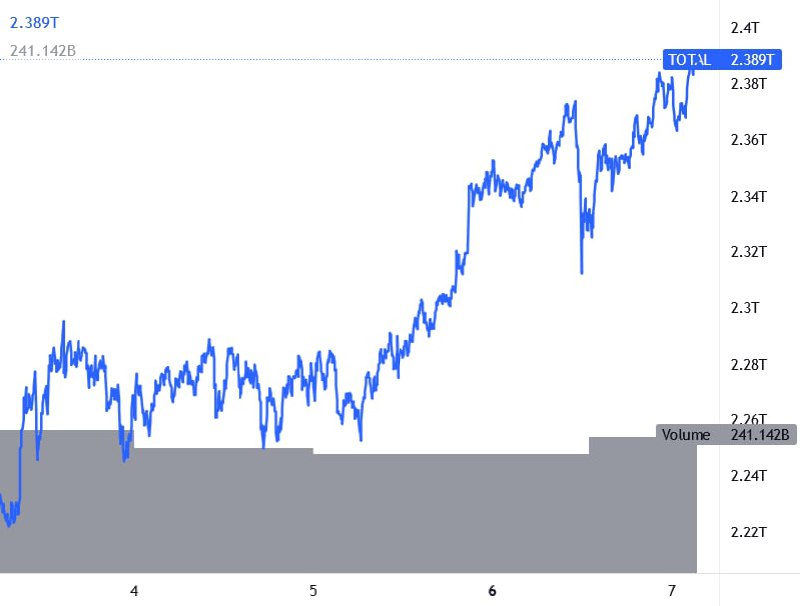
Total market capitalization:
MicroStrategy Insider Sales Hint Executives May Lack CEO’s Conviction
Insiders at MicroStrategy, the US-based software company led by vocal bitcoin (BTC) proponent Michael Saylor, may not be as bullish on the number one cryptocurrency as the CEO himself, new filings with the US Securities and Exchange Commission (SEC) suggests.
As first reported by Bloomberg, the filings showed that MicroStrategy’s Chief Financial Officer Le Phong and Chief Technology Officer Timothy Lang have both sold shares of the company by exercising about 30% of the stock options awarded to them. The sale, which occurred in August, after bitcoin’s all-time highs in the spring, reportedly brought in gains of about USD 7m for each of the executives.
Meanwhile, the CEO himself has not sold any shares, the filings showed.
And while Saylor remains a huge bitcoin bull, with his company holding approximately BTC 108,992 worth over USD 5bn at current prices, the insider sales show that others in the company may not be as convinced as the CEO.
Commenting on the news on Wednesday, Matt Maley, Chief Market Strategist at institutional trading firm Miller Tabak + Co., was quoted by Bloomberg as saying that the sale, in his view, is “a bad sign”:
“Senior executives do not sell stock if they think it’s going higher. It’s just a bad sign no matter how you slice it,” the market strategist said.
He also suggested that some on Wall Street are becoming concerned that Saylor is sacrificing his company’s core business for his laser focus on bitcoin.
However, the view was not shared by everyone, with for instance Ed Moya, senior market analyst at brokerage firm Oanda, quoted in the same report as saying that MicroStrategy is already “a cryptocurrency trade and not necessarily a bet on the company’s software solutions and services,” adding that MicroStrategy’s stock price will “continue to go the direction of Saylor and his bet on Bitcoin.”
At 08:24 UTC, the price of bitcoin was up 4.2% for the past 24 hours to trade at USD 46,571. The gains today followed a sharp sell-off on Tuesday, causing bitcoin to lose nearly USD 10k before recovering some of the losses. Meanwhile, MicroStrategy’s share price has also traded lower since this week’s market crash, falling by 7.3% on Tuesday and 1.6% Wednesday.

South Korea: Four Exchanges Safe but USD 2.6B Closure Storm Brewing
There is mixed news for the crypto exchange industry in South Korea, where it looks like the fate of the four biggest trading platforms is now secure – but customers of smaller exchanges could be caught up in a USD 2.6bn maelstrom.
After a new crypto law came into force earlier this year, exchanges have been told that they must register with the regulatory Financial Intelligence Unit (FIU) by September 24 or close or suspend their business operations.
To do so, they need to fulfill a number of criteria, including securing information security management system (ISMS) certification and real-name authenticated banking contracts for their customers. The latter has proved extremely problematic for most exchanges.
The market leader Upbit last month became the first to submit its documentation to the FIU and has now been joined by Bithumb, reported Yonhap and Money Today, after Bithumb finally sealed an extension to its deal with its existing banking partner NongHyup Bank (NH).
The “big four” already have banking deals in place and have all been offering real-name banking services for several years on six-month contracts with their partner banks. However, all four of the group’s deals had been due to expire on September 24.
But it looks like the rest of the “big four” will also submit their paperwork ahead of the deadline.
Earlier this week, South Korean crypto industry sources told Cryptonews.com that rivals Korbit and Coinone would also file before the week is done and were waiting on official green-lights from their banking partners (NH in the case of Coinone and Shinhan Bank in the case of Korbit).
This has proven to be the case: Kuki News reported that NH and Shinhan have now agreed to extend these deals, with a Korbit official stating that the exchange would likely file with the FIU before the end of September 10, or on Monday (September 13).
Coinone was quoted as stating it was still hopeful of filing before the end of today.
Furthermore, the same media outlet hinted that all was not yet lost for other larger exchanges such as Gopax and GDAC, which it claimed were still “in talks with banks.”
Regardless, banks, which have been told they will need to absorb the risk of hacks and money-laundering cases registered on exchange platforms, are proving reluctant to sign on the dotted line.
And YTN reported that the scale of damages from what the media are calling an incoming “pile” of exchange closures in the nation could hit the USD 2.6bn mark.
The Korea Fintech Industry Association has warned that trading in 42 altcoins will effectively be wiped out, with at least 30 exchanges facing imminent closure.
But Korea University’s Kim Hyung-joong, one of the nation’s leading blockchain academics, stated that the USD 2.6bn figure had been calculated on the basis of exchanges listed on platforms like CoinMarketCap. Plenty of smaller domestic exchanges, he noted, were not listed – meaning the losses to investors could rise yet higher than that.

IX SWAP - World’s 1st DeFi AMM & Liquidity Pools for Security Tokens and Tokenized Stocks.
IX SWAP is now trading at KuCoin and Uniswap!
Buy IXS and stake at https://app.ixswap.io/#/staking
https://twitter.com/IxSwap/status/1436676026243817480?s=20
Follow IXS on Twitter: https://twitter.com/IxSwap
Join IXS telegram group: https://t.me/ixswapofficial
Website: https://ixswap.io
IX SWAP is now trading at KuCoin and Uniswap!
Buy IXS and stake at https://app.ixswap.io/#/staking
https://twitter.com/IxSwap/status/1436676026243817480?s=20
Follow IXS on Twitter: https://twitter.com/IxSwap
Join IXS telegram group: https://t.me/ixswapofficial
Website: https://ixswap.io
Twitter
IX Swap
IX Swap staking is now LIVE!🌟 Stake in ixswap.io for up to 88% APY fixed rates! More info here➡️link.medium.com/ewWtEi9Gqjb @kucoincom @OccamFi @Poolz__ #SecurityToken #STO #TSO #DeFi #Staking $IXS
Russian Central Bank Tells Domestic Banks to Block Crypto Exchange Transactions
The Russian central bank has recommended that domestic commercial banks block their customers’ crypto exchange-related card and e-pay transactions.
In an official release, the Bank of Russia spoke of the need to stamp out internet-based “shadow economy”-related businesses. It called on domestic banks and e-pay operators to identify all accounts and e-wallets belonging to “illegal business activities” such as “cryptocurrency exchanges,” which it clumped together in the same group as “online casinos and lotteries,” “financial pyramid schemes” and forex dealers.
The central bank said it wanted domestic financial institutions to “block transactions” and “completely stop servicing” transactions made to accounts flagged as “shadow economy”-linked.
The central bank also provided banks with a list of protocols that it claimed would help banks effectively tell the difference between suspected “shadow economy” transactions and bona fide, above-board peer-to-peer business transactions.
And it concluded by repeating a familiar refrain: Explaining that crypto, forex, casinos, and the rest were “associated with high risks of losing money” and “fraudulent schemes.”
The media outlet Kod Durov (the Durov Code) commented that with this new measure, the Bank of Russia had “taken a step to stop the circulation of cryptocurrencies in Russia, despite the absence of direct legal prohibitions on exchanges and trading of cryptocurrencies for individuals.”
The Bank of Russia has been locked in a long impasse with pro-business forces in the government over crypto policy. While the central bank has repeatedly called for a blanket ban on crypto in a similar vein to China’s crypto crackdowns, the Ministry of Finance and other government organs are opposed to this kind of measure.
The resulting stalemate has led to relative inaction in the regulatory space, although some measures have passed, including a ban on crypto as a form of payment and tax reporting obligations on crypto earnings.
Crypto mining, however, continues to thrive in Russia. Bigger businesses are still pushing for tokenization. And the nation’s largest bank and tech giant Sberbank (also known as Sber) has launched a stablecoin – despite the Bank of Russia’s insistence that it also wants to limit stablecoin usage.
CBDCs, Stablecoins & Crypto Can Disrupt Traditional Finance – Moody’s
The major financial ratings agency Moody’s named central bank digital currencies (CBDCs) and stablecoins as two of the four forces that “have the potential to dislodge financial incumbents from their dominant role as middlemen in the financial system.”
The four forces, which also include Big Tech companies like Google or Facebook, and fintech firms like Square or PayPal, will become key forces “as the migration to digital accelerates,” the agency said in a report published on Tuesday.
Together, these four forces “could enable a future where phone wallets use CBDCs to provide basic ‘narrow banking’ services, or where aggregated demand from billions of consumers in a frictionless marketplace forces financial institutions to compete more fiercely,” the report said.
It also placed a heavy emphasis on the prospects of CBDCs to offer “faster, cheaper, safer and more inclusive money” to the world. It went on to say that “state money” as we know it today is “under pressure to modernize.”
“CBDCs could level the playing field” by cutting out existing middlemen like banks, the report said, while also adding that they “could strengthen financial stability by increasing the public’s exposure to risk-free assets.”
Meanwhile, the report added that stablecoins and other cryptocurrencies, dubbed “stateless money” by Moody’s, are potential disruptors because they bypass “traditional financial middlemen and gatekeepers.” However, they still remain “a wild card for now,” Moody’s said, although it noted that investments into the sector “continue apace.”
“… there is a lot of capital and research going toward creating a new financial system that bypasses traditional centralized gatekeepers,” Moody’s said, while also pointing out that although some of this may be “a solution in search of a problem,” only a single cryptocurrency needs to succeed “in order to reshape the landscape.”

Blockchain Users Shift Focus Towards Dapp Gaming
Blockchain users are increasingly shifting their interest towards games - with the number of unique active wallets connected to game decentralized apps (dapps) expanding by 64% month-on-month, according to dapp information provider DappRadar.
In the same period, decentralized finance (DeFi) and non-fungible token (NFT) unique wallets increased by only 3% and 6%, respectively.
The data is based on an analysis of some 884,000 users who connected to DappRadar between August 1 and September 12, the firm said.
The analyzed countries include the US, which dominated the findings with 121,000 users covered by the report, as well as a number of countries from Europe, North America, South America, Asia, Africa, and Australia.
The latest available data confirms the shift towards blockchain-based gaming.
Last May, 55% of DappRadar’s audience interacted with DeFi dapps, while the remaining 45% were equally divided between NFTs and games. Last June, DeFi generated 54% of the clickouts, while Games and NFTs represented a total of 46%.
“Flash forward to August, the numbers have changed drastically," the report said. "DeFi dapps now represent around 18% of the traffic whereas games account for 45% and NFTs are close to 41%.”
“August confirmed a trend we started observing in July — that dapp users are increasingly shifting their focus to gaming and NFTs, and less so on DeFi. Looking at the consumer behaviors behind those numbers makes the gaming segment all the more promising,” per the firm.
Moreover, the report indicates the beginnings of a trend involving a growing number of women entering the blockchain space and, along with it, dapp gaming.
Of the 240,000 analyzed users, 75% were men, and 25% women. This said, since May, the difference has been slightly decreasing, according to data from the report.