
Speed Is All You Need: On-Device Acceleration of Large Diffusion Models via GPU-Aware Optimizations
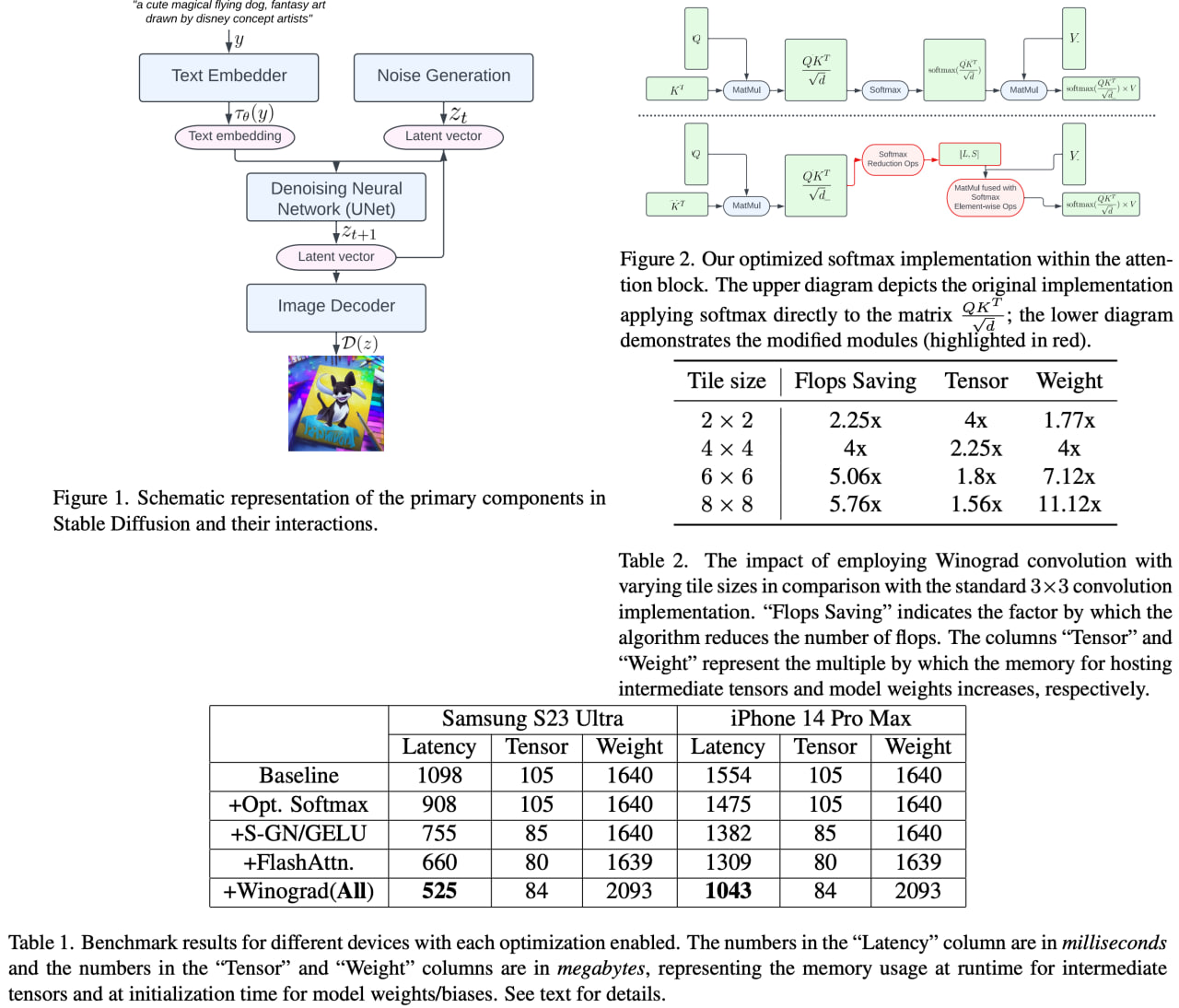
The rapid development of foundation models is revolutionizing the field of artificial intelligence, with large diffusion models gaining significant attention for their ability to generate photorealistic images and support various tasks. Deploying these models on-device brings numerous benefits, including lower server costs, offline functionality, and improved user privacy. However, with over 1 billion parameters, these models face challenges due to restricted computational and memory resources on devices.
Excitingly, researchers from Google have presented a series of implementation optimizations for large diffusion models that achieve the fastest reported inference latency to date (under 12 seconds for Stable Diffusion 1.4 without INT8 quantization for a 512 × 512 image with 20 iterations) on GPU-equipped mobile devices. These groundbreaking enhancements not only broaden the applicability of generative AI but also significantly improve the overall user experience across a wide range of devices, paving the way for even more innovative AI applications in the future.
Paper link: https://arxiv.org/abs/2304.11267
A detailed unofficial overview of the paper: https://andlukyane.com/blog/paper-review-siayn
#deeplearning #stablediffusion #inferenceoptimization
👍13❤3🔥1💩1
StableRep: Synthetic Images from Text-to-Image Models Make Strong Visual Representation Learners
In a ground-breaking exploration of visual representation learning, researchers have leveraged synthetic images produced by leading text-to-image models, specifically Stable Diffusion, achieving promising results. The study uncovers two key insights - firstly, when configured correctly, self-supervised methods trained on synthetic images can match or even outperform those trained on real images. This suggests an exciting avenue for efficient and effective representation learning, reducing the need for extensive real image datasets.
Secondly, the researchers have devised a novel approach called StableRep, a multi-positive contrastive learning method that treats multiple images, generated from the same text prompt, as mutual positives. The compelling finding is that StableRep, trained solely with synthetic images, outperforms representations learned by prominent methods such as SimCLR and CLIP, even when these used real images. In a striking demonstration, when language supervision is added, StableRep trained with 20M synthetic images outperforms CLIP trained with a whopping 50M real images. These findings not only underscore the potential of synthetic data but also pave the way for more efficient, large-scale visual representation learning.
Paper link: https://arxiv.org/abs/2306.00984
A detailed unofficial overview of the paper: https://andlukyane.com/blog/paper-review-stablerep
#deeplearning #cv #nlp #stablediffusion #texttoimage #syntheticdata

🔥8👍5❤4👀4👏1