
Probability of zero impact
During the merger of two huge stellar systems, the probability of a direct collision of two luminaries is negligible. Scientists compare this to the flight of two flies in an empty building the size of an entire planet.
Gravitational fields will simply softly rebuild orbits, leaving billions of stars completely safe.
#Stars #Universe #Science
🥰4❤1⚡1👍1
SpaceX launched 27 Starlink satellites into low-Earth orbit from Vandenberg Space Force Base in California. The mission expands the global satellite constellation, enhancing high-speed broadband coverage and connectivity. 🚀
#SpaceX ⚡ #Starlink ⚡ #SpaceLaunch
#SpaceX ⚡ #Starlink ⚡ #SpaceLaunch
🔥3⚡1❤1
Who invented the first light in the bulb?🧐
Thomas Edison's first successful model of light bulb, used in public demonstration at Menlo Park, December 1879.
In 1878, Edison began working on a system of electrical illumination, something he hoped could compete with gas and oil-based lighting.
#Fact ⚡ #Daily ⚡ #Space
Subscribe
Thomas Edison's first successful model of light bulb, used in public demonstration at Menlo Park, December 1879.
In 1878, Edison began working on a system of electrical illumination, something he hoped could compete with gas and oil-based lighting.
#Fact ⚡ #Daily ⚡ #Space
Subscribe
⚡2
Compact Computer for the Moon
Hewlett Packard Enterprise has built a tiny high-performance computer for the Moon weighing just 1.2 kg.
The hardware is scheduled for a late 2026 launch on an Astrolab rover for NASA 🚀.
#Space ⚡ #Technology ⚡ #NASA
Hewlett Packard Enterprise has built a tiny high-performance computer for the Moon weighing just 1.2 kg.
The hardware is scheduled for a late 2026 launch on an Astrolab rover for NASA 🚀.
#Space ⚡ #Technology ⚡ #NASA
⚡3❤1
Amplifying the Small
Inflation did not just increase the size of the Universe; it acted as a giant magnifying glass for the quantum world. In normal situations, quantum effects are only apparent at atomic scales.
But thanks to rapid expansion, these quantum distortions were transformed into macroscopic objects. The distance between them stretched to the size of galactic superclusters. We are literally observing quantum mechanics in action by looking through a telescope at the largest structures of the cosmos. These are not just stars; they are quantum noises magnified quadrillions of times. 🔭
#Quantummechanics #Cosmos #Scale
⚡3🔥2
The U.S. Air Force successfully tested dropping SpaceX cargo drop pods from space, advancing the Rocket Cargo initiative to enable rapid global military resupply and support logistics in contested areas without risking human aircrews. 🚀
#SpaceX ⚡ #USAirForce ⚡ #RocketCargo
#SpaceX ⚡ #USAirForce ⚡ #RocketCargo
⚡2😢1
Very interesting fact about sun you didn't know🤔 If you could travel into space and look at the Sun🌞 without going blind, you’d find that it’s actually white⚪, and not yellow🌕.
Using a prism, you can see how sunlight can be broken up into the spectrum of its colors: red, orange, yellow, green, blue, indigo and violet.
When you mix all those colors together, you get white.
Here’s the strange part.
If look at all the photons coming in, our star is actually sending the most photons in the green portion of the spectrum.
#Fact ⚡ #Daily ⚡ #Space
Subscribe
❤4⚡1
NASA's Perseverance Mars rover has set a historic distance record by traveling more than 28 miles across the Martian surface. Operating with advanced autonomous navigation capabilities, it has driven farther than any previous vehicle on another world. 🚀
#NASA ⚡ #Perseverance ⚡ #Mars
#NASA ⚡ #Perseverance ⚡ #Mars
⚡1
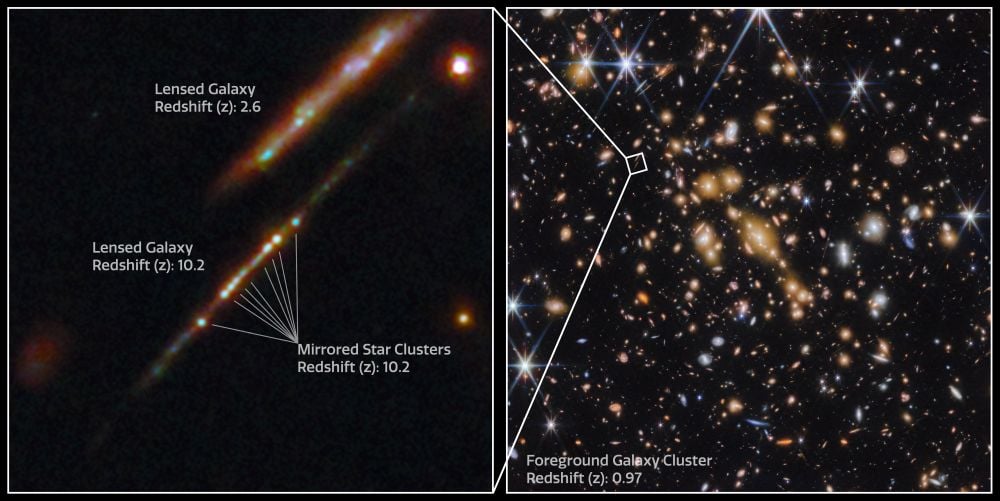
James Webb Space Telescope pinpoints birthplace of early black hole seeds
On November 2, astronomers revealed that the James Webb Space Telescope detected five dense star clusters packed into an ancient galaxy just 460 million years after the Big Bang. Led by Viola Bocchi from the Sapienza University of Rome, researchers analyzed these tightly bound stellar groups within the Cosmic Gems arc to solve a long-standing cosmic puzzle. 🔭
These clusters contained masses reaching up to ten million solar masses, creating ideal conditions for runaway stellar collisions. Such intense crushing pressure forces matter together, forming heavy seeds for intermediate-mass black holes, which are rare cosmic objects weighing between one hundred and one hundred thousand times the mass of the Sun. 🌌
While earlier studies spotted potential intermediate-mass black holes only in modern cosmic neighborhoods like the Omega Centauri cluster, finding these dense ancient clusters proves the heavy seed process began shortly after the universe started. ⚫
The team tested their findings using advanced computer models to confirm how these dense environments rapidly build massive black hole cores.
#SpaceExploration
#BlackHoleSeeds
#SpaceTelescope
Who was Niels Bohr?🤔
Niels Bohr was a Danish physicist known for his work on atomic structure and quantum theory.
His Bohr model proposed that electrons orbit the nucleus in discrete energy levels.
He also introduced the concept of complementarity, which explains contradictory properties of particles.🧐
#Fact ⚡ #Daily ⚡ #Space
Subscribe
❤2⚡1
🧬 DNA building blocks found on asteroid Ryugu
Scientists found all five essential nucleobases, the genetic letters of life, in pristine samples from asteroid Ryugu.
This confirms that key ingredients for life existed in space billions of years ago before reaching Earth.
#SpaceDiscovery ⚡ #AsteroidRyugu ⚡ #DNA
Scientists found all five essential nucleobases, the genetic letters of life, in pristine samples from asteroid Ryugu.
This confirms that key ingredients for life existed in space billions of years ago before reaching Earth.
#SpaceDiscovery ⚡ #AsteroidRyugu ⚡ #DNA
🔥2⚡1
Cosmic snapshot from childhood
Just 380 thousand years after the Big Bang, the universe cooled enough for light to fly freely forward. Cosmic microwave background radiation captured an exact density map of early matter. These ancient sound waves in plasma still serve as an ideal cosmic ruler for astronomers.
#Physics #Relic #Space
⚡1
ESA's asteroid probe captures first clear view
On October 18, the small-car-sized Hera probe captured a clear image of the binary asteroid system Didymos and Dimorphos from 1,280 kilometers away.
The mission investigates the aftermath of a 2022 collision where a NASA spacecraft intentionally struck the smaller rock to alter its orbit.
#SpaceExploration ⚡ #Asteroids ⚡ #Space
⚡1
NASA’s Artemis II moon launch disrupted Earth's upper atmosphere, creating a hole that temporarily impacted GPS and drone positioning signals 🚀
#ArtemisII ⚡ #SpaceLaunch ⚡ #NASA
#ArtemisII ⚡ #SpaceLaunch ⚡ #NASA
⚡3
Melting the Primordial Lattice
The transformation of the vacuum from a solid-like state to its current liquid-like form was the Universe's defining architectural moment. As the cosmos cooled, this rigid lattice structure began to phase-shift, releasing massive amounts of energy that fueled early matter.
This transition was uneven, creating structural defects in the fabric of space. These microscopic glitches became the gravitational seeds for the first stars and black holes. The entire architecture of our universe is built upon the fractures of that ancient, melting vacuum.
#Physics #Cosmogenesis #Space
⚡3
SpaceX has partnered with Qualcomm to supply cellular base station infrastructure for its Starlink Mobile network. Under this multi-year agreement, SpaceX will deploy Qualcomm's Dragonwing technology across tens of thousands of 5G cell sites starting in 2027 to challenge major U.S. wireless carriers 🛰️
#SpaceX ⚡ #Starlink ⚡ #Qualcomm
#SpaceX ⚡ #Starlink ⚡ #Qualcomm
⚡2
How bigger is the Sun than Earth?🤔
It is 864,000 miles (1,392,000 km) in diameter, which makes it 109 times wider than Earth.
It's 10,000 degrees Fahrenheit (5,500 degrees Celsius) at the surface, and 27 million degrees Fahrenheit (15,000,000 degrees Celsius) in the core.🌞
#Fact ⚡ #Daily ⚡ #Space
Subscribe
It is 864,000 miles (1,392,000 km) in diameter, which makes it 109 times wider than Earth.
It's 10,000 degrees Fahrenheit (5,500 degrees Celsius) at the surface, and 27 million degrees Fahrenheit (15,000,000 degrees Celsius) in the core.🌞
#Fact ⚡ #Daily ⚡ #Space
Subscribe
⚡3
SpaceX is building an independent mobile operator network following rejections from major telecommunications providers for virtual network agreements. The project involves acquiring wireless spectrum and integrating 5G technology to support direct satellite-to-cellular connectivity. Industry executives express skepticism over the massive multi-billion-dollar investments required for spectrum acquisition. 📡
#SpaceX ⚡ #5G ⚡ #Satellite
#SpaceX ⚡ #5G ⚡ #Satellite