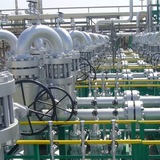
Heat Exchangers Working Principle and It's Types ?
Heat Exchangers: Working Principle and Types
---
🔧 Working Principle of Heat Exchangers
A heat exchanger is a device that transfers heat between two or more fluids (liquid or gas) without mixing them. The main principle behind heat exchangers is thermal conduction, where heat flows from a hot fluid to a cooler one through a solid barrier (usually metal) or directly when fluids are in contact.
🔁 Key Concepts:
No direct mixing: Fluids are usually separated by a solid wall or flow in separate channels.
Heat Transfer Direction: Heat always moves from the hotter to the colder fluid.
Types of Flow:
Parallel Flow – both fluids move in the same direction.
Counter Flow – fluids move in opposite directions (more efficient).
Cross Flow – fluids move at right angles to each other.
---
🧰 Types of Heat Exchangers
1. Shell and Tube Heat Exchanger
Structure: Consists of a series of tubes inside a cylindrical shell.
Use: Common in oil refineries and power plants.
Advantage: Handles high pressure and temperature.
2. Plate Heat Exchanger
Structure: Thin corrugated plates stacked together, fluids flow between alternate plates.
Use: HVAC systems, dairy and food processing.
Advantage: High efficiency, compact design.
3. Finned Tube Heat Exchanger
Structure: Tubes with external fins to increase surface area.
Use: Air conditioning, car radiators.
Advantage: Improved heat transfer to air.
4. Double Pipe Heat Exchanger
Structure: One pipe inside another; fluids flow in inner and outer pipes.
Use: Small industries and labs.
Advantage: Simple design, low cost.
5. Air Cooled Heat Exchanger
Structure: Uses ambient air to cool process fluids.
Use: Oil refineries, chemical plants.
Advantage: No water required for cooling.
6. Regenerative Heat Exchanger
Structure: Uses a temporary heat storage medium (like a ceramic matrix) that gets alternately heated and cooled.
Use: Gas turbines, air preheaters.
Advantage: Reuses heat efficiently.
7. Condensers and Evaporators (in HVAC)
Condensers: Remove heat from refrigerant gas, turning it into liquid.
Evaporators: Absorb heat into the refrigerant, turning liquid into vapor.
---
📌 Summary
Heat exchangers are critical in power generation, chemical processing, automotive, and HVAC systems. Choosing the right type depends on:
* Fluid type
* Operating pressure & temperature
* Heat transfer efficiency needed
* Space and cost constraints
Pump sizing involves selecting a pump that meets the specific requirements of a system. Key factors to consider:
1. *Flow rate*: Volume of fluid to be pumped.
2. *Head pressure*: Pressure required to overcome resistance.
3. *Fluid properties*: Viscosity, density, and temperature.
*Sizing steps:*
1. Determine flow rate and head pressure requirements.
2. Select pump type (centrifugal, positive displacement, etc.).
3. Consider fluid properties and system conditions.
*Important considerations:*
1. *Efficiency*: Optimize pump efficiency for energy savings.
2. *Reliability*: Choose a pump that meets system demands.
3. *Maintenance*: Consider ease of maintenance and repair.
*Common applications:*
1. *Industrial processes*: Chemical processing, oil and gas, etc.
2. *Water treatment*: Drinking water, wastewater, etc.
3. *HVAC systems*: Heating, ventilation, and air conditioning.
#PumpSizing #PumpSelection #IndustrialPumps #FluidHandling #EngineeringDesign
*Improving Centrifugal Pump Capacity: #CentrifugalPumps #PumpCapacity #IndustrialSolutions ✅‼️‼️
To enhance the capacity of a centrifugal pump, consider the following strategies:
1. *Increase Impeller Size*: A larger impeller can handle more flow and pressure, thus increasing pump capacity. #ImpellerUpgrade
2. *Adjust Pump Speed*: Increasing the pump speed can boost flow rate and capacity. Ensure the pump's motor and mechanical components can handle the increased load. #PumpSpeed #VariableSpeedDrives
3. *Parallel Operation*: Running multiple pumps in parallel can significantly increase overall system capacity. #ParallelPumps #FlowRate
4. *Optimize System Design*: Reduce friction losses in the piping system by using larger pipes, minimizing bends, and ensuring proper pipe sizing. #SystemDesign #FrictionLoss
5. *Regular Maintenance*: Ensure the pump is well-maintained, with regular checks on wear and tear, lubrication, and alignment. #PumpMaintenance #Reliability
6. *Upgrade to a Larger Pump*: If the current pump is undersized, consider upgrading to a larger model designed for higher capacity. #PumpUpgrade #CapacityIncrease
7. *Improve Suction Conditions*: Ensure the suction line is properly sized and free from restrictions to improve flow into the pump. #SuctionConditions #PumpPerformance
By implementing these strategies, you can effectively enhance the capacity of your centrifugal pump and improve overall system efficiency. #CentrifugalPumpSolutions #IndustrialEfficiency
AI Overview
Isometric drawings are a technique for representing three-dimensional objects on a two-dimensional surface. They use a special perspective where all three axes are drawn at a 30-degree angle, creating a 3D illusion without foreshortening. This method is commonly used in technical drawings, design, and video games to visualize and communicate spatial relationships.
Key Characteristics of Isometric Drawings:
Angles: The x, y, and z axes are all at a 120-degree angle to each other.
Perspective: There is no perspective, meaning no foreshortening of distant objects.
Full Scale: All three dimensions are drawn at full scale, unlike perspective drawings where distant objects appear smaller.
Applications: Isometric drawings are useful for:
Technical Illustration: Showing how components fit together or how something works.
Engineering and Architecture: Communicating design concepts and plans.
Design and Visual Communication: Presenting 3D objects in a clear and understandable way.
Video Games: Creating 3D environments in a 2D space.
How Isometric Drawings Work:
Establish Axes: The drawing begins with the three axes drawn at 120-degree angles to each other.
Plot Dimensions: The principal dimensions (height, width, and depth) are plotted along the axes.
Draw Outline: The outer lines of the object are drawn, connecting the plotted points.
Add Details: Internal details and features are added.
Maintain Accuracy: All parallel lines remain parallel, and the angles between lines are maintained.
Benefits of Isometric Drawings:
Clear Visualization:
They provide a clear and easy-to-understand representation of 3D objects.
Precise Representation:
They offer a more accurate depiction of an object's dimensions compared to some perspective drawings.
Easy to Communicate:
They are effective tools for communicating design ideas and technical details.
No Distortion:
They minimize distortion, making them suitable for situations where precise representation is needed.