Forwarded from The Exaltation of Beauty
The Moldovița Monastery, built by Voivode Petru Rareș in 1532, is one of the eight monasteries in Northern Moldavia with frescoes painted on the outer walls. Sister Maika, who has been living in the monastery for more than 50 years, says that it is "the holy scriptures in color".
Moldovița's frescoes were painted by Toma of Suceava in 1537. They are filled with yellow accents and are well preserved. The predominantly yellow-and-blue paintings on its exterior represent recurring themes in Christian Orthodox art: a procession of saints leads up to the Virgin enthroned with the Child in her lap, above the narrow east window; the "Tree of Jesse" springs from a recumbent Jesse at the foot of the wall to marshal the ancestry of Christ around the Holy Family.
Tall arches open the porch to the outside and daylight. Within it, "The Last Judgment" covers the entire surface of the west wall with its river of fire and its depiction of the sea giving up its dead to judgment.
Forwarded from The Exaltation of Beauty
Fresco of the Siege of Constantinople, 1537, Moldovița Monastery, Romania
The "Siege of Constantinople" commemorates the intervention of the Virgin in saving the city of Constantinople from Persian attack in A.D. 626 (although the siege depicted is rather the Fall of Constantinople in 1453).
The "Siege of Constantinople" commemorates the intervention of the Virgin in saving the city of Constantinople from Persian attack in A.D. 626 (although the siege depicted is rather the Fall of Constantinople in 1453).
Forwarded from The Exaltation of Beauty
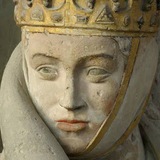
Bust of Petru Rareș, who ruled Moldavia from 1527 to 1538 and again from 1541 to 1546, promoted a new vision for Bukovina churches. He commissioned artists to cover the interiors and exteriors with elaborate frescoes.
Forwarded from The Exaltation of Beauty
Gustave Doré, L'Ascension, 1879
Doré depicts Christ, in glory but still human, with wide open arms and surrounded by a multitude of angels gesticulating theatrically.
The earthly world, which can be seen in the distance through the clouds, takes on the appearance of a wild and grandiose landscape inspired by the Scottish Highlands, which Doré discovered during a trip to Scotland in 1873. The painter thus gives the biblical account a dimension which is both concrete and dreamlike, placing the onlooker far away from the Earth, amidst the Angels.
Forwarded from The Exaltation of Beauty
Gustave_Doré_-_L'Ascension (1).jpg
802.7 KB
In 1866 Doré rented a former gymnasium which he transformed into a studio at 3 Rue Bayard in Paris. An outstanding, self-taught drawer, he had an extraordinary capacity for artistic creation, and painted large format works here which expressed his desire to be recognised as a painter. Rebuffed by the criticism in France, this monumental piece received a more favourable reception in London and then in the United States, where Doré sent a number of his paintings as soon as they were finished during the last years of his life.
For this reason, Doré’s painting is little represented in French collections. The Petit Palais is one of the rare museums, along with those of Strasbourg, Bourg-en-Bresse and Nantes, which can exhibit to the public some of the gigantic religious paintings from the Doré Gallery.
For this reason, Doré’s painting is little represented in French collections. The Petit Palais is one of the rare museums, along with those of Strasbourg, Bourg-en-Bresse and Nantes, which can exhibit to the public some of the gigantic religious paintings from the Doré Gallery.
Forwarded from The Exaltation of Beauty
Alexander Consulting the Oracle of Apollo (1789) by Louis-Jean-François Lagrenée
Alexander the Great, after becoming king of the Macedonians, but before launching his famous invasion of the Persian Empire, decided to stop by the Oracle at Delphi for a prophecy about his future. Alexander’s visit to Delphi sparked a curious legend, and the odd story was later recorded by the prolific biographer, Plutarch. As the story goes, Alexander had the bad luck of arriving at Delphi on a day when the Oracle was closed due to religious law and customs. The young king, the legend tells, was such an impetuous and headstrong person that, rather than wait a day or two for the Oracle site to resume its operations, Alexander instead barged into the complex and forcefully compelled the priestess to deliver a divine message, despite the religious laws forbidding her from carrying out her duties on that day.
Alexander the Great, after becoming king of the Macedonians, but before launching his famous invasion of the Persian Empire, decided to stop by the Oracle at Delphi for a prophecy about his future. Alexander’s visit to Delphi sparked a curious legend, and the odd story was later recorded by the prolific biographer, Plutarch. As the story goes, Alexander had the bad luck of arriving at Delphi on a day when the Oracle was closed due to religious law and customs. The young king, the legend tells, was such an impetuous and headstrong person that, rather than wait a day or two for the Oracle site to resume its operations, Alexander instead barged into the complex and forcefully compelled the priestess to deliver a divine message, despite the religious laws forbidding her from carrying out her duties on that day.
Forwarded from The Exaltation of Beauty
IMG_20220317_002117.jpg
1.9 MB
On this odd episode, Plutarch wrote:
“[Alexander] visited Delphi because he wished to consult the oracle of Apollo about the expedition against the Persians. It so happened that he arrived on one of those days which are called inauspicious, when it is forbidden for the oracle to deliver a reply. In spite of this he first sent for the prophetess, and when she refused to officiate and explained that the law forbade her to do so, he went up himself and tried to drag her by force to the shrine. At last, as if overcome by his persistence, she exclaimed, ‘You are invincible, my son!’ and when Alexander heard this, he declared that he wanted no other prophecy…”
Such is the scene that Louis-Jean-François Lagrenée re-creates in his painting, featured above. It shows Alexander the Great dragging a priestess, known as a Pythia, towards a statue of Delphi’s patron god, Apollo. The scene likely is set right around the time when the priestess complained that pushy Alexander was invincible, or perhaps incorrigible.
Forwarded from The Exaltation of Beauty
Rogier van der Weyden, Saint George and the Dragon, c. 1432/1435
The special mixture of reality, fantasy, and virtuosity that is particular to early Netherlandish painting is nowhere more apparent than in this exquisite panel. In an episode from the popular legend, Saint George in black Gothic armor pins the dragon to the ground with his lance; at the left kneels the fashionably attired Princess Cleodolinda who was to have been sacrificed to the dragon. George was a Roman soldier living in third-century Cappadocia, but the setting has here been transformed from ancient Asia Minor to the contemporary Belgian countryside.
Passing through a series of overlapping hills, we come upon a walled city surrounded by water and dominated by a castle perched atop a fantastic mountain. This scene is almost certainly imaginary and yet is rendered with the greatest clarity and realism. The attention to specific detail has led to the suggestion that the artist made use of a magnifying glass.
Forwarded from The Exaltation of Beauty
saint_george_and_the_dragon_1966.1.1.jpg
4 MB
The artist's interest in the depiction of light -- reflecting on George's armor and the dragon's scales -- and atmospheric effects shows the influence of Jan van Eyck. The painting is also stylistically related to manuscript illumination that would suggest this is an early work. The panel may originally have been part of a larger ensemble, perhaps a diptych, and was most likely used for private devotion.
Forwarded from The Exaltation of Beauty
“Allegory of Charles I of England and Henrietta of France in a Vanitas Still Life”, by Carstian Luyckx, 1770s
During the seventeenth century a form of still life called the vanitas developed as a means to impart an allegorical message about the inevitability of death. The subject here refers to Charles I’s troubled life and is a testament to the suddenness of death and the vanity of early power and glory. For example, the bubbles pertain to the brevity of Charles I’s life (he was beheaded at the age of 44), the broken skull conveys the fragility of human beings, and the globe symbolizes the power and possessions that death steals away.
During the seventeenth century a form of still life called the vanitas developed as a means to impart an allegorical message about the inevitability of death. The subject here refers to Charles I’s troubled life and is a testament to the suddenness of death and the vanity of early power and glory. For example, the bubbles pertain to the brevity of Charles I’s life (he was beheaded at the age of 44), the broken skull conveys the fragility of human beings, and the globe symbolizes the power and possessions that death steals away.