
<b>Game Of My Life #03: We are back!</b>
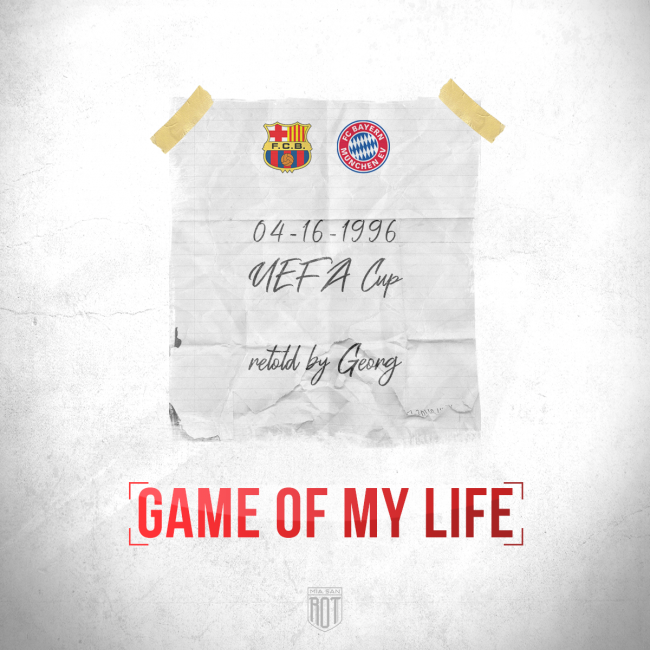
Having just managed a 2-2 draw in the first leg, Bayern traveled to Barcelona and secured their progress to the final by a 1-2 away win in the return leg.April 16, 1996, Barcelona. FC Barcelona welcomes FC Bayern in the second leg of the UEFA Cup semi-final. Bayern needed a high-scoring draw or an away win to push through to the final in front of a crowd of 115,000 fanatic supporters in the Camp Nou, where Barcelona had not lost a European competition home game since 1992. The game marked the first time the two giants had ever met in a competitive match.<a href="#why-the-game-was-special"></a>Why the game was special<a href="#fc-bayern-in-the-middle-of-the-1990s-almost-an-ordinary-club"></a>FC Bayern in the middle of the 1990s – almost an ordinary club.The 1990s. Football shoes were black. The players on the pitch were numbered 1 to 11. FC Bayern Munich was frequently dubbed “FC Hollywood”, but in sporting terms they were far away from shiny glamour.The glorious 1970s were but a distant memory, the bloodletting of many top German players to Italy’s greener pastures had left its mark on German football in general and Bayern in particular.<a href="#disappointing-years-by-bayern-standards"></a>Disappointing years by Bayern standardsOver the last five years, Bayern had won the Bundesliga title only once. The last triumph in the DFB-Pokal had been in 1986, their cup runs were spotted with embarrassing defeats to lower division clubs like Weinheim, Homburg, and Vestenbergsgreuth.They did not fare much better on the European stage. In 1991/92, they went out of the UEFA Cup after a 2-6 defeat against Copenhagen in the second round. In 1992/93, they were not even qualified, and 1993/94 they again suffered a second round elimination, this time at the hand of Norwich. In 1994/95, they participated in the still very young Champions League for the first time. They advanced from the group stage and two draws against Gothenburg in the quarter finals were enough to prevail. But in the semis, Louis van Gaal’s Ajax Amsterdam proved a bridge too far, inflicting a comprehensive 5-2 defeat on Bayern. Despite the fairly easy route to the semi-finals, having got there was a respectable achievement.<a href="#and-then-came-barcelona"></a>And then came BarcelonaAt the beginning of the 1995/96 season, Otto Rehagel was appointed as the fifth Bayern head coach in four years. After a defeat in the first match, seven consecutive wins under his reign saw Bayern march through to the semi-finals of the UEFA Cup. And now Barcelona waited. Johan Cruyff’s team was one of the top teams in Europe in the early 1990s: from 1991 to 94 they were Spanish champions four times in a row and reached the final of the European Champion Clubs’ Cup in 1992 and 94, which they also won in 1992. But in the spring of 1996, Cruyff’s era at Barcelona seemed to be beyond its peak. The squad was still top class, but the departures of stars like Laudrup, Stoichkow and Koeman could not be compensated. In La Liga, a fourth place in 1995 and a third place in 1996 were the result. Nevertheless, they firmly believed in their chance to reach the final against Bayern.<a href="https://miasanrot.com/wp-content/uploads/sites/2/2019/12/BarcaFCB1996en-650x650.png">Media</a><a href="#in-case-you-missed-it"></a>In case you missed it<a href="#the-starting-lineups"></a>The starting lineupsJohan Cruyff sent his team out in its usual 4-3-3 formation. He had to make do without injured Pep Guardiola. Ferrer, Nadal, Popescu and Sergi Barjuán defended in front of goalkeeper Busquets. Bakero played in the holding midfielder position and Amor and Roger García in the two number eight positions. Luís Figo as the right winger, Jordi Cruyff as a fluid center-forward and Kodro as the nominal left-winger completed the first eleven. Otto Rehhagel opted for a 3-5-2/3-6-1 formation. In front of Kahn, Babbel, Kreuzer, and Helmer formed the back three. Regular holding midfielder Matthäus…
Having just managed a 2-2 draw in the first leg, Bayern traveled to Barcelona and secured their progress to the final by a 1-2 away win in the return leg.April 16, 1996, Barcelona. FC Barcelona welcomes FC Bayern in the second leg of the UEFA Cup semi-final. Bayern needed a high-scoring draw or an away win to push through to the final in front of a crowd of 115,000 fanatic supporters in the Camp Nou, where Barcelona had not lost a European competition home game since 1992. The game marked the first time the two giants had ever met in a competitive match.<a href="#why-the-game-was-special"></a>Why the game was special<a href="#fc-bayern-in-the-middle-of-the-1990s-almost-an-ordinary-club"></a>FC Bayern in the middle of the 1990s – almost an ordinary club.The 1990s. Football shoes were black. The players on the pitch were numbered 1 to 11. FC Bayern Munich was frequently dubbed “FC Hollywood”, but in sporting terms they were far away from shiny glamour.The glorious 1970s were but a distant memory, the bloodletting of many top German players to Italy’s greener pastures had left its mark on German football in general and Bayern in particular.<a href="#disappointing-years-by-bayern-standards"></a>Disappointing years by Bayern standardsOver the last five years, Bayern had won the Bundesliga title only once. The last triumph in the DFB-Pokal had been in 1986, their cup runs were spotted with embarrassing defeats to lower division clubs like Weinheim, Homburg, and Vestenbergsgreuth.They did not fare much better on the European stage. In 1991/92, they went out of the UEFA Cup after a 2-6 defeat against Copenhagen in the second round. In 1992/93, they were not even qualified, and 1993/94 they again suffered a second round elimination, this time at the hand of Norwich. In 1994/95, they participated in the still very young Champions League for the first time. They advanced from the group stage and two draws against Gothenburg in the quarter finals were enough to prevail. But in the semis, Louis van Gaal’s Ajax Amsterdam proved a bridge too far, inflicting a comprehensive 5-2 defeat on Bayern. Despite the fairly easy route to the semi-finals, having got there was a respectable achievement.<a href="#and-then-came-barcelona"></a>And then came BarcelonaAt the beginning of the 1995/96 season, Otto Rehagel was appointed as the fifth Bayern head coach in four years. After a defeat in the first match, seven consecutive wins under his reign saw Bayern march through to the semi-finals of the UEFA Cup. And now Barcelona waited. Johan Cruyff’s team was one of the top teams in Europe in the early 1990s: from 1991 to 94 they were Spanish champions four times in a row and reached the final of the European Champion Clubs’ Cup in 1992 and 94, which they also won in 1992. But in the spring of 1996, Cruyff’s era at Barcelona seemed to be beyond its peak. The squad was still top class, but the departures of stars like Laudrup, Stoichkow and Koeman could not be compensated. In La Liga, a fourth place in 1995 and a third place in 1996 were the result. Nevertheless, they firmly believed in their chance to reach the final against Bayern.<a href="https://miasanrot.com/wp-content/uploads/sites/2/2019/12/BarcaFCB1996en-650x650.png">Media</a><a href="#in-case-you-missed-it"></a>In case you missed it<a href="#the-starting-lineups"></a>The starting lineupsJohan Cruyff sent his team out in its usual 4-3-3 formation. He had to make do without injured Pep Guardiola. Ferrer, Nadal, Popescu and Sergi Barjuán defended in front of goalkeeper Busquets. Bakero played in the holding midfielder position and Amor and Roger García in the two number eight positions. Luís Figo as the right winger, Jordi Cruyff as a fluid center-forward and Kodro as the nominal left-winger completed the first eleven. Otto Rehhagel opted for a 3-5-2/3-6-1 formation. In front of Kahn, Babbel, Kreuzer, and Helmer formed the back three. Regular holding midfielder Matthäus…
<b>Manuel Neuer: “We played Pep football”</b>
The performance in the first half against Cologne reminded Manuel Neuer of the attractive and successful football Bayern played under Pep Guardiola. The sense of self-contentment seems to run dangerously high at the record champions currently. A comment.When Pep Guardiola gathered his players around him for the final team talk to give out his last tactical instructions before a game, Manuel Neuer would allegedly always sit in the front row. Sources close to the club said at the time that he was one of the team’s biggest admirers of his coach.It can thus hardly be called a big surprise that the first half against Cologne did not remind the 33-year-old of the treble winning season under Jupp Heynckes, but of the extremely well planned and suffocating football his team played under Guardiola. “We played Pep football”, “Sport1” quotes Neuer as saying.The reporter Carsten Arndt used this opportunity to compare Bayern under Flick with Bayern under Guardiola. His result: Going forward the current team makes a really good impression. Despite making fewer passes and having less possession of the ball, they currently have more shots (20 to 18) and more big chances (5.2 to 3.2) than the successful Pep team. Their chance conversion is a bit better at the moment too (19 to 17 percent). As far as goals are concerned, the difference is actually quite clear: 3.1 goals per game under Flick opposed to 2.5 per game under Guardiola.<a href="#and-what-about-the-defense"></a>And what about the defense?So far, so good. But the article does not consider the defense at all. On average, Bayern has conceded 9.33 shots per game in the Bundesliga since Hansi Flick took over. Under Niko Kovač they averaged 10 this season and 7.6 last. In the 2017/18 (8.5) and 2016/17 (8.9) seasons this figure was also below the current average.In the first year under Guardiola’s reign, Bayern also conceded 8.9 shots per match, but in the following two years the figure dropped to 7.5 respectively. Since shots alone do not provide a complete picture, the quality of the chances should also be taken into account. Perhaps Bayern under Flick only allow half chances?Here, the expected goals model from StatsBomb, whose values are openly accessible on the fbref.com website, is a suitable tool. Compared to the 2017/18 season under Kovač, the number of expected goals per game against has increased: from 0.77 to currently 0.96.Unfortunately, the data on fbref.com does not go back further than the previous year. However, if you look at the data from other, possibly less accurate models, an estimate for the time of Guardiola at Bayern might be around 0.6 to 0.7 expected goals against per game.<a href="#where-do-bayern-get-their-rest"></a>Where do Bayern get their rest?Without a doubt, Flick’s offensive playing style is the main reason why Bayern play successful football again and the players enjoy their time out on the pitch. On average, the reigning champions allow their opponents only 6.35 passes until they take a defensive action. A figure that was quite similar under Guardiola.But Guardiola’s greatest achievement, which he developed bit by bit over the three years he was at the club, was to make his football appear as though he had all phases of the game always carefully planned through to a T. There was always an alternative to every course of action. The players always knew what they had to do next. Even when things did not work out.In this regard, there is no comparison to the team’s current level of performance. Even if the development of Bayern under Flick is more than remarkable and his promotion to head coach was the right decision to rescue a faltering season, his team does not demonstrate that it is capable of the same extent of flexibility at the moment.If all goes according to plan, there are hints that Bayern is able to play an overwhelming and dominant football that even teams like Leipzig are unable to cope with.…
The performance in the first half against Cologne reminded Manuel Neuer of the attractive and successful football Bayern played under Pep Guardiola. The sense of self-contentment seems to run dangerously high at the record champions currently. A comment.When Pep Guardiola gathered his players around him for the final team talk to give out his last tactical instructions before a game, Manuel Neuer would allegedly always sit in the front row. Sources close to the club said at the time that he was one of the team’s biggest admirers of his coach.It can thus hardly be called a big surprise that the first half against Cologne did not remind the 33-year-old of the treble winning season under Jupp Heynckes, but of the extremely well planned and suffocating football his team played under Guardiola. “We played Pep football”, “Sport1” quotes Neuer as saying.The reporter Carsten Arndt used this opportunity to compare Bayern under Flick with Bayern under Guardiola. His result: Going forward the current team makes a really good impression. Despite making fewer passes and having less possession of the ball, they currently have more shots (20 to 18) and more big chances (5.2 to 3.2) than the successful Pep team. Their chance conversion is a bit better at the moment too (19 to 17 percent). As far as goals are concerned, the difference is actually quite clear: 3.1 goals per game under Flick opposed to 2.5 per game under Guardiola.<a href="#and-what-about-the-defense"></a>And what about the defense?So far, so good. But the article does not consider the defense at all. On average, Bayern has conceded 9.33 shots per game in the Bundesliga since Hansi Flick took over. Under Niko Kovač they averaged 10 this season and 7.6 last. In the 2017/18 (8.5) and 2016/17 (8.9) seasons this figure was also below the current average.In the first year under Guardiola’s reign, Bayern also conceded 8.9 shots per match, but in the following two years the figure dropped to 7.5 respectively. Since shots alone do not provide a complete picture, the quality of the chances should also be taken into account. Perhaps Bayern under Flick only allow half chances?Here, the expected goals model from StatsBomb, whose values are openly accessible on the fbref.com website, is a suitable tool. Compared to the 2017/18 season under Kovač, the number of expected goals per game against has increased: from 0.77 to currently 0.96.Unfortunately, the data on fbref.com does not go back further than the previous year. However, if you look at the data from other, possibly less accurate models, an estimate for the time of Guardiola at Bayern might be around 0.6 to 0.7 expected goals against per game.<a href="#where-do-bayern-get-their-rest"></a>Where do Bayern get their rest?Without a doubt, Flick’s offensive playing style is the main reason why Bayern play successful football again and the players enjoy their time out on the pitch. On average, the reigning champions allow their opponents only 6.35 passes until they take a defensive action. A figure that was quite similar under Guardiola.But Guardiola’s greatest achievement, which he developed bit by bit over the three years he was at the club, was to make his football appear as though he had all phases of the game always carefully planned through to a T. There was always an alternative to every course of action. The players always knew what they had to do next. Even when things did not work out.In this regard, there is no comparison to the team’s current level of performance. Even if the development of Bayern under Flick is more than remarkable and his promotion to head coach was the right decision to rescue a faltering season, his team does not demonstrate that it is capable of the same extent of flexibility at the moment.If all goes according to plan, there are hints that Bayern is able to play an overwhelming and dominant football that even teams like Leipzig are unable to cope with.…
<b>Assessing Bayern’s transfer window from a financial perspective – boom or bust?</b>
After what to some will have felt like an eternity, the transfer window for signing new players under contract finally closed on Monday. We have thoroughly evaluated Bayern’s performance in the window from a sporting perspective both on our <a href="https://miasanrot.de/transfersommer-2020-fazit/">German</a> and our <a href="https://miasanrot.com/transfer-day-2020/">English</a> page. Can the players fill the most urgent vacancies in the squad? Are they good enough to enable Bayern to continue to perform at the levels we have become so used to over recent months?My colleagues have done an excellent job exploring questions like these from all conceivable angles. In this article, I intend to evaluate Bayern’s transfer window from an economic perspective. Financially speaking, have Bayern taken too much of a risk? Or have they perhaps not taken enough of a risk? Have they acted prudently with respect to the special circumstances of COVID-19? Do the new signings represent good value for money?<a href="#financing-transfers-a-question-of-liquidity-now"></a>Financing transfers: A question of liquidity now…I do not intend to conduct a full-blown, in-depth analysis of FC Bayern’s financial performance in this article. We have done this elsewhere and we will certainly do so again when the 2019/20 financial report comes out. For the purposes of assessing Bayern’s transfer window performance, I will particularly focus on their current liquidity rather than figures like revenues, EBIT or profit, because their current liquidity, ie how flush with cash they are, in my opinion most accurately reflects their ability to invest in new players right now, in this very window. My assessment is based on the very simple premise that all transfers Bayern do are paid for in full and up front or will become due during the ongoing season. Therefore, if Bayern did not have enough cash on hand or were unable to obtain it quickly in the window, they would not have been able to spend it on new transfers.At the end of the financial year 2018/19 on 30 June 2019, the “FC BAYERN MÜNCHEN AG Konzern”, ie the entire company including all its subsidiaries, had cash reserves of €159m and an equity ratio of 68%. Their operating cash flow was €56m, meaning that during the financial year they generated €56m free, available cash to do with as they please from their key operating activities without having to sell players. They also have zero long-term liabilities such as bank loans or bonds (a fact that they are very proud of). On top of that, fast forward to today, Bayern have just won the Champions League, which has given them a fresh cash injection of €130m, an increase of €50m on the year before, where they earned about €80m after crashing out in the round of 16.As these figures indicate, Bayern is a very liquid business. They sit on massive cash reserves, have no long-term debt and because of their high equity ratio they could easily take out a loan in an instant if they felt they needed to to sign new players to bolster their squad. On top of that comes the Champions League windfall of an extra €50m on last year in cash, which they could also invest in new players immediately without compromising their financial baseline.<a href="#and-in-the-future"></a>… And in the futureBut that is the present. Prudent financial management (in fact, prudent management of any description) will always consider and plan based on future expectations. Therefore, when Bayern sign new players in 2020, it is not enough for them to look at their very healthy financial state at present, but they have to take the COVID-19 pandemic and its expected implications for the club’s future financial situation into account as well.Herbert Hainer estimated that Bayern will generate approximately €100m less in revenues this season than last. Based on the assumption that the COVID-19 pandemic will prevent the Bundesliga…
After what to some will have felt like an eternity, the transfer window for signing new players under contract finally closed on Monday. We have thoroughly evaluated Bayern’s performance in the window from a sporting perspective both on our <a href="https://miasanrot.de/transfersommer-2020-fazit/">German</a> and our <a href="https://miasanrot.com/transfer-day-2020/">English</a> page. Can the players fill the most urgent vacancies in the squad? Are they good enough to enable Bayern to continue to perform at the levels we have become so used to over recent months?My colleagues have done an excellent job exploring questions like these from all conceivable angles. In this article, I intend to evaluate Bayern’s transfer window from an economic perspective. Financially speaking, have Bayern taken too much of a risk? Or have they perhaps not taken enough of a risk? Have they acted prudently with respect to the special circumstances of COVID-19? Do the new signings represent good value for money?<a href="#financing-transfers-a-question-of-liquidity-now"></a>Financing transfers: A question of liquidity now…I do not intend to conduct a full-blown, in-depth analysis of FC Bayern’s financial performance in this article. We have done this elsewhere and we will certainly do so again when the 2019/20 financial report comes out. For the purposes of assessing Bayern’s transfer window performance, I will particularly focus on their current liquidity rather than figures like revenues, EBIT or profit, because their current liquidity, ie how flush with cash they are, in my opinion most accurately reflects their ability to invest in new players right now, in this very window. My assessment is based on the very simple premise that all transfers Bayern do are paid for in full and up front or will become due during the ongoing season. Therefore, if Bayern did not have enough cash on hand or were unable to obtain it quickly in the window, they would not have been able to spend it on new transfers.At the end of the financial year 2018/19 on 30 June 2019, the “FC BAYERN MÜNCHEN AG Konzern”, ie the entire company including all its subsidiaries, had cash reserves of €159m and an equity ratio of 68%. Their operating cash flow was €56m, meaning that during the financial year they generated €56m free, available cash to do with as they please from their key operating activities without having to sell players. They also have zero long-term liabilities such as bank loans or bonds (a fact that they are very proud of). On top of that, fast forward to today, Bayern have just won the Champions League, which has given them a fresh cash injection of €130m, an increase of €50m on the year before, where they earned about €80m after crashing out in the round of 16.As these figures indicate, Bayern is a very liquid business. They sit on massive cash reserves, have no long-term debt and because of their high equity ratio they could easily take out a loan in an instant if they felt they needed to to sign new players to bolster their squad. On top of that comes the Champions League windfall of an extra €50m on last year in cash, which they could also invest in new players immediately without compromising their financial baseline.<a href="#and-in-the-future"></a>… And in the futureBut that is the present. Prudent financial management (in fact, prudent management of any description) will always consider and plan based on future expectations. Therefore, when Bayern sign new players in 2020, it is not enough for them to look at their very healthy financial state at present, but they have to take the COVID-19 pandemic and its expected implications for the club’s future financial situation into account as well.Herbert Hainer estimated that Bayern will generate approximately €100m less in revenues this season than last. Based on the assumption that the COVID-19 pandemic will prevent the Bundesliga…
Miasanrot.de
Transfersommer 2020: Vier Neuzugänge für ein Halleluja?
Im Endspurt des Transfersommers hat der FC Bayern München spät gehandelt. Die wochenlangen Diskussionen und das ständige Hin und Her haben nun vorerst ein Ende. Der Kader für die neue Saison steht. Wir ordnen das Geschehen ein. Bouna Sarr, Eric Maxim Choupo…