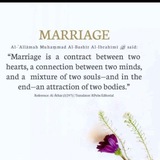
Always remember:
You married a human. Not an Angel. Just as you're not one yourself.
You married a human. Not an Angel. Just as you're not one yourself.
💯16👍4
Stay childish to each other. Look old to the world, but stay playful to one another. Don't grow too old or too big to show love. Don't say "we now have kids...". Let the kids be a part of the love story. Send your daughter to go tell her Mum you love her so much.
"Mummy, Daddy says he loves you".
You can tell the happiness in their eyes when they run such an errand, eagerly waiting for the return message.
Let your son watch you love his Mum deeply and sincerely, so he learns how to love a woman in a healthy environment, not from the manipulative and exploitative environment of relationships and watching others.
Love yourselves and show it, whatever the trials. Never feel too old to love and be loved!
Abu Imrān
💯23👍10😢1
كتاب الطلاق10 The Chapters on Divorce
(21)Chapter: That Khul` is undesirable for the women(21)باب كَرَاهِيَةِ الْخُلْعِ لِلْمَرْأَةِ
Sunan Ibn Majah 2054
It was narrated from Ibn 'Abbas (May ALLAH be pleased with him) that the Prophet (ﷺ) said:
"No woman asks for divorce when it is not absolutely necessary, but she will never smell the fragrance of paradise, although its fragrance can be detected from a distance of forty years' travel. "
حَدَّثَنَا بَكْرُ بْنُ خَلَفٍ أَبُو بِشْرٍ، حَدَّثَنَا أَبُو عَاصِمٍ، عَنْ جَعْفَرِ بْنِ يَحْيَى بْنِ ثَوْبَانَ، عَنْ عَمِّهِ، عُمَارَةَ بْنِ ثَوْبَانَ عَنْ عَطَاءٍ، عَنِ ابْنِ عَبَّاسٍ، أَنَّ النَّبِيَّ ـ صلى الله عليه وسلم ـ قَالَ " لاَ تَسْأَلُ الْمَرْأَةُ زَوْجَهَا الطَّلاَقَ فِي غَيْرِ كُنْهِهِ فَتَجِدَ رِيحَ الْجَنَّةِ . وَإِنَّ رِيحَهَا لَيُوجَدُ مِنْ مَسِيرَةِ أَرْبَعِينَ عَامًا " .
Grade: Hasan (Darussalam)
Reference : Sunan Ibn Majah 2054
In-book reference : Book 10, Hadith 39
English translation : Vol. 3, Book 10, Hadith 2054
كتاب الطلاق13 Divorce (Kitab Al-Talaq)
(717)Chapter: Regarding Someone Who Ruins A Wife For Her Husband(1)باب فِيمَنْ خَبَّبَ امْرَأَةً عَلَى زَوْجِهَا
Sunan Abi Dawud 2175
Narrated AbuHurayrah (May ALLAH be pleased with him):
The Prophet (ﷺ) said: Anyone who incites a woman against her husband or a slave against his master is not one of us.
حَدَّثَنَا الْحَسَنُ بْنُ عَلِيٍّ، حَدَّثَنَا زَيْدُ بْنُ الْحُبَابِ، حَدَّثَنَا عَمَّارُ بْنُ رُزَيْقٍ، عَنْ عَبْدِ اللَّهِ بْنِ عِيسَى، عَنْ عِكْرِمَةَ، عَنْ يَحْيَى بْنِ يَعْمُرَ، عَنْ أَبِي هُرَيْرَةَ، قَالَ قَالَ رَسُولُ اللَّهِ صلى الله عليه وسلم " لَيْسَ مِنَّا مَنْ خَبَّبَ امْرَأَةً عَلَى زَوْجِهَا أَوْ عَبْدًا عَلَى سَيِّدِهِ " .
Grade: Sahih (Al-Albani) صحيح (الألباني) حكم :
Reference : Sunan Abi Dawud 2175
In-book reference : Book 13, Hadith 1
English translation : Book 12, Hadith 2170
👍5
Employing 100 young men leads to 100 women getting married and building 100 new families. But employing 100 women leads to 100 young men being left unemployed and 100 women being left unmarried. Zina, consequently, now comes into the picture.
😢10👍5💔3
Hearts are not toys, and emotions are not a game to be played for temporary entertainment.🥺
When you consciously choose to break someone’s trust, lie to them, or give them false hope, you aren't just breaking them—you are signing a contract with the universe that you will one day have to pay back. Karma doesn’t forget, it doesn’t miss a beat, and it definitely doesn't sleep.
It sees the tears, it hears the broken promises, and it’s recording every single selfish move. You might feel powerful now, but remember that what goes around truly comes around.
People may forget your words, but they will never forget how you made them feel.
📌Take it as a loan; it will come back to you with interest ⏳✨.
#KarmaIsReal #ProtectYourPeace #HeartbreakQuotes #WhatGoesAroundComesAround #EmotionalTruths #SpiritualLessons #IntegrityMatters #RespectPeople
💯5⚡2
6 FORMS OF INTIMACY IN MARRIAGE:
Sex is often the first thing that we think of when we hear the word intimacy. Most people don’t realize that there are many forms of intimacy that allow us to have an extraordinary marriage.
6 FORMS OF INTIMACY ...
1) EMOTIONAL INTIMACY is closeness created through sharing our feelings, thoughts and desires. This comes by sharing how you feel about things. This comes through communicating with your spouse.
2) INTELLECTUAL INTIMACY involves a mutual understanding about the important areas or issues in your marriage. It's talking things like goals, budget, schedule, or how to raise your children with certain values. All of these involve discussion without fear of repercussion. It means that you have made your marriage a safe place for discussion. This also comes through communicating with your spouse.
3) SPIRITUAL INTIMACY is shared religious beliefs and observed religious practices. This can be as simple as praying together, going to church together, or discussing spiritual issues as a couple. Ultimately your life experiences, within the foundation of your shared faith, will create and deepen your spiritual intimacy. This is often missed by many marriages who don't realize the power of spiritual intimacy.
4) RECREATIONAL INTIMACY is being active together. Find those things that you like to do and do them with your spouse. Taking a walk together, make dinner, go to a museum, hike a mountain…do something with your spouse that allows you actively spend time together.
5) FINANCIAL INTIMACY is the sharing of your financial situation. Financial intimacy comes with developing a plan for your finances and being able to have open and honest communication with your spouse regarding money matters.
6) PHYSICAL INTIMACY is loving touch. Be it holding hands, a hug, a kiss or making love (having sex) we humans were designed to want to be touched. Touch can communicate acceptance and love, a closeness that only the two of you have based on your shared experiences. All of these things are GREAT for your marriage. They are what separate you being just roommates verses being soulmates. Put out the time and effort to make your marriage more intimate.
WHICH of these do you and your spouse need to work on?
👍14😢2
Our Daughters Marrying Other Religion
Today my heart is heavy.
Extended common friend… their daughter got married to a non-Muslim. The father says the boy accepted Islam — In shā’ Allāh khayr. We make ḥusn al-ẓann and hope it is sincere. Alḥamdulillāh.
But the real story started much earlier.
She went to university. Like many of our daughters today. There, she got into a relationship. The parents were shocked. Caught off guard. And eventually, they felt they had no choice but to accept the marriage.
I have seen this again and again.
Many of these marriages don’t last. Once emotions fade, reality hits. Deen weakens. Values clash. And the one who suffers the most… is often the girl.
This is not just one place.
This is happening everywhere — India, Canada, every non-Muslim environment.
Where are we going wrong?
We are focused on careers. Degrees. “Settling down.”
We send our daughters into environments full of fitnah at the most sensitive age… but we delay their marriage.
We say:
“Not yet.”
“Let her study.”
“Let her build her career.”
And in that delay… fitnah finds its way.
Allah already warned us:
يَا أَيُّهَا الَّذِينَ آمَنُوا قُوا أَنفُسَكُمْ وَأَهْلِيكُمْ نَارًا
O you who believe, protect yourselves and your families from the Fire. (66:6)
Your daughters are an amānah.
When they reach maturity, they have emotions, feelings, and needs. If we don’t guide them towards ḥalāl, the world will guide them towards ḥarām.
We say the boy is not “settled.”
But is being “settled” more important than dīn?
There are many young Muslim brothers. Good, educated, trying in life. Not fully settled yet — but why not let them grow together in ḥalāl?
Instead, we delay…
And then we regret.
Wallāhi, today was heavy.
This is not just a story.
This is a warning.
Protect your daughters. Guide them. Don’t throw them into fitnah and expect them to come out untouched.
اللهم احفظ بنات المسلمين واهدهم وثبتهم على دينك
May Allah protect all our daughters.
😢11💔8👍4
Conditions for a valid marriage in Islam...
Let me break it down simply.
1. The bride’s full and free consent.
2. The groom’s consent.
3. The wali (guardian),
usually the father, must approve on behalf of the bride.
4. There must be two witnesses,
generally two Muslim male witnesses.
And finally
The mahr.
A mandatory gift from
the groom to the bride, given as her right.
Once all five conditions are fulfilled,
and the nikah is formally conducted,
the marriage becomes halal.
👍19
The Messenger of Allāh صلى الله عليه وسلم said: “It is not right for any human being to prostrate to another; if it were right for one human being to prostrate to another, I would have commanded women to prostrate to their husbands because of the great rights that they have over them. By the One in Whose hand is my soul, if a man was covered from head to foot with weeping sores, oozing pus, and his wife was to come to him and lick his sores (to clean them), this would not fulfil the rights he has over her.’”
● [رواه أحمد ١٢١٥٣ ، صحيح الجامع ٧٧٢٥]
● [رواه أحمد ١٢١٥٣ ، صحيح الجامع ٧٧٢٥]
💯10👍4
Divorce does not shake the THRONE of Allah.
Prophet Muhammad salalaahu Alaihi wasalam has divorced before.
His companion has divorced before.
Prophet Muhammad salalaahu Alaihi wasalam daughters (2) have divorced before .
Divorce is allowed in Islam and Allah knows best,haven said divorce is allowed in Islam do not mean you divorce when you want it,no.
You divorce with Islamic reasons,there are some cases divorce is allowed and some case is not allowed and the prophet even said if a woman ask for divorce when is not necessary will not go to Jannah.
A man divorce and a woman ask for khul(initiate divorce).
Does the Throne of Allaah shake because of divorce?.
Answer
A hadeeth concerning that has been narrated from the Prophet (peace and blessings of Allaah be upon him), but it is a fabricated and false hadeeth.
This is what has been narrated from ‘Ali ibn Abi Taalib (may Allaah be pleased with him), that the Prophet (peace and blessings of Allaah be upon him) said: “Do not issue divorce, for the Throne shakes because of divorce.” Narrated by Ibn ‘Adiyy in al-Kaamil (5/112) and by al-Khateeb in Tareekh Baghdaad (12/191), and via Ibn al-Jawzi in al-Mawdoo’aat (2/277), via ‘Amr ibn Jumay’ from Juwaybir from al-Dahhaak from al-Nazzaal ibn Sabrah from ‘Ali ibn Abi Taalib (may Allaah be pleased with him).
Ibn al-Jawzi said:
It is a mawdoo’ (fabricated) hadeeth… ‘Amr ibn Jumay’ used to narrate munkar ahaadeeth from prominent people, and mawdoo’ ahaadeeth from sound narrators. End quote.
He was as da’eef (weak) and a fabricator by many scholars, including the following:
Al-Khateeb al-Baghdaadi in Tareekh Baghdaad (12/187), Ibn al-Qaysaraani in Dhakheerat al-Huffaaz (2/1147), al-Sakhaawi in al-Maqaasid al-Hasanah (p. 31), al-Shawkaani in al-Fawaa’id al-Majmoo’ah (p. 139), al-San’aani and al-‘Ajlooni in Kashf al-Khafa’ (1/361), and al-Albaani in al-Silsilah al-Da’eefah (1/278, hadeeth no. 147).
The fact that the hadeeth is da’eef does not mean that divorce is permissible and is not disliked by Allaah. Rather divorce is disliked by Allaah, and is not permissible except when there is a need for it. A man does not have the right to divorce his wife for no good reason that makes it permissible.
Shaykh al-Islam Ibn Taymiyah (may Allaah have mercy on him) said:
The basic principle concerning divorce is that it is forbidden, and it is only permitted as much as is necessary.
Majmoo’ al-Fataawa, 33/81.
Shaykh Ibn ‘Uthaymeen (may Allaah have mercy on him) said:
The basic principle concerning divorce is that it is makrooh, and the evidence for that is the verse in which Allaah says concerning those who swore not to have intercourse with their wives for four months (interpretation of the meaning):
“Those who take an oath not to have sexual relation with their wives must wait for four months, then if they return (change their idea in this period), verily, Allaah is Oft-Forgiving, Most Merciful.
227. And if they decide upon divorce, then Allaah is All-Hearer, All-Knower”
[al-Baqarah 2:226-227]
This (the phrase “then Allaah is All-Hearer, All-Knower”) is a kind of warning, whereas in the case of taking back the wife, Allaah says, “verily, Allaah is Oft-Forgiving, Most Merciful”. This indicates that divorce is not liked by Allaah, and that the basic principle is that divorce is makrooh.
Al-Sharh al-Mumti’, 10/428
👍1
PROVISIONS FOR THE DIVORCED WOMAN.
Undoubtedly, Islam ordered that provisions be made for the divorced woman. But it's not in the form of sharing the divorcing husband's assets as done in KUFR Culture, Law and Tradition.
The provisions for the divorced woman covers the Iddah period. It's the WAITING PERIOD, during which the woman can neither remarry, nor enter into any relationship with an opposite sex. It lasts for the period of three menstrual cycles. It could last longer than that, if a pregnancy appears before the end of the three menstrual cycles.
The Iddah has a number of purposes. One, to allow for tempers to cool off, for the possibilities of a settlement, where the divorce is revocable. Two, to allow an early pregnancy to reach observable period, as it affects the entire post divorsal treatment. Three, to allow for reflections and planning of the days as ahead, under a different life situations. Etc.
The provisions for the divorced wife is same as that of a full wife, except that there would be no conjugal relations with her. She's entitled to all rights to care and protection. Where the divorce is irrevocable, having conjugal relations with her is prohibited. Where it's revocable, a conjugal relations with her automatically revokes the divorce!
Where a pregnancy occurs, the Iddah period lasts until the birth of the baby. At the birth of the baby, the Iddah ends along with all the entitlements, except that of the baby. The mother becomes entitled to the caretaker allowances for the baby, until when she ceases to be in charge of the lad.
The provisions spoken of for a divorced woman only covers the waiting period. Islam teaches that at the end of the waiting period, a divorced woman should return back to her parents, regardless of her age and status. Parents are ordered to receive and care for her fully, until she marries another husband. Islamic Law does not permit that a woman lives on her own, without a supervisory guardian.
👍9
كتاب النكاح9 The Chapters on Marriage
(51)Chapter: Hitting women(51)باب ضَرْبِ النِّسَاءِ
Sunan Ibn Majah 1985
It was narrated that Iyas bin 'Abdullah bin Abu Dhubab said:
"The Prophet said: 'Do not beat the female slaves of Allah.' Then 'Umar came to the Prophet and said: 'O Messenger of Allah, the woman have become bold towards their husbands? So order the beatin g of them,' and they were beaten. Then many women went around to the family of Muhammad,. The next day he said: 'Last night seventy women came to the family of Muhammad, each woman complaining about her husband. You will not find that those are the best of you.' "
حَدَّثَنَا مُحَمَّدُ بْنُ الصَّبَّاحِ، أَنْبَأَنَا سُفْيَانُ بْنُ عُيَيْنَةَ، عَنِ الزُّهْرِيِّ، عَنْ عَبْدِ اللَّهِ بْنِ عَبْدِ اللَّهِ بْنِ عُمَرَ، عَنْ إِيَاسِ بْنِ عَبْدِ اللَّهِ بْنِ أَبِي ذُبَابٍ، قَالَ قَالَ النَّبِيُّ ـ صلى الله عليه وسلم ـ " لاَ تَضْرِبُوا إِمَاءَ اللَّهِ " . فَجَاءَ عُمَرُ إِلَى النَّبِيِّ ـ صلى الله عليه وسلم ـ فَقَالَ يَا رَسُولَ اللَّهِ قَدْ ذَئِرَ النِّسَاءُ عَلَى أَزْوَاجِهِنَّ فَأْمُرْ بِضَرْبِهِنَّ . فَضُرِبْنَ فَطَافَ بِآلِ مُحَمَّدٍ ـ صلى الله عليه وسلم ـ طَائِفُ نِسَاءٍ كَثِيرٍ فَلَمَّا أَصْبَحَ قَالَ " لَقَدْ طَافَ اللَّيْلَةَ بِآلِ مُحَمَّدٍ سَبْعُونَ امْرَأَةً كُلُّ امْرَأَةٍ تَشْتَكِي زَوْجَهَا فَلاَ تَجِدُونَ أُولَئِكَ خِيَارَكُمْ " .
Grade: Sahih (Darussalam)
Reference : Sunan Ibn Majah 1985
In-book reference : Book 9, Hadith 141
English translation : Vol. 3, Book 9, Hadith 1985
👍3
Don’t be afraid of poverty when it comes to marriage!
إن يكونوا فقراء يغنهم الله من فضله
In case they are poor, Allaah will enrich them of His Grace…
al-Qurtubi: Do not refrain from getting married because the man or the woman is poor.
If they are poor, Allaah will make them independent of means by His bounty.
This is a promise of independence of means to those who get married, seeking the pleasure of Allaah and seeking to protect themselves from sin.
● [تفسير القرطبي ١٢:٢١٨]
👍14
Before marrying someone please openly discuss finances, moral values, future goals, family expectations, and health issues with each other beforehand. A friend of mine didn’t have these discussions before marriage and now both partners are facing difficulties because of it
💯21👍5
Sh. Ibn ʿUthaymeen Raḥimahullāh said:
“I see it from the blessing of Allāh upon a husband if he's married to a woman who loves him!!”
● [سلسلة اللقاء الشهري ٣١]
“I see it from the blessing of Allāh upon a husband if he's married to a woman who loves him!!”
● [سلسلة اللقاء الشهري ٣١]
💯24👍3⚡2
[Chapter: The wife who stipulates in the marriage contract that her husband cannot take another wife].
Al-Marwazī رحمه الله stated:
I asked Imām Ahmad, "What about the woman who stipulates that her husband cannot marry another woman, nor have a concubine, and not take her out of her own house (to live with him)?"
Imām Ahmad replied: "All these conditions are for her (it is her right). If the man marries another woman or takes her out of her house, then she can choose to stay or to divorce him."
Ishāq (ibn Rāhawayh) agreed with Ahmad.
٢١٥٠ - إن اشترطت عليه ألا يتزوج عليها]
قلت: امرأة اشترطت على الرجل عند عقدة النكاح ألا تتزوج علي، ولا تتسرى، ولا تخرجني من داري؟
قال: هذِه الشروط كلها لها، فإن تزوج أو
تسرى فهي مخيرةٌ، إن شاءت أقامت معه، وإن شاءت فارقته. قال النبي -صلى اللَّه عليه وسلم-: "إِنَّ أَحَقَّ الشُّرُوطِ أَنْ يُوفَى بِهَا مَا أسْتَحْلَلْتُمْ بِهِ الفُرُوجَ".
قال إسحاق: كما قال.
"مسائل الكوسج" (١٠٧٤)
👍9
Zina takes everything from you.
Your wealth, Barakah, state of mind, everything.
It’s one of the few sins in the Qur’an called “fahishah” pure filth.
Here’s why it’s far more destructive than you think;
Zina is not just an act. It’s a chain reaction. It begins with a glance. A smile. A message. A meet-up.
And then before you realize it your heart has crossed a line your body will soon follow.
Allah didn’t just say “don’t commit zina.” He said:
"Do not even go near it." (Qur’an 17:32)
Because the roads leading to zina are just as deadly as zina itself. One step too close and you’re in quicksand.
When you fall into zina, you lose more than you gain:
•Your faith temporarily leaves you (Hadith).
•Your rizq is affected.
•Your du’a feels empty.
•Your mental state becomes restless.
It’s not just a sin, it’s a thief.
Allah didn’t just say “don’t commit zina.” He said:
"Do not even go near it." (Qur’an 17:32)
Because the roads leading to zina are just as deadly as zina itself. One step too close and you’re in quicksand.
👍12💯6
Real love is when two hearts beat for one goal: to be reunited in Jannah. Like Umm al-Dardāʾ(رضي الله عنها) once said to Abu al-Dardāʾ(رضي الله عنه):
“You chose me in this world. I choose you for the akhirah.”
Even after Abu al-Dardāʾ passed away and others came to propose, she turned them down, saying:
“I have already promised myself to Abu al-Dardāʾ in the next life.”
Because her heart wasn’t searching for a new beginning; it was already waiting for a reunion in Jannah.
May Allāh bless us with a love story that doesn’t end in this world, but continues by His Mercy, forever.
Ref: Siyar Aʿlām al-Nubalāʼ, 4/284
😢19👍10🕊8💯5⚡4💔1
We need a generation of women whose *hearts are attached to the Hereafter.*
Women who take the *Mothers of the Believers and the righteous companions* as their role models… not actresses, singers, or those who live for nothing but display.
Women who seek sacred knowledge, and nurture in their children the foundation of correct belief.
Women whose concern is not fashion, markets, weddings, or idle talk… but the *pleasure of Allāh* and *the raising of the word of Tawhīd.*
*The righteousness of a woman = the righteousness of the Ummah.*
_Be that woman… raise yourself, and you will raise generations._ ✨
سفینة الصابرین
Women who take the *Mothers of the Believers and the righteous companions* as their role models… not actresses, singers, or those who live for nothing but display.
Women who seek sacred knowledge, and nurture in their children the foundation of correct belief.
Women whose concern is not fashion, markets, weddings, or idle talk… but the *pleasure of Allāh* and *the raising of the word of Tawhīd.*
`From here, real change begins.```*The righteousness of a woman = the righteousness of the Ummah.*
_Be that woman… raise yourself, and you will raise generations._ ✨
سفینة الصابرین
👍9⚡7💯5
Dear Muslim Brother or Sister,
Don't make your spouse as your life's goal. Your real goal in life is to worship Allah and to do deeds that please Him. Marriage and fulfilling each other's rights after marriage is part of this process but not the end goal in and of itself. When you realize this it becomes much easier in your relationship to understand each other as well as to mutually take decisions for Allah's sake as well as to cope up with all the external pressures from family
Don't make your spouse as your life's goal. Your real goal in life is to worship Allah and to do deeds that please Him. Marriage and fulfilling each other's rights after marriage is part of this process but not the end goal in and of itself. When you realize this it becomes much easier in your relationship to understand each other as well as to mutually take decisions for Allah's sake as well as to cope up with all the external pressures from family
👍27😢1🕊1💯1