
<b>Bundesliga MD 17 preview: Bayern against Wolfsburg</b>
Following the last minute victory against Freiburg, a happy ending to the year for FC Bayern is right around the corner. But first they will have to overcome the league’s best defense in their home game against Wolfsburg on Saturday afternoon.26 games, 24 defeats, 2 draws – that is Wolfsburg’s horrible record against the record champions. 17 goals for and 76 goals against speak a clear language. In recent years, for Wolfsburg to concede five or six goals in this fixture has been nothing out of the ordinary.However, one of the two draws was a 2-2 away at the Allianz Arena in 2017. Right now, Wolfsburg’s defense seems to be the strongest it has been in years. Under new coach Oliver Glasner, they conceded only 16 goals (first rank in the Bundesliga). Other statistics support the view that this has not been a fluke: Only 16 expected goals against (xGa) is the league’s best value and 11.3 shots conceded puts them in third in this particular category.Yet even during their strongest phase they have not been able to to climb to the top of the table despite their defensive qualities. They are not threatening enough going forward to be able to have done that. A record of 18 goals (joint second last with Cologne and Paderborn), 13.8 shots per game (8th place), and 21 expected goals (xG) (10th place) is average at best. The only real offensive threat comes from Wout Weghorst, who has already scored 11 times and made 3 assists in 23 games so far this season.<a href="https://miasanrot.com/wp-content/uploads/sites/2/2019/12/FCBWOB-1.jpg">Media</a><a href="#vfl-wolfsburg-being-aggressive-and-threatening-in-transition"></a>VfL Wolfsburg: being aggressive and threatening in transitionThis follows upon a season where Wolfsburg was able to create a decent goal threat. 62 goals in total (6th place) equating 1.82 goals per game (currently 1.13) was a presentable number last term. But Glasner’s focus is on defense.Initially, this approach was very successful. After all, one goal a game is enough if the opponent does not score at all. In all competitions, Wolfsburg has won 1-0 four times already. But they have also had six 1-1 draws. This makes them Bundesliga leaders in terms of the number of draws alongside Dortmund, who have also had six draws so far.Glasner announced before the beginning of the season that there would not be a characteristic “Glasner football” at Wolfsburg. But his handwriting is clear to see. It is not a top priority for Wolfsburg to keep the ball in their own ranks anymore. They also take greater risks with their passing – 75% pass completion is the third-worst figure in the league. Much of Wolfsburg’s success depends on their quality in gegenpressing.<a href="#problems-in-a-5-2-3-3-4-3-formation"></a>Problems in a 5-2-3 / 3-4-3 formationWolfsburg often looks for a long ball up front to get the ball into areas where their offense is well positioned to attack their opponents. If no such situation exists, they often circulate the ball around in their own defense until there is a propitious opportunity for the long ball up. Wolfsburg has 68 long passes (low and high) per game on average.Nevertheless, this strategy appeared to have become increasingly questionable between the 1-1 draw against Leipzig in October and the 2-0 victory against Frankfurt towards the end of November. So Glasner has reacted and made some adjustments in recent weeks.<a href="https://miasanrot.com/wp-content/uploads/sites/2/2019/12/BVBWOB-960x650-1.jpg">Media</a><strong>A situation from the first half of Wolfsburg’s match against Dortmund</strong>Until the 0-1 defeat against Freiburg in early December, Glasner had preferred a back three / five. They mostly adopted a 5-4-1 formation against the ball. The major drawback of this team in this formation was its lack of vertical compactness. The three center-backs and the two holding midfielders did not properly harmonize and often failed to keep a compact…
Following the last minute victory against Freiburg, a happy ending to the year for FC Bayern is right around the corner. But first they will have to overcome the league’s best defense in their home game against Wolfsburg on Saturday afternoon.26 games, 24 defeats, 2 draws – that is Wolfsburg’s horrible record against the record champions. 17 goals for and 76 goals against speak a clear language. In recent years, for Wolfsburg to concede five or six goals in this fixture has been nothing out of the ordinary.However, one of the two draws was a 2-2 away at the Allianz Arena in 2017. Right now, Wolfsburg’s defense seems to be the strongest it has been in years. Under new coach Oliver Glasner, they conceded only 16 goals (first rank in the Bundesliga). Other statistics support the view that this has not been a fluke: Only 16 expected goals against (xGa) is the league’s best value and 11.3 shots conceded puts them in third in this particular category.Yet even during their strongest phase they have not been able to to climb to the top of the table despite their defensive qualities. They are not threatening enough going forward to be able to have done that. A record of 18 goals (joint second last with Cologne and Paderborn), 13.8 shots per game (8th place), and 21 expected goals (xG) (10th place) is average at best. The only real offensive threat comes from Wout Weghorst, who has already scored 11 times and made 3 assists in 23 games so far this season.<a href="https://miasanrot.com/wp-content/uploads/sites/2/2019/12/FCBWOB-1.jpg">Media</a><a href="#vfl-wolfsburg-being-aggressive-and-threatening-in-transition"></a>VfL Wolfsburg: being aggressive and threatening in transitionThis follows upon a season where Wolfsburg was able to create a decent goal threat. 62 goals in total (6th place) equating 1.82 goals per game (currently 1.13) was a presentable number last term. But Glasner’s focus is on defense.Initially, this approach was very successful. After all, one goal a game is enough if the opponent does not score at all. In all competitions, Wolfsburg has won 1-0 four times already. But they have also had six 1-1 draws. This makes them Bundesliga leaders in terms of the number of draws alongside Dortmund, who have also had six draws so far.Glasner announced before the beginning of the season that there would not be a characteristic “Glasner football” at Wolfsburg. But his handwriting is clear to see. It is not a top priority for Wolfsburg to keep the ball in their own ranks anymore. They also take greater risks with their passing – 75% pass completion is the third-worst figure in the league. Much of Wolfsburg’s success depends on their quality in gegenpressing.<a href="#problems-in-a-5-2-3-3-4-3-formation"></a>Problems in a 5-2-3 / 3-4-3 formationWolfsburg often looks for a long ball up front to get the ball into areas where their offense is well positioned to attack their opponents. If no such situation exists, they often circulate the ball around in their own defense until there is a propitious opportunity for the long ball up. Wolfsburg has 68 long passes (low and high) per game on average.Nevertheless, this strategy appeared to have become increasingly questionable between the 1-1 draw against Leipzig in October and the 2-0 victory against Frankfurt towards the end of November. So Glasner has reacted and made some adjustments in recent weeks.<a href="https://miasanrot.com/wp-content/uploads/sites/2/2019/12/BVBWOB-960x650-1.jpg">Media</a><strong>A situation from the first half of Wolfsburg’s match against Dortmund</strong>Until the 0-1 defeat against Freiburg in early December, Glasner had preferred a back three / five. They mostly adopted a 5-4-1 formation against the ball. The major drawback of this team in this formation was its lack of vertical compactness. The three center-backs and the two holding midfielders did not properly harmonize and often failed to keep a compact…

<b>Game Of My Life #05: How a 2-1 home win changed my life</b>
Only three days after their devastating 5-2 defeat in the second leg of the Champions League semi-finals against Ajax Amsterdam, FC Bayern managed to redeem themselves. They achieved a 2-1 home victory against future champions Dortmund.<a href="#a-season-in-the-thrall-of-transition"></a>A season in the thrall of transitionBayern started the season as the reigning champions, having won the title in the 1993/94 season. That season cost Erich Ribbeck his job, he was released during the winter break. Shortly before the end of the season, Bayern lost 4-0 away to Kaiserslautern, almost squandering their title prospects in the process. Ultimately, 17 wins sufficed to secure Bayern the title. So Bayern started the 1994/95 season as the title holders. Before the season began, Italian star coach Giovanni Trapattoni had been installed at the club to rebuild the club’s shaky foundation for sustainable long-term sporting success. To facilitate Trapattoni’s task, new players Oliver Kahn (€2.3m from Karlsruhe), Jean-Pierre Papin (€2.75m from Milan), and Alain Sutter (€1.4m from Nuremberg) were signed. Kahn had made a name for himself as a goalkeeping talent on the rise at Karlsruhe and was considered Germany’s future in goal. Papin arrived as a highly decorated star, having won the French championship four times with Olympique Marseille as well as the Italian championship twice and the Champions League once with Milan. He was also the world’s top scorer and winner of “Europe’s footballer of the year” in 1991. A bonafide world star had come to the Isar. On the other hand, Bayern’s squad had also taken some serious hits. Raimond Aumann, Olaf Thon, Bruno Labbadia and Adolfo Valencia had left the club during the off-season. No doubt the team was a team in transition. Besides the stars, there were also lot of young talents who had to be integrated as well. <a href="#before-the-game-against-dortmund"></a>Before the game against Dortmund<a href="#champions-league-aftermath"></a>Champions League aftermathBayern had decided to put their focus for the season on the Champions League early on as their Bundesliga campaign never really flourished. They reached second place in the group stage and after a 0-0 in the first and a 2-2 in the second leg against Gothenburg in the quarter-finals, they even reached the semi-finals. There, after another 0-0 draw in the first leg, Bayern suffered a devastating 2-5 defeat in the return leg at the hands of van Gaal’s Ajax, a team replete with such future luminaries as van der Sar, de Boer, Seedorf, Litmanen, Kluivert and Davids, whose names would come to reverberate around Europe for years to come. With the loss Bayern had missed out on putting a positive spin on an otherwise disappointing season. They had no answer to the 3-4-3 system of van Gaal, but partly also brought about their own downfall through making quite a few individual mistakes before the goals themselves. And so the dream of the final in Athens lay in tatters.<a href="#problems-in-the-bundesliga"></a>Problems in the BundesligaMeanwhile in the Bundesliga, Bayern was in sixth place with six points off the top. The players did not feel comfortable with Trapattoni’s conservative tactics. The team was also hampered by a number of injuries. By the time of the confrontation with Dortmund, chief operator and midfield mainstay Matthäus had only got 16 applications, Kahn had 23. The goalkeeper was also unavailable in Amsterdam. Jean-Pierre Papin, who was meant to lead the line in attack, had only played six games. His goals were desperately missing in attack. Bayern’s dearth of goals was one of their cardinal problems throughout the 1994/95 season. They only managed to score 55 times all season, equalling 1.6 goals per game. 41 conceded goals on the other end were too many to make up for their paucity in attack.On matchday 27, the fixture list saw Bayern meet then league leaders Dortmund. Dortmund was…
Only three days after their devastating 5-2 defeat in the second leg of the Champions League semi-finals against Ajax Amsterdam, FC Bayern managed to redeem themselves. They achieved a 2-1 home victory against future champions Dortmund.<a href="#a-season-in-the-thrall-of-transition"></a>A season in the thrall of transitionBayern started the season as the reigning champions, having won the title in the 1993/94 season. That season cost Erich Ribbeck his job, he was released during the winter break. Shortly before the end of the season, Bayern lost 4-0 away to Kaiserslautern, almost squandering their title prospects in the process. Ultimately, 17 wins sufficed to secure Bayern the title. So Bayern started the 1994/95 season as the title holders. Before the season began, Italian star coach Giovanni Trapattoni had been installed at the club to rebuild the club’s shaky foundation for sustainable long-term sporting success. To facilitate Trapattoni’s task, new players Oliver Kahn (€2.3m from Karlsruhe), Jean-Pierre Papin (€2.75m from Milan), and Alain Sutter (€1.4m from Nuremberg) were signed. Kahn had made a name for himself as a goalkeeping talent on the rise at Karlsruhe and was considered Germany’s future in goal. Papin arrived as a highly decorated star, having won the French championship four times with Olympique Marseille as well as the Italian championship twice and the Champions League once with Milan. He was also the world’s top scorer and winner of “Europe’s footballer of the year” in 1991. A bonafide world star had come to the Isar. On the other hand, Bayern’s squad had also taken some serious hits. Raimond Aumann, Olaf Thon, Bruno Labbadia and Adolfo Valencia had left the club during the off-season. No doubt the team was a team in transition. Besides the stars, there were also lot of young talents who had to be integrated as well. <a href="#before-the-game-against-dortmund"></a>Before the game against Dortmund<a href="#champions-league-aftermath"></a>Champions League aftermathBayern had decided to put their focus for the season on the Champions League early on as their Bundesliga campaign never really flourished. They reached second place in the group stage and after a 0-0 in the first and a 2-2 in the second leg against Gothenburg in the quarter-finals, they even reached the semi-finals. There, after another 0-0 draw in the first leg, Bayern suffered a devastating 2-5 defeat in the return leg at the hands of van Gaal’s Ajax, a team replete with such future luminaries as van der Sar, de Boer, Seedorf, Litmanen, Kluivert and Davids, whose names would come to reverberate around Europe for years to come. With the loss Bayern had missed out on putting a positive spin on an otherwise disappointing season. They had no answer to the 3-4-3 system of van Gaal, but partly also brought about their own downfall through making quite a few individual mistakes before the goals themselves. And so the dream of the final in Athens lay in tatters.<a href="#problems-in-the-bundesliga"></a>Problems in the BundesligaMeanwhile in the Bundesliga, Bayern was in sixth place with six points off the top. The players did not feel comfortable with Trapattoni’s conservative tactics. The team was also hampered by a number of injuries. By the time of the confrontation with Dortmund, chief operator and midfield mainstay Matthäus had only got 16 applications, Kahn had 23. The goalkeeper was also unavailable in Amsterdam. Jean-Pierre Papin, who was meant to lead the line in attack, had only played six games. His goals were desperately missing in attack. Bayern’s dearth of goals was one of their cardinal problems throughout the 1994/95 season. They only managed to score 55 times all season, equalling 1.6 goals per game. 41 conceded goals on the other end were too many to make up for their paucity in attack.On matchday 27, the fixture list saw Bayern meet then league leaders Dortmund. Dortmund was…
<b>Looking back: An ode to Super Mario</b>
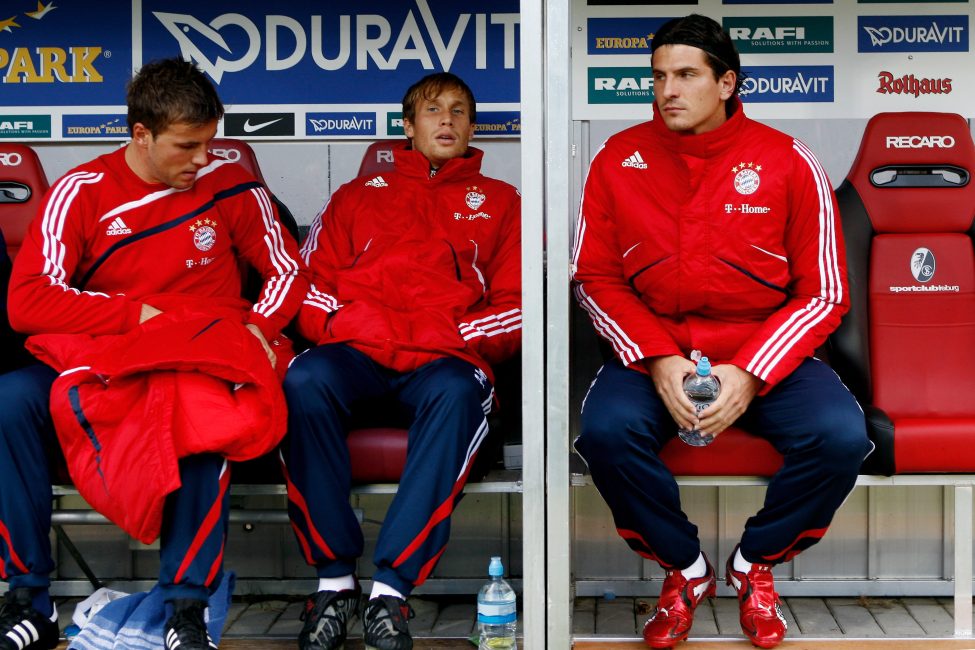
Within the last week two of Bayern’s finest strikers since the turn of the century announced their retirement: Mario Gómez and Claudio Pizarro. We wanted to pay these two greats one last tribute. In part one Daniel writes about one of Germany’s most underrated and falsely critiqued forwards.Everybody loves an underdog story and despite how well known his talents were, that’s exactly what Mario Gomez’ career had been.<a href="#problems-under-van-gaal"></a>Problems under van GaalAfter he burst on the scene with Stuttgart in 2003 he quickly attracted the interest of Bayern, and so they signed him in a rather strange transfer in 2009. Sure, the Klinsmann-disaster exposed many problems in the squad but the centre-forward position wasn’t really one of them. Obviously they had signed him just because of the good ol’ Uli Hoeneß strategy: If there was a quality German player, he was to play for Bayern. So despite Miroslav Klose and Luca Toni working well together, Bayern splashed the record-breaking fee of €30 million and signed Gómez in what the media would soon call the biggest transfer flop in Bayern’s history.<a href="https://miasanrot.com/wp-content/uploads/sites/2/2020/07/sc-freiburg-v-fc-bayern-muenchen-bundesliga-975x650.jpg">Media</a><strong>Mario Gómez in his main position in 2009: The bench.</strong>
(Photo by Alex Grimm/Bongarts/Getty Images)Louis van Gaal is a genius coach and Bayern must be eternally thankful for him changing their style of football, yet despite being a man of many talents, communication certainly wasn’t one of them. When things became dicey and questions arose why certain signings didn’t perform, he was quick to shift the blame: You see, they weren’t all <em>his</em> signings, the club signed Tymoshuck and Gómez <em>before</em> he came, so <em>he</em> had nothing to do with it.Such a public statement usually spells doom for any player and indeed the season was disastrous for Gómez. He started the campaign expecting to be Bayern’s first choice striker and ended it as their third. And whereas many of his teammates managed to turn the season around with a spectacular World Cup, that tournament was a disaster for him, too.<a href="#resurrection-against-hannover"></a>Resurrection against HannoverGómez was looking for a way out, for a fresh start. He wanted to join Liverpool and when everything seemed done and dusted, his time at Bayern appeared to come to a close before it had even started. Or so everybody thought, but Uli Hoeneß and Karl-Heinz Rummenigge firmly overrode his transfer request. Both being former strikers themselves, they knew something about forwards and still saw something in Gómez.So the 2010/11 season started right where the previous one had left off. With weeks going by and Gómez simply watching Olić from the comfort of the bench. Then fate intervened. With both Olić and Klose injured, van Gaal was forced to begrudgingly start his unwanted number three and, as the saying goes, the rest was history. To call his performances from this point on an explosion would still be an understatement. To this day I sometimes look up that fateful game against Hannover and remember how happy I was for him scoring that career-turning hattrick. Gómez didn’t score once in the first seven games of the season and ended up with the absurd goal tally of 28. Had he scored at that rate in all 34 games that season, Lewandowski might’ve been chasing Gómez, not Gerd Müller this season. All the talk of not fitting in with Bayern, only being a counter-attacking footballer, van Gaal hating him, all of that went quiet. Naturally, the bosses were beaming with contentment, reminding everybody what a great decision it was to veto that Liverpool move.<a href="#humility-amidst-constant-underappreciation"></a>Humility amidst constant underappreciationFor two seasons straight Gómez scored left and right. In the league, in the cup, in the Champions League. All the while just showing…
<b>Bayern beat Lyon to reach Champions League Final</b>
In what was a tricky tie against a very good Lyon side, Bayern went about their business and ended up finishing them off with relative ease. However, things could have went very differently if Lyon had taken their chances early.The first 20 minutes were shaky for Bayern. Lyon had 2 excellent opportunities to take an early lead and potentially put the pressure on Bayern but Neuer did just enough to keep them out. A few minutes later, Gnabry took a ball from Kimmich and dribbled through the Lyon defense before blasting it past the Lyon keeper. 15 minutes later, he would finish off what looked like an unbelievable miss by Lewandowski to make it 2-0. Bayern had several more chances through the first half but failed to convert any of them.The second half saw Lyon attempt to get back into the action, but largely fail, and Bayern look as if they had no fears of a legitimate comeback. Lewandowski would get his requisite goal in the 88th minute to finish off the French side and put Bayern through to their first Champions League Final since 2013.<a href="#gnabry-picks-up-the-slack"></a>Gnabry Picks up the SlackGnabry, without question was the best player on the pitch today. Lewandowski struggled to finish the way that we’re used to despite still ending up on the scoresheet. Müller failed to make the impact that he has over recent months. Perišić never found his footing. But Serge took the team on his back and willed them to a lead.It is this type of performance in this type of game that has become a hallmark of the young German. It is the reason he is nearly a guaranteed starter when healthy. He steps up when it matters most. He isn’t afraid of the big lights. He has the confidence in himself and his ability to make plays and shoulder the burden when others are being smothered. Whether he is as consistent as some would like in the Bundesliga or not, he showed up today and has done so every time Bayern have really needed him to.<a href="#problems-with-the-press"></a>Problems with the PressDespite the focus from the media on Bayern’s high back line, to me the area where Bayern looked the most vulnerable was when Lyon really put them under pressure via the press. The Bayern players did not look comfortable. They misplaced passes. They struggled to advance the ball. In the end, that high back line then became an issue because they made bad and careless mistakes.While Lyon is a very different team to PSG and it is unlikely, based on my limited knowledge of them, that PSG will press the same way that Lyon did (relentlessly and as a team) it is something that Hansi Flick will presumably try to iron out prior to the Final on Sunday. Those little mistakes and easy giveaways will be disastrous against the offensive firepower that PSG have.<a href="#cruising-in-the-second-half"></a>Cruising in the Second HalfThe second half of this match was very lack luster. Bayern looked supremely confident in their position with a 2-0 lead and if truth be told, it never really looked like Lyon was going to pose a threat. Yes they had a few opportunities, which even produced a very memorable save by Manuel Neuer, but the feeling watching the match never really changed after the second goal went in. Bayern knew they only had to see out the remaining 45 minutes and Lyon knew that the battle was largely lost. I give them all the credit in the world for putting forth as much effort as they did. Lyon worked as hard as they could to make it a match, but in the end made no headway.While it was a little boring and even frustrating to watch as a Bayern supporter, you can easily understand why Hansi Flick and the Bayern players would try to make things as easy on themselves in the second half as possible. They now go into the final with all players available. No one got a card. No one got injured. Fringe or returning players got game time. No one was overly physically taxed. All of these things will be massively…
In what was a tricky tie against a very good Lyon side, Bayern went about their business and ended up finishing them off with relative ease. However, things could have went very differently if Lyon had taken their chances early.The first 20 minutes were shaky for Bayern. Lyon had 2 excellent opportunities to take an early lead and potentially put the pressure on Bayern but Neuer did just enough to keep them out. A few minutes later, Gnabry took a ball from Kimmich and dribbled through the Lyon defense before blasting it past the Lyon keeper. 15 minutes later, he would finish off what looked like an unbelievable miss by Lewandowski to make it 2-0. Bayern had several more chances through the first half but failed to convert any of them.The second half saw Lyon attempt to get back into the action, but largely fail, and Bayern look as if they had no fears of a legitimate comeback. Lewandowski would get his requisite goal in the 88th minute to finish off the French side and put Bayern through to their first Champions League Final since 2013.<a href="#gnabry-picks-up-the-slack"></a>Gnabry Picks up the SlackGnabry, without question was the best player on the pitch today. Lewandowski struggled to finish the way that we’re used to despite still ending up on the scoresheet. Müller failed to make the impact that he has over recent months. Perišić never found his footing. But Serge took the team on his back and willed them to a lead.It is this type of performance in this type of game that has become a hallmark of the young German. It is the reason he is nearly a guaranteed starter when healthy. He steps up when it matters most. He isn’t afraid of the big lights. He has the confidence in himself and his ability to make plays and shoulder the burden when others are being smothered. Whether he is as consistent as some would like in the Bundesliga or not, he showed up today and has done so every time Bayern have really needed him to.<a href="#problems-with-the-press"></a>Problems with the PressDespite the focus from the media on Bayern’s high back line, to me the area where Bayern looked the most vulnerable was when Lyon really put them under pressure via the press. The Bayern players did not look comfortable. They misplaced passes. They struggled to advance the ball. In the end, that high back line then became an issue because they made bad and careless mistakes.While Lyon is a very different team to PSG and it is unlikely, based on my limited knowledge of them, that PSG will press the same way that Lyon did (relentlessly and as a team) it is something that Hansi Flick will presumably try to iron out prior to the Final on Sunday. Those little mistakes and easy giveaways will be disastrous against the offensive firepower that PSG have.<a href="#cruising-in-the-second-half"></a>Cruising in the Second HalfThe second half of this match was very lack luster. Bayern looked supremely confident in their position with a 2-0 lead and if truth be told, it never really looked like Lyon was going to pose a threat. Yes they had a few opportunities, which even produced a very memorable save by Manuel Neuer, but the feeling watching the match never really changed after the second goal went in. Bayern knew they only had to see out the remaining 45 minutes and Lyon knew that the battle was largely lost. I give them all the credit in the world for putting forth as much effort as they did. Lyon worked as hard as they could to make it a match, but in the end made no headway.While it was a little boring and even frustrating to watch as a Bayern supporter, you can easily understand why Hansi Flick and the Bayern players would try to make things as easy on themselves in the second half as possible. They now go into the final with all players available. No one got a card. No one got injured. Fringe or returning players got game time. No one was overly physically taxed. All of these things will be massively…